High tear resistance
For thin edges, hanging holes and snap features where stress concentrates, resisting further tear propagation. A priority when the part has sharp corners or is pulled repeatedly.
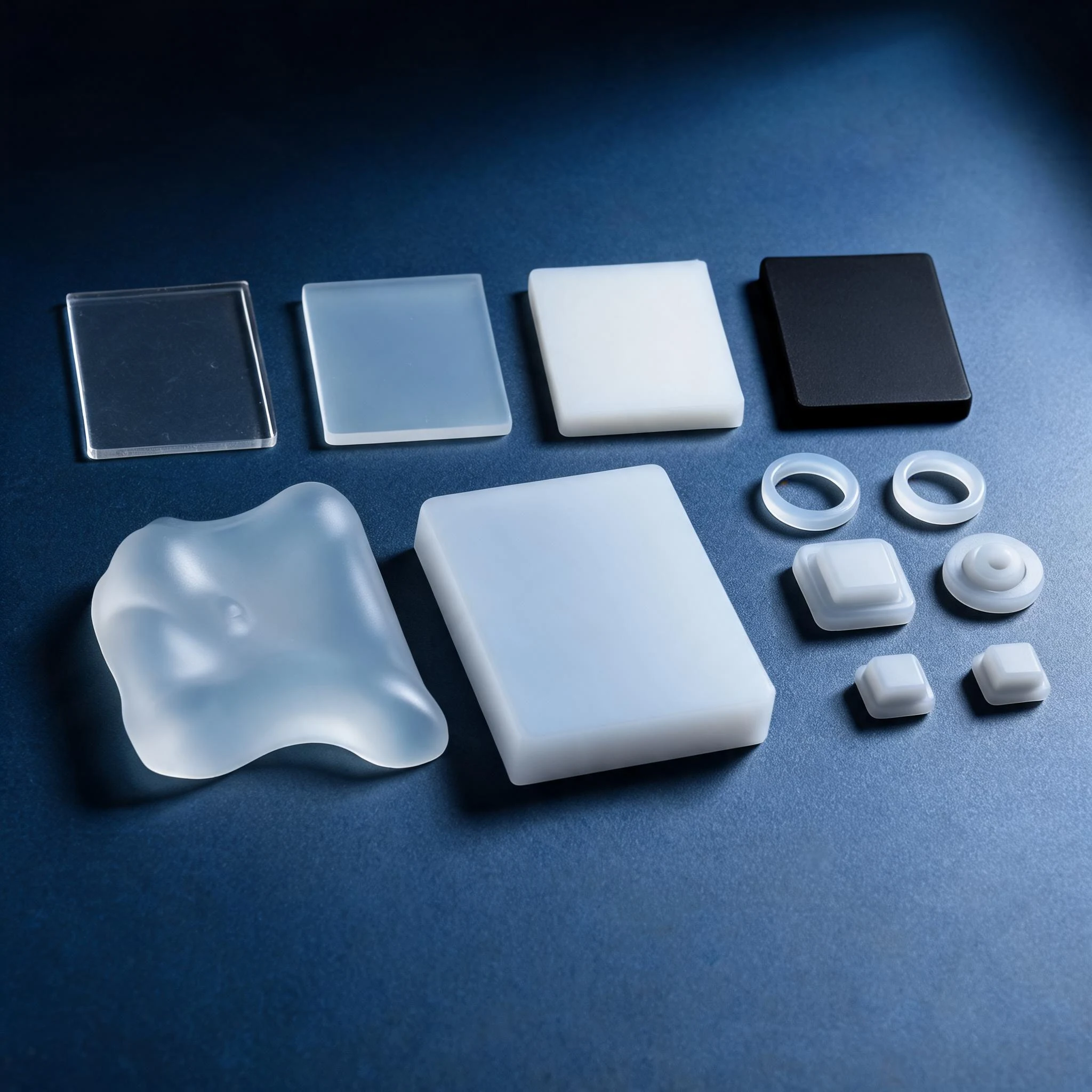
Silicone properties laid out by group — material system, mechanics, environment tolerance, function, safety and cleanliness, hardness and appearance, and substrate matching — so that selection starts from the few properties that actually decide the part.
Silicone properties are not independent of each other: raising hardness usually costs feel, adding a flame retardant system can affect transparency, and chasing low migration means adjusting both formula and post-treatment. Real selection means finding the few items the product cannot compromise on, then confirming how far the rest may move.
Nine groups follow: material system first, then performance and function, then hardness, appearance and substrate matching, ending with working conditions and verification. Formula and parameters for a specific project still rest on the assessment and sampling result.
1 · Material system
This is the first fork in selection: the two are not substitutes for each other, but are chosen by structural precision, volume and cleanliness requirement.
| Comparison | Solid silicone (HCR) | Liquid silicone (LSR) |
|---|---|---|
| Supply form | Supplied as raw rubber; curing agent is added and the compound is milled before molding | Two-component low-viscosity liquid, metered and mixed before use |
| Molding route | Mainly compression or transfer molding, and can be combined with screen printing or coating | Mainly liquid injection molding, with precision tooling and temperature control |
| Tooling and flash | Split line fit is relatively tolerant; flash needs trimming | High sealing requirement; parts come out essentially flash-free, to an accuracy of ±0.05 mm |
| Automation and consistency | Loading and de-molding rely more on operator experience | Metering, injection and de-molding run in sequence, giving better batch consistency |
| Suits | Lower volume, simpler structures, thicker silicone sections, and parts where a specific grade must be chosen | Thin-wall precision parts, fine structures, higher volume, and products needing medical-grade or food-grade clean production |
| Strength | Flexible, controllable overall cost, wide choice of grades | Efficient, consistent, stable appearance |
The full description of molding routes and tool systems is under molding and tooling; the choice between the two materials is confirmed per project after reviewing structure, volume and cleanliness requirement.
2 · Mechanics and structure
"Strong" is not one property: tension, tearing, repeated bending and long-term compression each call for something different.
For thin edges, hanging holes and snap features where stress concentrates, resisting further tear propagation. A priority when the part has sharp corners or is pulled repeatedly.
Takes large deformation without breaking, for parts that must be slipped on, stretched over a body or stretched far and recover, such as protective sleeves and stretch fittings.
Recovers quickly after deformation, for keys, sealing faces and parts that must respond immediately, with less feel degradation after repeated pressing.
Recovers slowly, used for energy absorption and body-contour fitting — structures that must follow a curve or absorb impact.
For structures that absorb vibration and drop impact; usually designed together with thickness, geometry and hardness rather than relying on material alone.
Still recovers after long compression — a key item for seals and load-bearing structures: excessive compression set means a seal fails over time.
3 · Environment tolerance
Outdoor use, in-vehicle use, repeated washing and chemical contact usually rule out some material directions first.
Covers the need to stay flexible when cold and not to soften or age faster when hot: standard silicone holds long-term service around 250 °C, and special heat-resistant formulas reach 400 °C. The range must match real conditions: a short peak and continuous service are different requirements, and long-term high temperature also depends on media, load and ageing, so these should be stated separately and confirmed against the material direction.
For products exposed outdoors for long periods, UV and ozone are the main causes of surface yellowing and cracking. Selection follows an ageing-resistant direction, and colour stability is confirmed with a physical sample.
Parts in contact with cleaning agents, sweat, oils or chemical media require the medium type, concentration and contact time to be defined before the material direction and any post-treatment are set.
Waterproofing is not only a material question; structure and hardness matter too. Seal compression, rebound retention and how the interface closes together decide long-term water performance. For repeated washing, hydrolysis and temperature resistance must be assessed together.
4 · Functional properties
These three appear mainly on electronic and electrical products; they pull in different directions and are tested differently.
Tested to the UL94 standard and commonly determined as V0, V1 or V2. Adding a flame retardant system can affect transparency and rebound, so when several requirements coexist the priorities have to be set.
The aim is to drain static charge, so resistance must be held inside a specific band, with the test voltage and contact method defined; this is the opposite direction from insulation.
Focused on volume resistivity, surface resistivity and breakdown voltage for electrical protection in overmolded and potted electronics, assessed together with the potting structure design.
5 · Safety and cleanliness
The core requirement here is less migration, less odour and less release, which needs both the formula direction and the post-treatment to work together.
For utensils, seals and accessories in contact with food; migration and odour matter, and the food type, temperature and contact time should be stated at selection stage.
Builds on low migration with biocompatibility and clean production conditions, for medical accessories, protective parts and body-contact wearable products.
For enclosed spaces or products worn against the body; odour requirements are normally confirmed at the sampling stage with a physical part and an agreed method.
Avoids fogging, yellowing and odour in use. Post curing (post bake) removes small-molecule volatiles and is a standard step for food-grade and medical-grade products.
Heavy metals and restricted additives are controlled as required, covering RoHS, halogen-free and customer-specified environmental grades, supported by elemental spectroscopy and related tests.
Post curing, plasma activation and other downstream steps directly affect final odour, migration and surface state, so they are planned together with material selection.
6 · Hardness and appearance
These are the most visible properties and the most likely to cause disputes at batch stage, so they are confirmed with a physical sample during sampling.
Hardness normally has to satisfy three things at once: whether assembly needs the part to slip on or snap tight, how much compression sealing or cushioning needs, and whether the structure itself needs support. Feel and sealing parts are usually softer; wear-resistant and structural parts are harder.
Colour and surface texture are affected by hardness and formula — a harder compound feels firmer and translucency is influenced by fillers. The surface finishing page lists mold texture, coating, printing, laser marking, flocking and post curing.
7 · Substrate matching
Silicone is an inert material with low surface energy, and its bonding conditions differ clearly between substrates, so the treatment is matched accordingly.
| Substrate | Common materials | What matters in overmolding | Treatment direction |
|---|---|---|---|
| Metal insert | Stainless steel, aluminium alloy, iron, copper | Surface oil and oxide, insert location, thermal expansion difference against silicone | Ultrasonic cleaning + plasma activation + metal heat-cure primer + controlled-temperature curing |
| Plastic part | ABS, PC, nylon, PBT | Little heat tolerance, easy cracking, molding temperature limited by the substrate | Plastic-specific primer, running at room temperature or medium-temperature curing |
| PCBA electronics | PCB board, components, solder joints | Sensitive to pressure, corrosion and leakage; gate position must clear the components | Low-corrosion, low-volatiles insulating primer, with gate and runner avoidance design |
| Battery and electromagnetic parts | Battery assemblies, antennas, coils, sensing elements | Insulation and sealing, where coverage thickness and position affect function | Coverage thickness and position set by the functional verification requirement, confirmed by sampling measurement |
The full description of interface treatment and primer families is under bonding to other materials.
8 · Working conditions
Once the conditions are stated clearly, the workable range usually narrows sharply.
| Use condition | Properties to confirm first | Easily overlooked |
|---|---|---|
| Repeated pressing (keys) | High rebound, tear resistance, low compression set | Feel degradation and structural fatigue in long-term use |
| Long-term compression (seals) | Compression set resistance, rebound, matched hardness | Seal compression amount and media compatibility |
| Long outdoor exposure | Ageing resistance, ozone resistance, temperature range, colour stability | Yellowing risk on clear or light-coloured parts |
| Repeated washing or damp heat | Hydrolysis resistance, temperature range, abrasion resistance | Combined effect of detergent contact and mechanical rubbing |
| Wearable, body contact | Low odour, low migration, skin-contact comfort | Surface change after sweat contact and long-term friction |
| Electronic protection and potting | Insulation, moisture protection, flame retardance where needed | Component tolerance and gate avoidance |
| Must slip on or stretch far | High tensile strength, high tear resistance | Recovery after stretching, and whether printed graphics distort |
9 · Selection verification
Once the material direction is set, data still has to confirm that it holds in this project: whether performance reaches the target, whether the interface is reliable, whether the environment is survivable and whether dimensions stay stable. Verification items and acceptance criteria are best agreed at the planning stage.
Tensile, tear, rebound and compression set, plus the peel strength of silicone against the substrate.
Temperature and humidity cycling, UV and ozone ageing, salt spray and thermal shock, confirming reliability outdoors and under temperature change.
Insulation resistance, dielectric strength and UL94 flame retardant grade, together with volatile and migration content.
Accuracy of key dimensions, wall thickness uniformity, surface texture and colour consistency.
Equipment and the list of executable items are on the R&D and testing page.
FAQ
Look at structural precision, volume and cleanliness. For fine, thin-wall, higher-volume products, or products needing medical-grade or food-grade clean production, liquid silicone has the advantage in consistency and automation. For lower volume, simpler structures and thicker silicone layers, compression molding of solid silicone is more flexible and allows a wider choice of grades.
Shore A hardness is adjustable from 0 to 90. The choice has to satisfy three things at once: assembly feel, the compression needed for sealing or cushioning, and the support the structure needs. Feel and sealing parts are usually softer, structural parts needing support and wear resistance are harder, and the final value is confirmed with a physical sample.
Flame retardant grades are tested to the UL94 standard and commonly determined as V0, V1 and V2. The required grade comes from the industry and safety regulations the product falls under. At selection stage it is confirmed at the same time whether transparency, rebound or food and medical grade requirements must also be met, because these requirements usually involve trade-offs.
No. Insulation blocks current and focuses on volume resistivity, surface resistivity and breakdown voltage; anti-static dissipates static charge and needs resistance held within a specific band. The two pull in opposite directions, so the requirement must be defined first and the test method and acceptance criteria confirmed with it.
A food-contact grade targets applications in contact with food and focuses on migration and odour; a medical grade adds biocompatibility and clean production conditions. Both need a low-volatiles, low-migration formula, usually combined with post curing to reduce small-molecule volatiles further.
With data: mechanical items such as hardness, tensile and tear strength, peel strength and compression set; environmental items such as temperature and humidity cycling, UV and ozone, salt spray and thermal shock; and items for insulation, flame retardance and dimensional accuracy. Confirmed data then serves as the acceptance baseline for volume production.
Send us the operating environment, the way the part is loaded, the assembly relationship and any compliance requirements. We will narrow the material direction first, then arrange sampling verification.