Silicone molds and molding processes

Tool type and molding method decide precision, yield and consistency. We match the tool and process to product structure, application, performance requirements and appearance standard, and support single-colour, multi-colour and combined-bonding molding for silicone over metal, plastic or PCBA.

Settle tooling and molding method before talking about volume

The difference between silicone products is often not whether they can be made, but which route is used. For the same structure, compression molding and liquid injection differ in precision, flash, consistency and unit cost. Electronic composite parts add one more constraint: the insert must not shift and must not be crushed during molding.

We do not run a single fixed production mode. Structure complexity and insert type come first, then operating environment, performance and appearance standard, and then the tool type, molding method and downstream finishing — only then the volume arrangement. Controlling precision from the tool outwards costs less than repeated correction in production. For parts with a frozen structure and higher volume, cycle rate and unit cost also depend on machine retrofit and automation, which is covered in the equipment and capacity section of the capability page.

The content below describes tooling and molding routes in general terms. Tool structure, molding method and process parameters for a specific product are confirmed after reviewing drawings or samples.
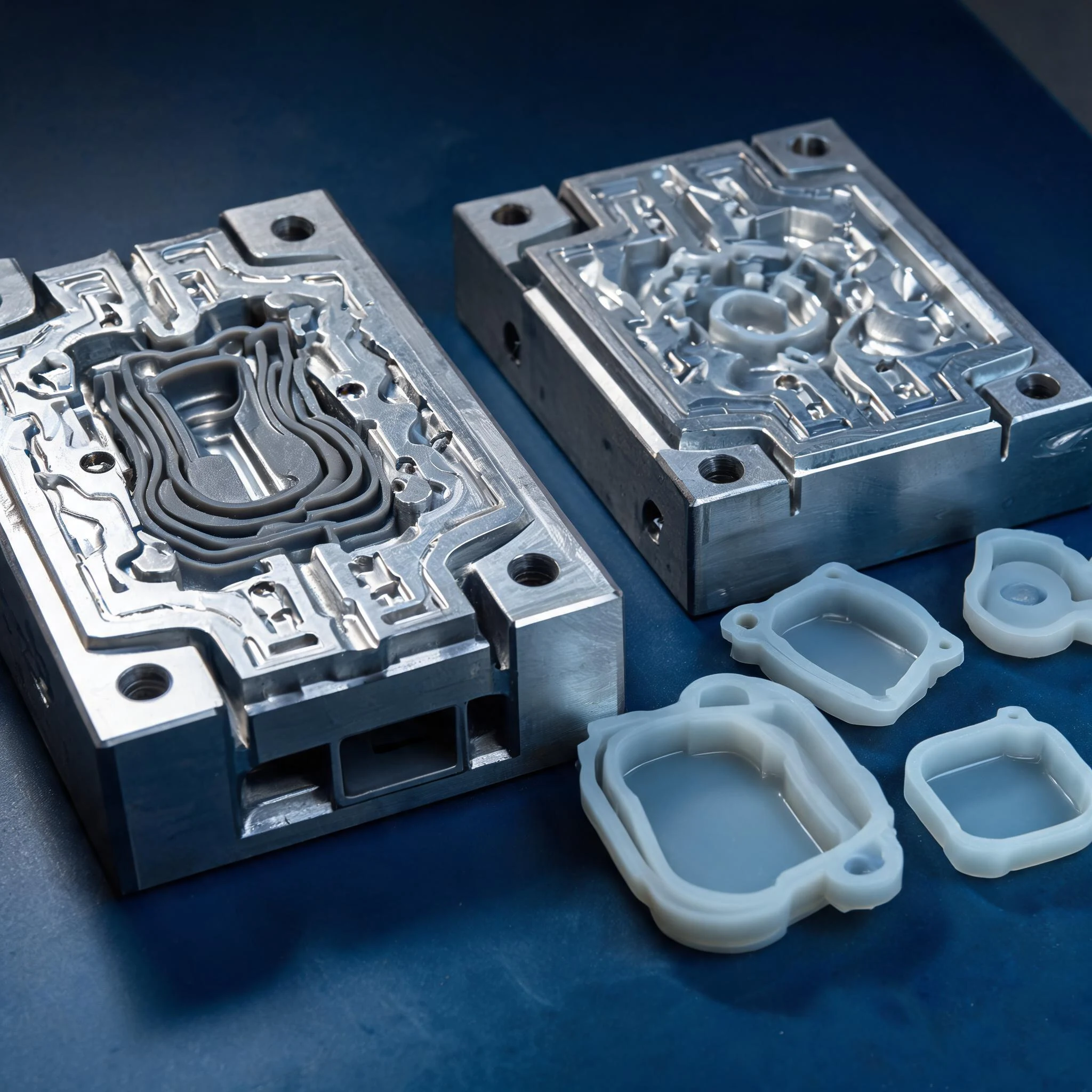
Silicone mold cavity and molded part
Cavity precision and insert locating structure directly decide how tightly the overmold fits and how consistent the batch is.

Molding routes

Nine mainstream silicone molding processes

Covering solid silicone, liquid silicone and special compounds for precision small parts, irregular structures, sealing parts, electronic composites and thin-wall parts. Compression, liquid injection, potting and blow molding are the main mold-based routes; screen printing and spray coating build surface function; dispensing, extrusion and calendering cover local functional layers, constant sections and sheet or roll stock.

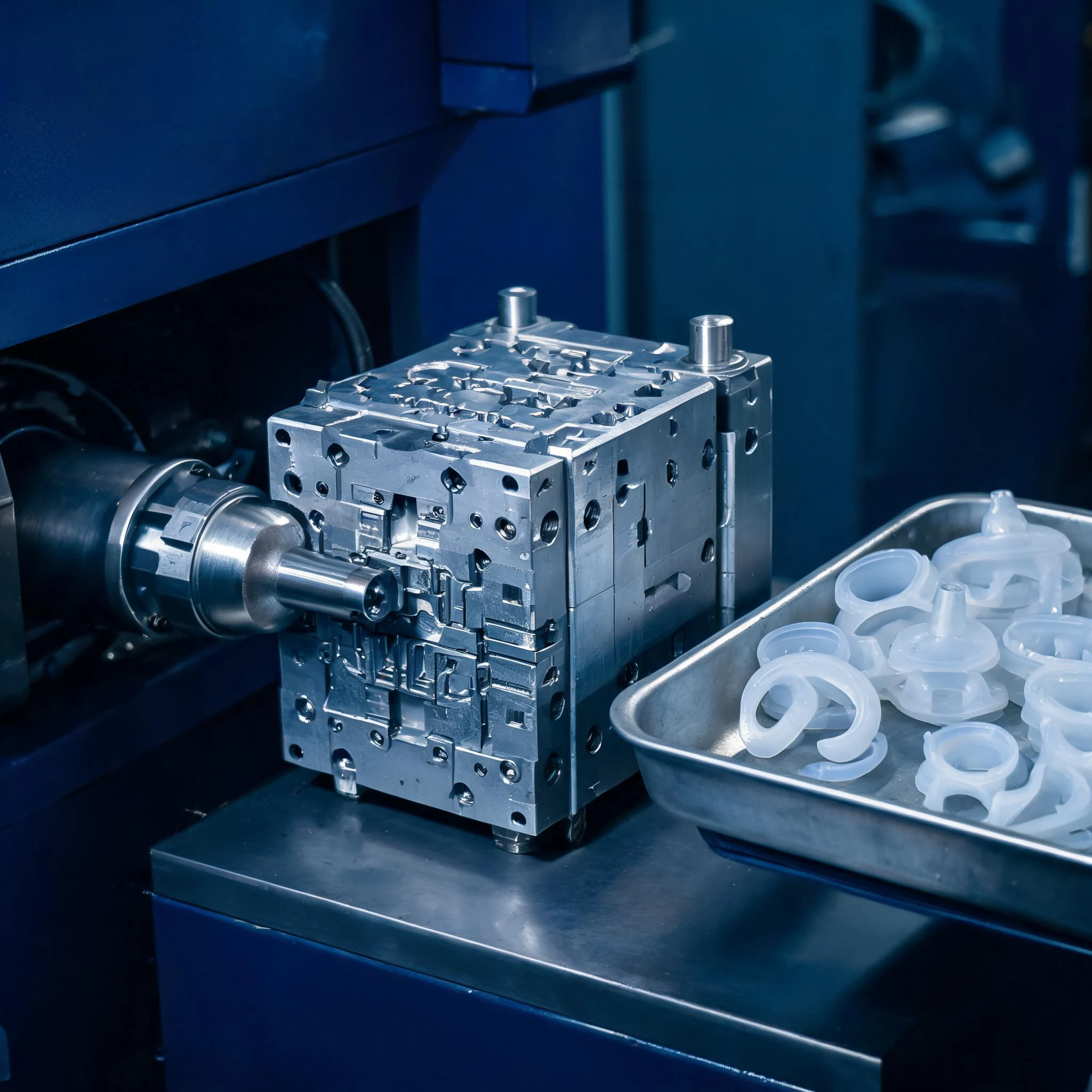
Liquid silicone injection and mold closing
Liquid injection suits thin walls and fine structures: injection pressure, mold temperature and venting together decide consistency.
Compression Molding

Compression molding (mainstream for solid silicone)

The classic, most widely used route: pre-cut solid silicone compound is placed in the cavity and cured under high temperature and pressure.

  • Stable, precise and with controllable volume cost
  • Suits insert molding of silicone over metal, plastic and PCBA
  • Keeps silicone and insert tightly fitted, limiting voids and delamination
  • Commonly used for seals, keys, overmolded structural parts and daily silicone accessories
LSR Injection

Liquid silicone injection (precision route)

Liquid silicone is injected under pressure into a closed mold on dedicated LSR equipment and cured rapidly.

  • Fast cycle, high consistency, no flash or burrs
  • Suits high-precision, high-cleanliness, thin-wall complex structures
  • Supports medical-grade and food-grade liquid silicone production
  • Used for wearable parts, medical silicone components and precision waterproof electronic parts
Potting

Potting (precision filling and sealing)

Protective potting for electronic components, modules and boards against water, moisture, electrical leakage and vibration: liquid silicone is mixed to ratio and dispensed precisely into the mold or gap, then cured at room temperature or with heat.

  • Highly flowable, fills completely with no dead zones
  • Fully encloses PCBA, circuits and small precision hardware
  • Insulates against dust and moisture ingress
  • The core process for silicone and electronic composite protection
Blow Molding

Blow molding (hollow products)

Developed for hollow silicone products: air pressure presses melted compound against the mold wall to cure in shape.

  • Even wall thickness, good toughness, no seams
  • Suits silicone hoses, hollow protective sleeves and inflatable silicone parts
  • Makes thin-wall hollow protection that traditional routes struggle with
Screen Printing

Screen printing (thin layers and graphics)

For thin surface layers, graphics and anti-slip coatings: silicone ink or a special compound is printed through a screen and oven cured into an integrated thin structure.

  • Accurate graphics, local thickening, anti-slip texture and insulating coatings
  • Often combined with compression or injection molding
  • Used for electronic keys, silicone panels and precision accessory surfaces
Spray Coating

Spray coating (functional surface layer)

Using the substrate as the carrier, automated spraying distributes a functional silicone compound evenly over the surface, curing into a dense functional layer.

  • Delivers anti-slip, wear-resistant, insulating, waterproof and release surfaces
  • Suits silicone composite molding on metal, plastic and electronic parts
  • Used for premium electronic accessories, security protection parts and industrial anti-slip parts
Dispensing

Silicone dispensing (local functional layers)

A dispenser lays liquid silicone along a programmed path; viscosity and surface tension control the layer thickness, and it cures at room temperature or with heat. No mold is needed — a patterned fixture positions the part.

  • No tooling, fast to sample; structure or size changes mean a new fixture, not a new tool
  • Suits thin functional layers, local thickening for cushioning, anti-slip or sealing beads
  • Can be applied locally on metal, plastic, PCBA and panel parts, clearing components and holes
  • Often used for small trial batches, projects with an unfrozen structure, and sealing of equipment housings
  • Batch consistency depends on the fixture, shot size and cure conditions and is confirmed against the cycle
Extrusion

Silicone extrusion (continuous constant sections)

Solid silicone is pushed continuously through a die and then cured in line in a hot-air or salt-bath tunnel, producing constant-section strips, tubes and cords cut to length.

  • Continuous production, unlimited length: clear efficiency and material-use advantage on long profiles
  • Suits sealing strips, profiled strips, silicone tubing, cords and foamed silicone strips
  • Section shape is set by the die; changing a section costs less than cutting a new mold
  • Not suitable for complex 3D structures or insert overmolding — those still need mold-based molding
  • Confirm section tolerance, cure shrinkage, hardness and rebound, and the compression set of sealing strips
Calendering

Silicone calendering (sheet and roll stock)

Compound is pressed continuously through a multi-roll calender into sheet or roll stock of even thickness, then cured; it can be laminated with a reinforcement layer or produced as foam sheet.

  • Even thickness and continuous width, with controllable cost and consistency on sheet products
  • Suits silicone sheet and roll stock, gasket substrate, insulating and cushion pads, foamed silicone sheet
  • Shaped downstream by die cutting, punching or trimming, and can be supplied with adhesive backing
  • Confirm thickness tolerance, density and hardness, and surface state (smooth, textured or release)
  • Where adhesive backing or reinforcement is needed, the bonding method is covered under dissimilar bonding

Tool systems

Tools matched to the molding process and compound

The tool is the core of precision. We build tools to the molding route, the silicone compound and the product structure instead of forcing a general-purpose tool onto a new structure.

Solid Silicone Mold

Solid silicone molds

For solid silicone compression molding, machined from quality tool steel with high cavity precision, resistant to high temperature and pressure and slow to distort.

  • Suits single-colour, multi-colour, irregular structures and standard overmolded parts
  • Wear resistant and durable, with stable volume production
  • The general choice for standard silicone products and silicone over metal or plastic
LSR Mold

Liquid silicone molds

For LSR injection, using high-precision mirror tool steel with accurate temperature control, runner and venting systems.

  • Very tight sealing, no overflow, flash-free parts
  • Precision up to ±0.05 mm
  • Meets the precision and cleanliness requirements of medical, food and premium electronics
Potting Mold

Potting molds

Designed for electronic potting: accurate opening and closing, good sealing, no compound leakage or edge overflow.

  • Suits located potting of PCBA modules, electronic components and precision hardware assemblies
  • Controls potting thickness and shape accurately
  • Keeps the potting layer full and even, with stable insulation and waterproofing
Casting Mold

Casting molds

For irregular, large or low-volume custom silicone products, with short tool lead time and good value.

  • Suits cast molding of complex curved and irregular structures
  • Balances sampling speed with small-batch quality
  • Fits structural verification and early trial production

Molding options

Single-colour, multi-colour and combined-bonding molding

Complex silicone composites are rarely produced by one molding route; they are split by structure and combined.

Single-colour one-piece molding

One mold, one colour family, one cure: simple, stable and fast in volume.

Suits standard solid-colour accessories, basic overmolded parts and standard seals.

Multi-colour one-piece molding

Multi-station molds, staged curing or synchronized injection bring two or more colours into one part without secondary assembly or gluing.

Clear colour boundaries, no colour bleed and no peeling; used for coloured keys, marked silicone parts and decorative electronic accessories.

Combined-bonding molding

For silicone assemblies molded by different routes, or composite assembly of silicone with metal, plastic or electronic components, using environmentally friendly bonding, high-temperature lamination and nano bonding to form one unit.

High bond strength, resistant to pulling and ageing, no cracking; suited to non-standard silicone composite products.

Our approach

From tool selection to volume delivery on one line

Most silicone factories work with a single molding route and general-purpose tooling on standard subcontract work. We match tool and process in one pass against structural complexity, operating environment, performance parameters, volume and appearance standard.

  1. 01

    Tool selection

    Fix the tool type and cavity plan from the molding route, compound and structure, and design the insert locating structure at the same time.

  2. 02

    Process matching

    Choose compression, injection, potting or blow molding against volume, precision and appearance requirements.

  3. 03

    Molding combination

    Decide the single-colour, multi-colour or combined-bonding combination and fix the compound and hardness requirements.

  4. 04

    Downstream finishing

    Surface finishing and post-curing combined as required, with inspection and volume delivery arranged accordingly.

On electronic composites — silicone over metal, plastic or PCBA — matching process and tool precisely removes delamination, bond loss, deformation, cracking and short precision at source.

FAQ

Questions about tooling and molding

Compression molding or liquid injection?

It depends on structure, volume and appearance. Solid silicone compression molding covers most standard silicone parts and overmolded composites with stable quality and controllable cost; liquid injection suits high-precision, high-cleanliness, thin-wall complex structures and medical or food-grade products, with fast cycles, good consistency and no flash.

What precision can a liquid silicone mold reach?

Liquid silicone molds use high-precision mirror tool steel with temperature control, runner and venting systems; parts are flash-free with precision up to ±0.05 mm. Tolerances for a specific part are confirmed against its structure and dimension directions.

Which products suit potting?

Mainly protection of electronic components, modules and boards against water, moisture, electrical leakage and vibration. Liquid silicone is mixed to ratio and dispensed by automated equipment into the mold or gaps, filling completely with no dead zones and fully enclosing PCBA, circuits and small precision hardware.

Multi-colour molding versus bonded assembly?

Multi-colour one-piece molding uses multi-station molds, staged curing or synchronized injection with no secondary assembly or gluing, giving clear colour boundaries, no colour bleed and no peeling. Bonded assembly belongs to combined-bonding molding and is used to join components of different materials or different molding routes.

What does blow molding solve?

It is for hollow products: air pressure presses melted silicone against the mold wall, giving even wall thickness, good toughness and no seams. It is used for silicone hoses, hollow protective sleeves, inflatable silicone parts and thin-wall hollow protection that other routes struggle to make.

How are tooling cost and sampling handled?

Tool structure and cost are stated in the quotation, and ownership and cost responsibility are confirmed in writing per project. The sampling stage freezes the structure and process window as the basis for volume production.

Structure or insert to assess?

Send the part structure, insert type, operating environment and quantity range. We confirm tooling and molding method first, then discuss sampling and volume.

Request an assessment