Hemostat grip sleeve
Silicone overmolded onto a stainless steel instrument body: non-slip grip, electrical insulation, resistance to disinfection fluid, with no edge lift after repeated disinfection and autoclave cycles.
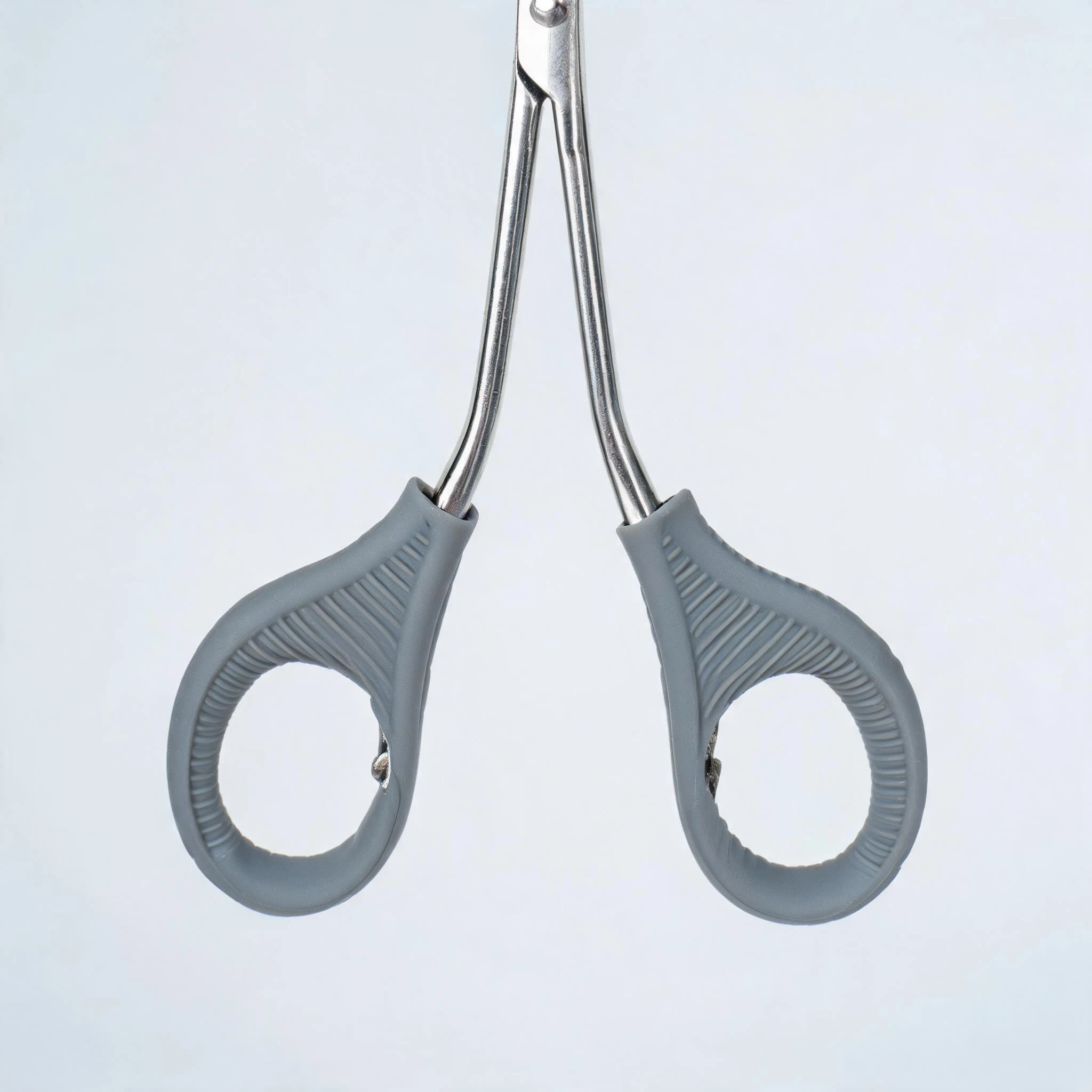
Product description
A grip sleeve looks like a layer of soft rubber, but one part has to deliver four things at once: grip, electrical insulation, resistance to disinfection fluid and no delamination after repeated cycles. The instrument body is stainless steel - smooth and thermally conductive - so the bond comes from surface preparation plus mechanical locking, not from squeezing harder.
There are two structural routes. Mechanical locking uses a flange, an undercut groove or a through-hole so the silicone flows through and locks during moulding. Adhesive bonding uses a primer matched to stainless steel to form a chemical bridge on a clean, blasted surface. Production parts usually combine both: locking as the safety net, primer for initial strength.
Wall thickness and hardness are set together. Too thin and the instrument digs into the hand; too thick and it dulls the feedback of the ratchet. Shore A 40-60 keeps most instruments both grippy and readable, but the sample decides - instrument geometry and grip style vary more than any parameter table.
Structure and material points
- Prepare the surface: degrease, blast or passivate stainless steel before primer; oil and polishing residue are the first cause of delamination.
- Lock mechanically: a flange around the profile, an internal groove or silicone through a hole resists re-assembly and thermal cycling.
- Disinfection resistance: chlorine, peroxide and glutaraldehyde affect elastomers differently; choose against the real soak and wipe routine.
- Insulation: the grip area must be fully covered with no pinholes; dielectric withstand follows the instrument requirement.
- Ratchet feel: adjust wall thickness and hardness together and stay clear of the hinge so closing force is unchanged.
Options
Typical range and process rules
The table shows the usual range for this part family. Dimensions, tolerances and acceptance criteria follow the project drawing; colour and feel are approved on a physical sample.
| Item | Typical range | How it is fixed |
|---|---|---|
| Instrument fit | Custom to body length and profile; straight, curved and various sizes | Instrument sample or 3D model |
| Coverage | From the grip zone to the full handle; grip and insulation zones can differ | Grip position and handling routine |
| Wall thickness | 0.8-2.5 mm typical, locally thicker under texture | Feel and rebound on samples |
| Hardness | Shore A 40-60 typical, higher where more support is needed | Approved on a physical sample |
| Surface | Fine non-slip texture, matte, local bumps | Assess soil retention against the cleaning method |
| Colour | Solid colours, matched to a colour chip or Pantone | Colour plaque and sample approval |
| Process | Primer bonding, mechanical locking, or both | Instrument structure and re-assembly frequency |
| Cleaning | Alcohol wipe, chlorine or peroxide soak, autoclave | Cycle test with the real medium, concentration, dwell and frequency |

Before tooling
Three things to settle
The tool and process are only frozen once these are agreed; dimensions and tolerances follow the drawing.
- Instrument sample or 3D model, plus hinge, ratchet and tooth positions (they set the clearance)
- Disinfection and sterilisation method, medium concentration, dwell time and annual cycles
- Dielectric withstand requirement and whether test data is needed; grip feel and cosmetic acceptance
FAQ
Questions on the grip sleeve
Does the grip sleeve delaminate after repeated autoclave cycles?
Three things decide it: whether the stainless steel surface preparation is correct, whether primer and silicone match, and whether the structure provides mechanical locking. With all three, instrument parts normally hold through the usual sterilisation cycles; confirm the cycle count on real samples during sampling rather than on a data sheet.
Does disinfection fluid make the silicone tacky or discoloured?
Chlorine and peroxide based fluids affect elastomers most. Long soaking can leave a tacky surface, discolouration or slight swelling. Choose the compound against the actual medium, concentration, dwell time and frequency, and move to a more chemically stable grade if needed.
Can the grip sleeve be pulled off or rotated?
The retention comes from structure, not from tolerance: a flange wrapping the instrument profile, an internal undercut groove or silicone flowing through a hole. Confirm the assembly sequence on samples and run pull-off and torsion checks.
More in metal + silicone
The same interface route applies to aluminium and galvanised steel parts.
Send the instrument and the disinfection routine
Instrument sample or 3D model, disinfection method, insulation requirement and annual volume are enough for a structure proposal and a sampling plan.