Composite parts
Six substrate families, one sequence: substrate behaviour, surface preparation, structure, failure modes, verification. The substrate decides the rest.
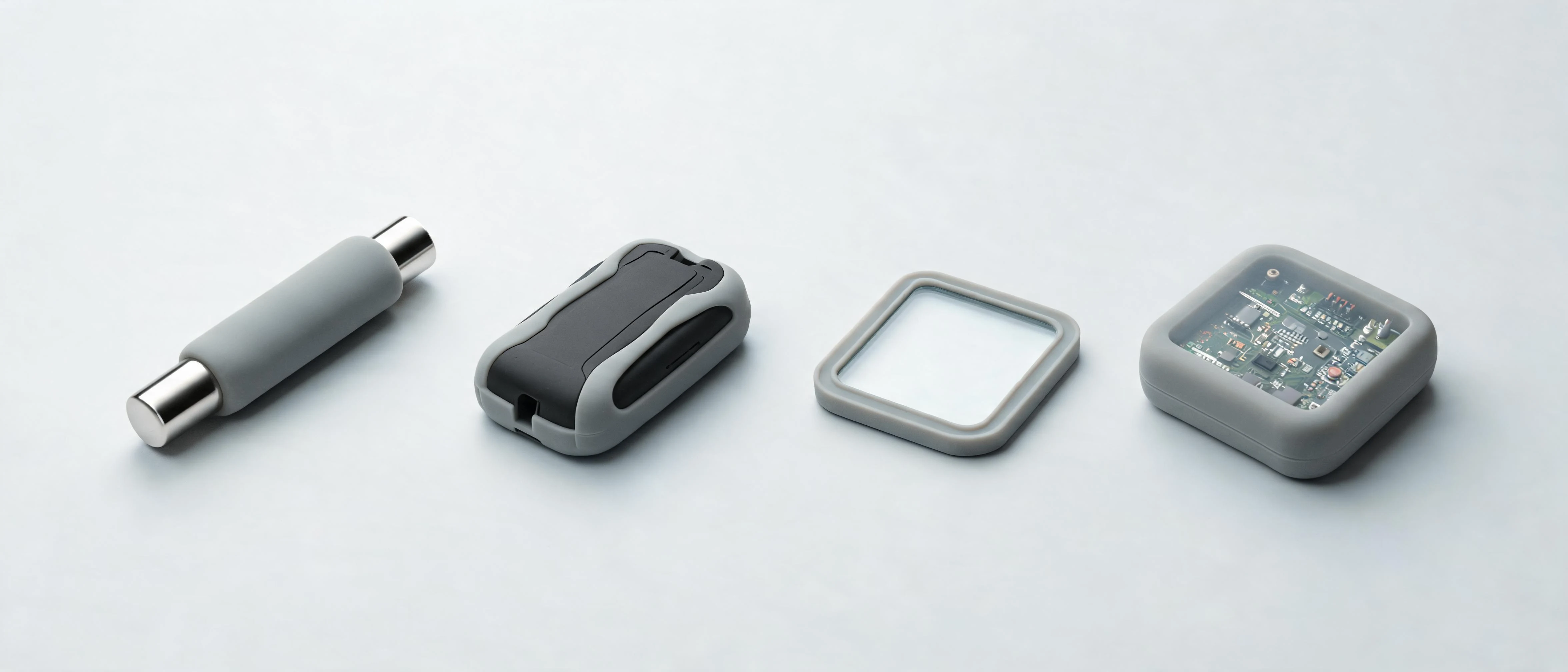
Why these pages are grouped by substrate
A wrong primer or a skipped blasting step rarely shows up at first article; it shows up after the first disinfection cycle or after a few months in the field. Grouping finished parts by substrate keeps the failure knowledge next to the process that prevents it.
Each group page lists the parts made in that combination, the interface routes that work, and the three failure modes we check first when a sample delaminates.
Four decisions in order
- Interface first: surface energy and roughness decide whether it bonds at all; hardness and wall thickness decide whether it survives.
- Structure beats primer: flanges, through-holes and undercuts hold through thermal cycling and repeated assembly.
- Substrate has to pass first: plastic heat resistance, glass edge stress and PCBA solder joints are not negotiable.
- Verification matches the duty cycle: disinfection, washing, drop, thermal cycling - in the order the part actually sees them.
Substrate families
The groups
English pages are being added group by group; the metal + silicone group is live now.
-
Metal + silicone parts
Stainless steel, aluminium, copper, galvanised steel and cast iron. Surface preparation, mechanical locking, thermal expansion. 5 parts.
-
Engineering plastics + silicone
PC, ABS, PBT and glass-filled nylon. Substrate heat resistance usually limits the moulding window. 5 parts.
-
Glass and ceramics + silicone
Tempered glass panels and alumina heater plates. Dense surfaces, so silane primer and edge-wrapping carry the bond. 3 parts.
-
PCBA + silicone
Boards, coin cells and switches encapsulated together at low pressure. 4 parts.
-
Fabric, webbing and film + silicone
Lycra, nylon webbing and PET film. The bond has to move with the substrate. 3 parts.
-
Dual-durometer silicone
Soft and hard silicone in one cycle; the parting line decides the yield. 2 parts.
-
Silicone grip dots
Dots printed on fabric, elastic, hook-and-loop and TPU or nylon hot-melt film. Roll width 1440 mm, continuous length 10000 mm, samples in 3 days.
Group pages for the five families above are being published one part at a time; the Chinese editions are complete today.
Verification
What we test on composite parts
The list is cut down to the duty cycle of the part; methods and acceptance criteria are agreed before sampling.
| Category | Typical test | Note |
|---|---|---|
| Interface | Peel, pull-out, shear | Re-test after thermal and disinfection cycles; watch the drop, not only the initial value |
| Sealing | Air leak, water pressure, IP rating | Test method and hold time follow the enclosure requirement |
| Electrical | Dielectric withstand, continuity | Required when metal and circuitry share one part |
| Durability | Repeated bending, pressing, assembly | Convert service cycles into test cycles and fix the fixture |
| Environment | Thermal, humidity, UV, salt spray | Three or four of these, chosen by the real environment |
FAQ
Three questions we hear most
Can the tool be cut before the interface is fixed?
Not advisable. Blasting, passivation, primer and mechanical locking decide the tool layout and the overmold geometry. Cutting first usually means re-cutting the tool, which costs more than the week needed to settle the interface.
Does the thermal expansion mismatch pull the bond apart?
It can, most visibly on long metal inserts. Shortening the continuous overmold length, adding a buffer section, or letting silicone flow through holes in the metal works better than thickening the rubber.
Can a sample replace a drawing for evaluation?
Yes. A physical sample plus the service conditions - temperature, media, cleaning or sterilisation method and order volume - is enough for a structure proposal and a sampling plan.
Other product pages
Individual parts that are already documented in English.
Send the substrate and the structure
Substrate grade, surface condition, service environment and annual volume are enough for a first answer.