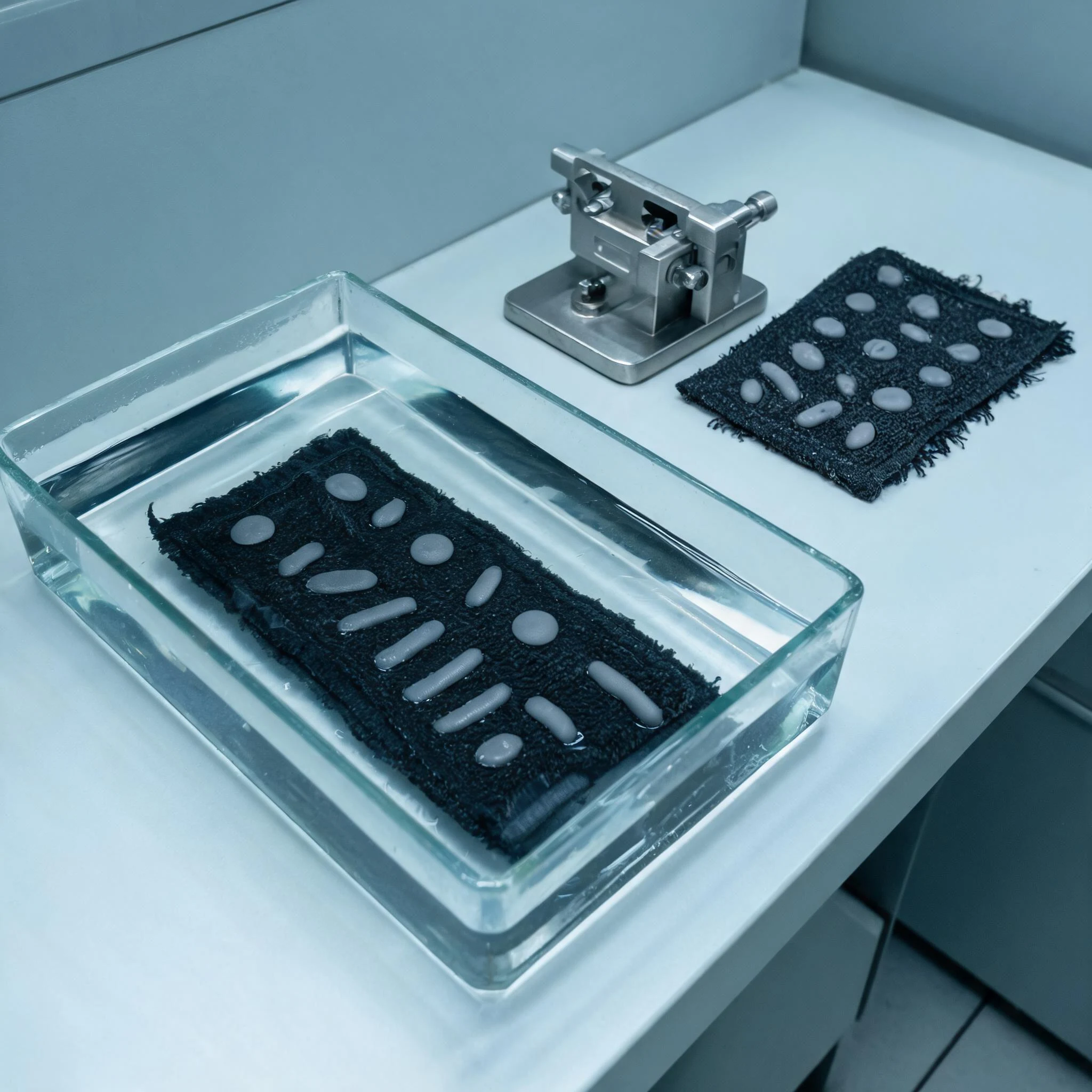
Putting anti-slip dots on fabric is easy; keeping them there is not. Washing, abrasion, sweat and drying act together, and the first thing to fail is usually the interface, not the silicone.
1. Four failure modes
Edge lift starts at the perimeter, usually from under-cure or damage during cutting. Whole-dot loss means no mechanical key into the fabric, common on sized fabric that was never desized. Tackiness and dust pick-up point to incomplete cure or plasticiser migration. Hardening and cracking come from over-cure or long hot drying. The fixes are different, so read the fracture first.
2. Three test conditions
Wash cycles have to match reality: water temperature, detergent type, dwell time and cycle count. Wet and dry abrasion should use the actual counter-surface, not the same cloth every time. Sweat and salt spray cover skin contact and outdoor use.
| Test | How | What to look at |
|---|---|---|
| Wash cycles | Real temperature, detergent and count | Lift, loss, hardening, dimensional change |
| Wet and dry abrasion | Fixed load and stroke, repeated | Time to wear-through, worn profile |
| Sweat and salt spray | Soak or spray for the real duration | Peel at the interface, colour and feel |
| Stretch cycling | Repeat at the working elongation | Pitch change, cracks, local lift |
3. Writing the acceptance criteria
Fix three things: the test conditions, the judgement method, and the sample size and frequency. "Washable" on its own means nothing - two labs can reach opposite conclusions. Prove bond and cure first, then wash, then abrasion and sweat.
Conclusion
Life is decided at the interface and by the cure. Test in the order the product sees in use, and write the conditions into acceptance before discussing price and lead time.
Related: process routes, grip design, dots on elastic, and the product page.