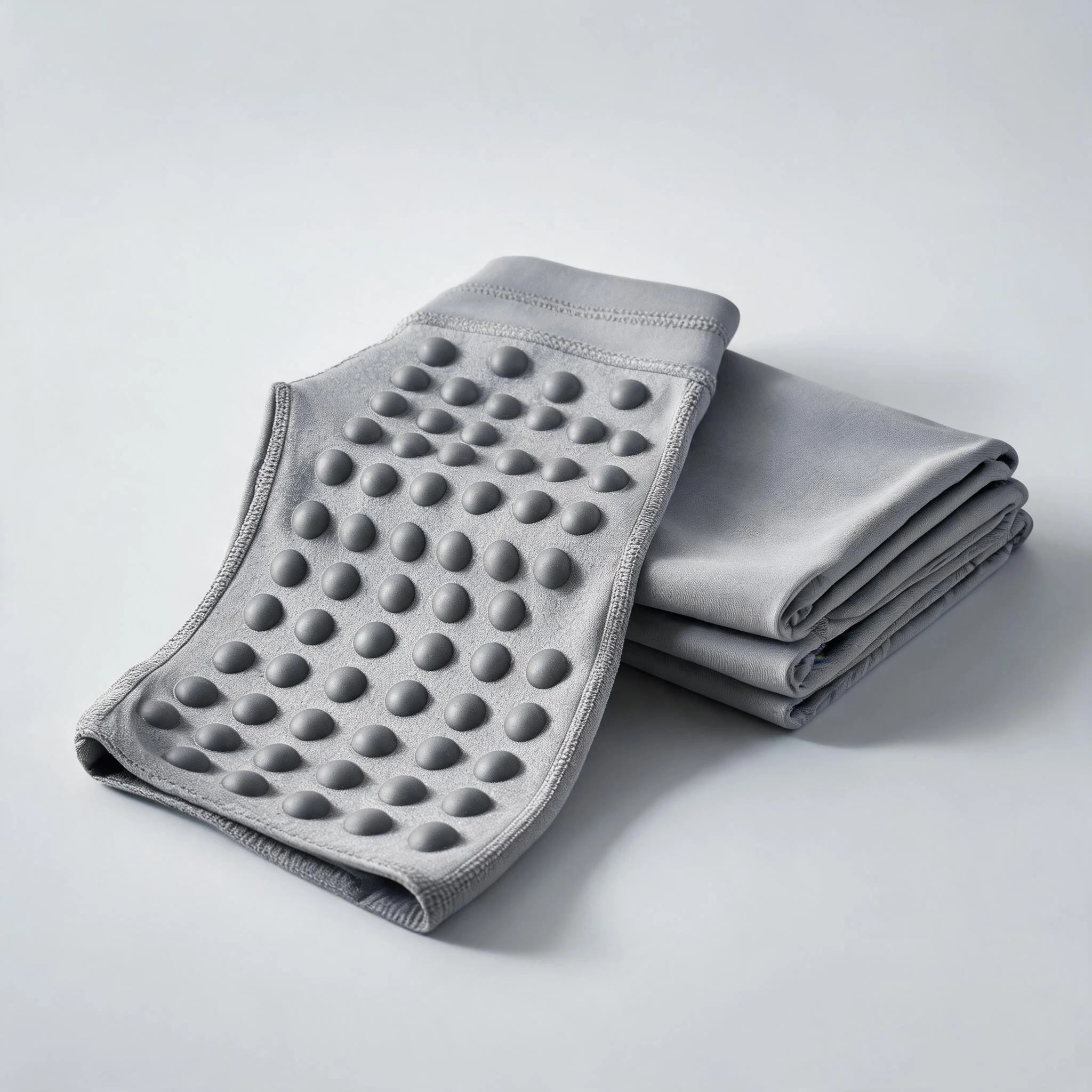
Grip dots control relative slip between two layers. Cuffs that ride up, pads that shift during movement, socks that roll, insoles that rotate - all are a grip problem, and grip can be designed.
Treating grip dots as "print a row of dots" usually gives one of two results: no grip, or a surface hard enough to feel wrong against skin.
1. Four parameters carry the grip
Diameter sets the contact area of one dot, height decides whether it can press into the other surface, pitch sets how many contacts per area, and hardness sets how hard it pushes back once compressed. They have to move together.
| Parameter | Turn it up | Side effect |
|---|---|---|
| Diameter | More contact area, more grip | Visible on thin fabric, prints through |
| Height | Bites into the other texture | Feels hard, wears faster, flattens in wash |
| Pitch (density) | More contacts per area | Too dense behaves like a full coating |
| Hardness | Stronger rebound, resists collapse | Too hard feels sharp; too soft collapses |
2. Four application profiles
Pad interiors need "no migration, no pressure points": medium diameter, low height, tighter pitch. Cuffs and socks need small dense dots laid along the stretch direction. Insoles and cushions resist shear, so larger dots and higher hardness. Gloves and tool grips need a higher friction coefficient rather than a larger contact area.
3. Working with elastic
Anything elastic has to be designed in the stretched state. An array laid out flat opens up when worn, so pitch drops out of range; either pre-compensate against the working elongation or use bars that stay continuous along the stretch.
Conclusion
Denser and harder is not automatically better. Set the four parameters against the application, draw the pattern, then prove grip and comfort on a physical sample.
Related: process routes, wash resistance, dots on elastic, and the product page.