Precision silicone overmolding · drawing review → sampling → volume

Perforated silicone parts: absorb, insulate, breathe

A helmet liner, an insole, a bra cup, a seat pad: different products, the same four jobs — take a hit, hold heat away from the body, let air and vapour through, and keep the weight down. On a perforated silicone part all four come from one thing, the hole pattern. This page is about how that pattern becomes a specification.

Four jobs, one geometry

The holes are structure, not decoration

Impact absorption

Silicone takes a blow by deforming and springing back, not by crushing cells. Perforation adds a second mechanism: the walls between holes buckle in a controlled way, so the pad stiffens progressively as it compresses — soft in the first millimetre, firm at the end of the travel. What limits the life of the pad is compression set: once it stops returning, it stops protecting.
Heat and cold

Silicone conducts heat slowly and the holes hold still air, so the pad separates the wearer from whatever is behind it: a shell heated by the sun, a cold pavement, a metal seat pan. The same property works against you in a hot environment — heat that gets in stays in, and the vent path has to carry it away.

Airflow

Silicone is not porous, so every bit of airflow comes from the holes. That is the advantage rather than the drawback: open area becomes a designed number instead of a by-product of foam density. Foam breathes through open cells, but those cells also hold sweat and odour and close up when wet; a perforated pad keeps the same path after washing.

Lower weight

Silicone is roughly an order of magnitude denser than PU or EVA foam, so a perforated pad is lighter than solid silicone but still heavier than foam of the same thickness. Lightness therefore has to come out of the geometry: more open area, a thinner profile, and material left only where the load actually passes.

镂空产品
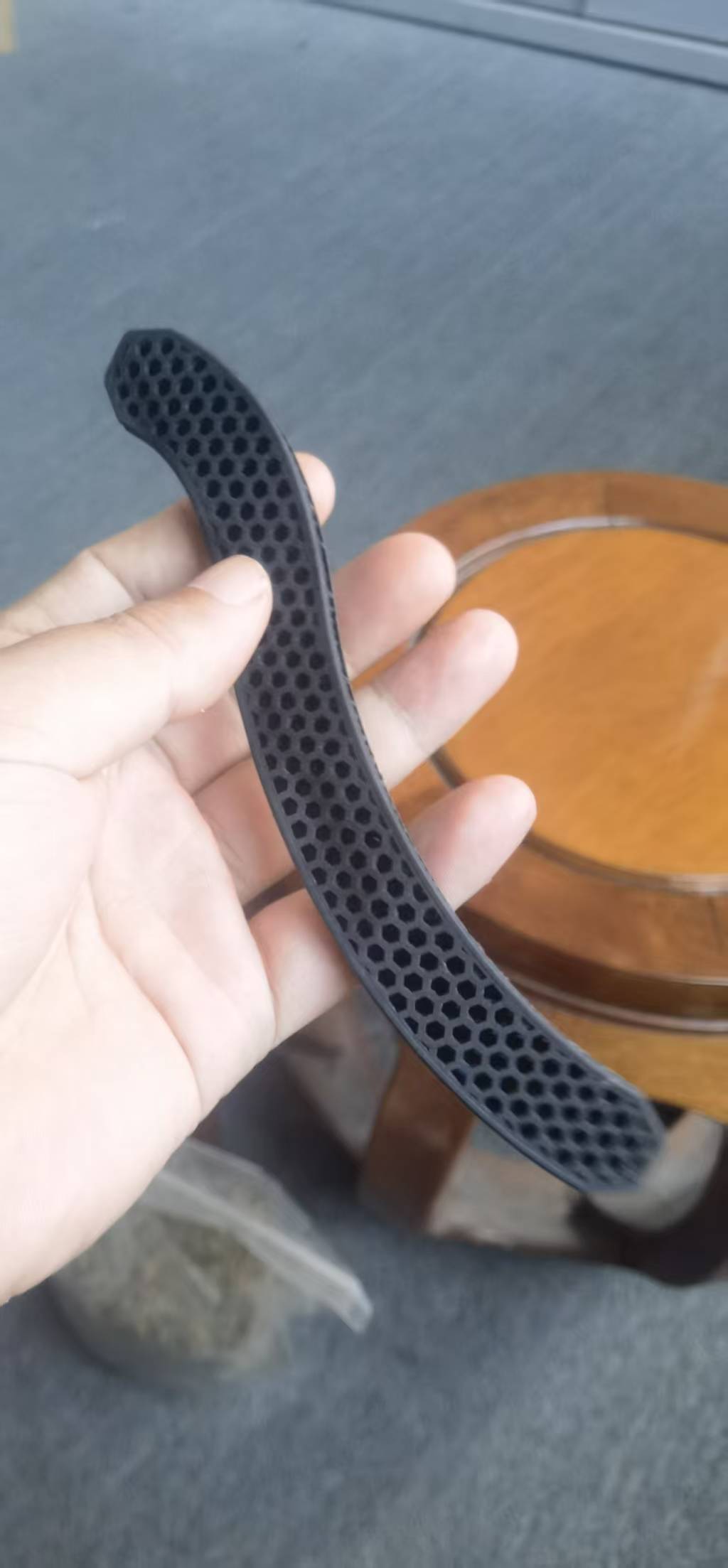
One-shot moulded strip: the honeycomb is formed by core pins, so the rib between two holes is a moulded wall rather than a punched edge.

Moulded, not punched

The rib between two holes is the part

Most perforated pads can be made two ways: punch or die-cut a flat sheet, or mould the holes in the tool in one shot. Punching is cheaper for simple flat gaskets; moulding wins as soon as the holes sit in a curved part, the ribs get thin, or the geometry has to vary across the pad.

A punched hole leaves a sheared edge and a stress ring around it, and the die crushes the wall between closely spaced holes. A moulded hole takes its shape from a core pin: a rounded edge, a smooth bore, and a hole position that comes from the tool rather than from sheet stretch.

On this part it also removes a whole step from the route — no punching, no de-flashing around every hole, no second fixture. The trade-off is tooling: core pins are the expensive and fragile part of the tool, and their diameter against depth decides what can be moulded at all. That is covered on moulding perforated silicone in one shot.

Applications

Five places this geometry earns its cost

The same part family, five different duty conditions. What changes between them is the profile and the load, not the material.

ApplicationThe dutyWhy perforated siliconeWhat fails first
Helmet and protective liner Repeated impact, sweat, sun-heated shell Keeps its shape and its vent path after washing; no foam crumbs inside the shell Compression set in the crown pads; tearing where the shell clamps the edge
Bra cup and base layer Skin contact for hours, frequent washing Skin-contact grade, stable colour, no foam dust, airflow that survives the wash Yellowing under sunscreen and sebum; distortion if the pad is bonded rather than pocketed
Insole and footbed Body weight in cycles, sweat, ground heat and cold Recovers after compression, can be washed, keeps a defined vent path under the arch Fatigue cracking at the forefoot flex line; rib wear under the heel
Pillow and cushion Continuous load, body heat, hygiene Does not absorb sweat or hold odour, and the surface can be wiped or washed Slow recovery if the pattern is too open for the load
Functional seating Long compression, shear at the front edge, ventilation Ventilated contact surface that can be replaced without rebuilding the seat Creep under constant load at elevated temperature

Two faces on one part

The body side is open, the frame side is solid

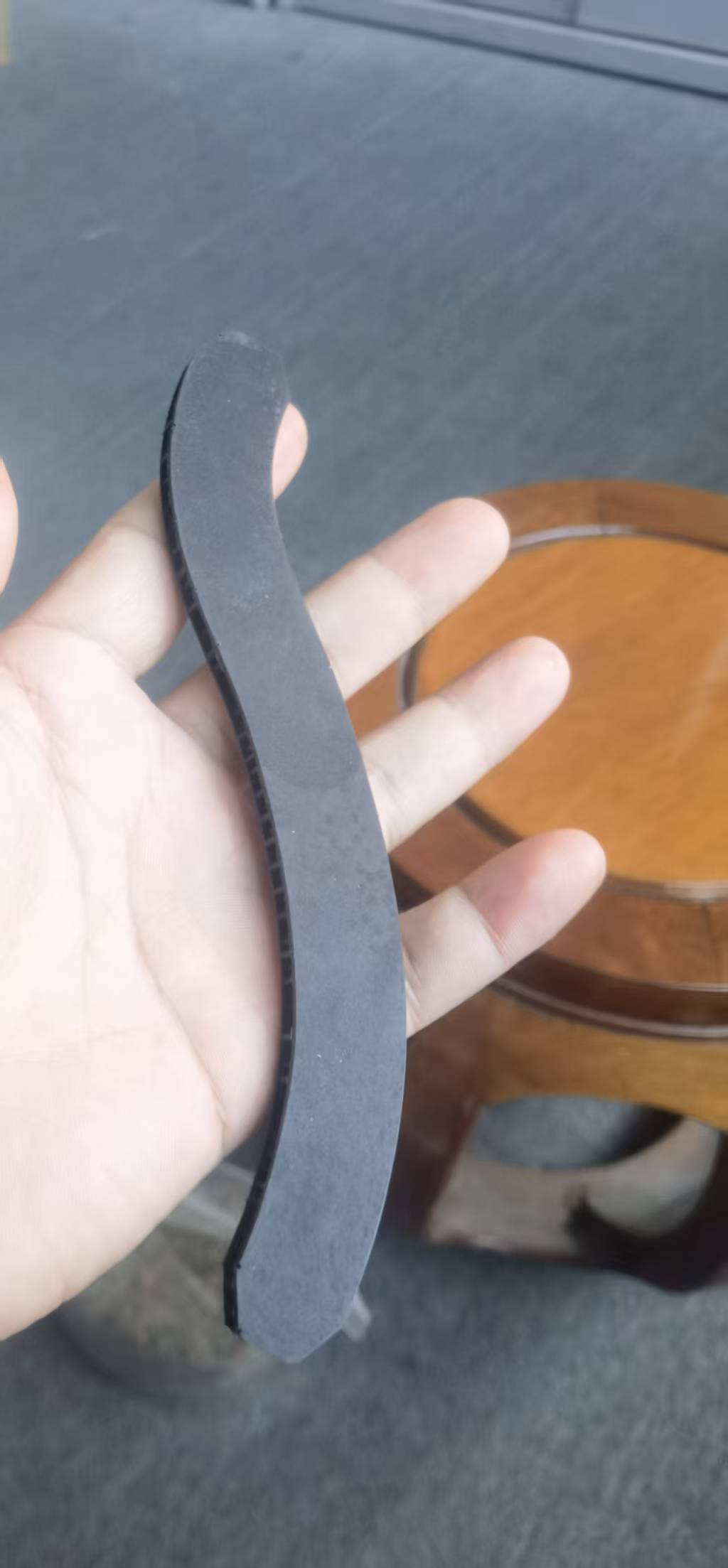
A liner or a seat pad usually touches two different worlds. The face against the body wants an open pattern, a soft edge and a surface that does not stick to skin. The face against the shell, frame or floor wants a solid skin: it takes the abrasion, spreads the load and gives the adhesive or the clamp something to hold.

Both faces come out of the same shot. A solid skin on one side, ribs and open cells on the other, and the ribs in between acting as the spring — that is the structure in the photo opposite, and it is why the pattern is drawn as a section rather than as a flat layout.

防撞条
The reverse face of the same strip: solid skin for the frame side, honeycomb on the body side.

Specification

Seven things to fix before tooling

None of these can be left to the toolmaker — each one changes how the pad feels. Values are set against test pieces and the real assembly; we do not quote a helmet, an insole or a cushion to a single universal figure.

ParameterWhat it decidesHow it is fixed
Hole diameterLocal softness and how the surface feels under a thumbTest pieces at the final thickness and hardness
Pitch and open areaAirflow, weight, spring rateCalculated from the drawing, verified on the first sample
Rib widthTear strength and fatigue life at the narrowest pointSectioned sample, measured at the thinnest wall
Thickness and profileHow far it compresses, and where the load landsMatched to the gap in the assembly, not chosen in isolation
HardnessSupport versus giveTrial pads at the real load and wear time
Edge and mountingWhether the pad survives being clamped, sewn into a pocket or snapped inJoint design reviewed before the pad is drawn
Skin contact and washingGrade, colour stability, odour, extractablesReports confirmed per project; wash cycle agreed with the buyer

Sampling and volume

Prove the feel in small lots, then cut production steel

Perforated pads are judged by hand before they are judged by a drawing, so the first step is a plate or single-cavity tool to get the pattern and the wall thickness right, then a second round with the pattern frozen. Tooling and sampling are quoted separately — the rules are on sampling and tooling.

At volume, inspection is built around the features that actually drift: open area, hole position against the datum, rib width at the thinnest section, and flash crossing a hole. Colour and hardness are retained against the sealed sample, and confidentiality terms are on confidentiality and NDA. If you are still choosing between foam and a moulded pad, the comparison is in foam or perforated silicone.

One boundary worth stating: the pad is moulded here, but textile lamination, sewing and final assembly into the helmet, shoe or seat stay with the customer or the garment maker. We can overmould a rim or a snap feature onto the pad so it survives that assembly.

Replacing a foam pad?

Send the current part, the gap it sits in and the load it takes; we will come back with a pattern and a wall thickness to test, not a catalogue number.

Send your project