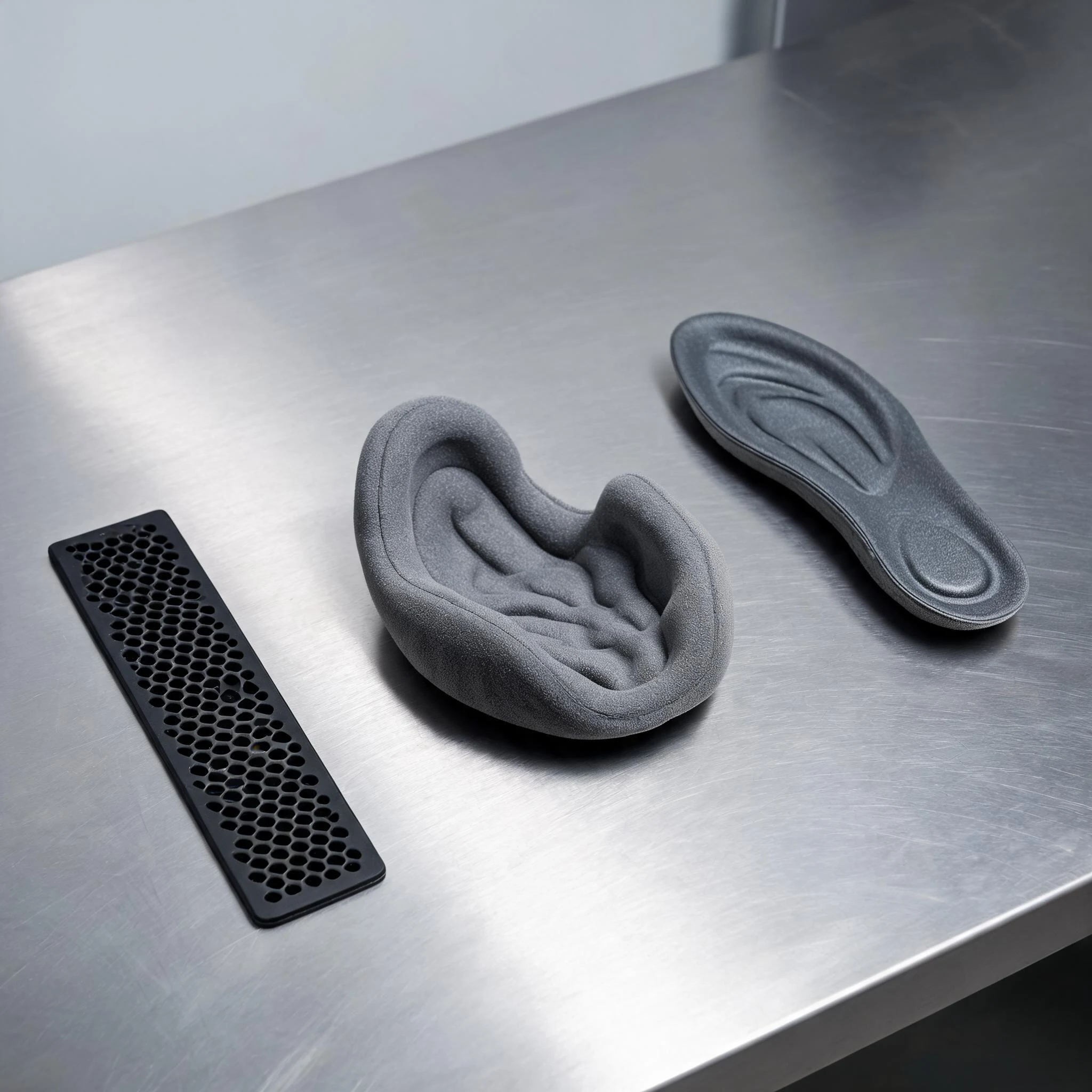
Product teams keep arriving with the same question: can the foam in our helmet liner, our insole, our bra cup be replaced with silicone? The honest answer is usually yes — and then the project runs into trouble, because the question was framed as a material swap when it is a structure swap.
A foam pad and a moulded silicone pad are not the same object with a different recipe. One is a compressed block of cells; the other is a web of walls with holes designed into it. They absorb load differently, breathe differently, fail differently, and one of them can be machine washed for years while the other cannot be washed at all.
1. Why the question keeps arriving
Three things pushed it forward. First, hygiene: pads that sit against skin for hours take sweat and sebum, and a foam pad holds both. Second, lifespan: foam pads inside helmets flatten, crumble and start shedding dust long before the shell is worn out, and the customer notices at replacement time. Third, the padding has become visible — in open-structure helmet liners and ventilated insoles the pattern is part of the product now, not hidden under a cover.
There is also a supply-side push. Buyers ask foam suppliers for more documentation than they used to, and some brands have concluded that a part which can be washed, wiped and inspected is simpler to defend than one that cannot.
2. Eight jobs, compared
| Job | PU or EVA foam | Perforated silicone |
|---|---|---|
| Airflow | Through open cells; depends on density and on how far the pad is compressed | Through moulded holes; the path stays open under load because the walls hold it |
| Impact | Cell collapse — progressive while the foam is new and dry | Elastic deformation plus controlled wall buckling; holds its curve longer |
| Heat and cold | Good insulator while dry, much less so once soaked | Low conductivity, largely unaffected by moisture |
| Weight | Very light; this is where foam is strongest | Heavier per unit volume; lightness has to come from open area and profile |
| Sweat and odour | Absorbs and retains; odour persists after drying | Does not absorb; can be washed and wiped |
| Life in service | Fatigues, flattens, crumbles, sheds dust | Keeps shape; may yellow or whiten, which is cosmetic unless the grade is wrong |
| Tooling and volume | Cheap tooling, low minimums, quick to change | Tooling investment with core pins; pays back with volume or complexity |
| Shaping freedom | Any thick 3D contour, laminated or skived | Uniform walls, curvature and graded patterns — but pin depth limits very thick sections |
3. Where foam still wins
Silicone does not win everywhere, and a supplier who says it does is selling rather than engineering. Foam stays the better answer in four situations:
- Weight is the binding constraint. Cycling helmets, running shoes and travel products are weighed by buyers. A perforated pad is lighter than solid silicone, and still heavier than foam of the same thickness.
- The contour is deep and three-dimensional. Foam can be moulded into a thick, irregular cushion in one cheap tool; silicone wants a wall that fills evenly, and very thick sections with pins are difficult and expensive.
- Volume is small or the design is still moving. Prototypes and short runs belong with foam or die-cut sheet.
- The product wants the memory-foam feel. Slow-recovery softness is a foam property; silicone can be soft, but it springs back rather than sinking.
4. Three things that change when you switch
The pad becomes a spring with a rate. A foam pad is specified mostly by thickness and density. A perforated pad is specified by thickness, hole diameter, pitch, rib width and hardness, and the load curve is the result of all five. Copying the foam thickness across is the most common first mistake: the silicone part has to be designed against the gap it sits in and the load it carries.
The pattern becomes a drawing feature and an inspection feature. Once holes are structural, open area and rib width have to appear on the drawing with tolerances, and inspection has to measure them — a sectioned part for rib width, not just a glance at the surface. On the tooling side this is where core pins, venting and release are decided; the process notes are on moulding perforated silicone in one shot.
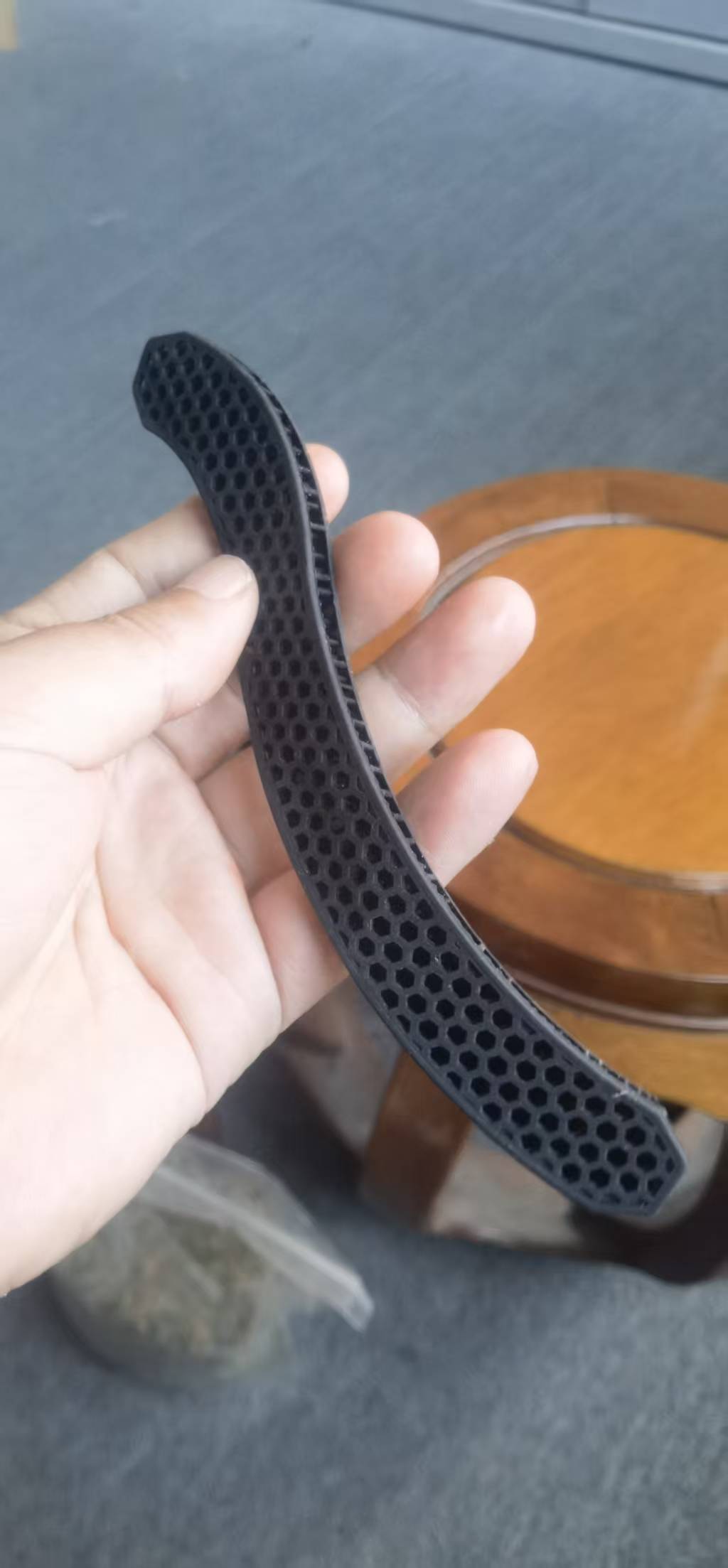
The edge becomes the wear point. Foam forgives being sewn, stapled or clamped almost anywhere. Silicone at a clamped edge can tear, so the mounting has to be designed: a pocket, a moulded rim, a snap feature, or an overmoulded frame. Textile lamination and sewing stay with the garment or helmet maker; the part that leaves the tool has to be ready for that step.
5. What to test before committing
- Compression set at the temperature the product will actually see — a pad that recovers at room temperature can fail in a closed car or against a heated seat;
- Dynamic fatigue at body temperature, with the number of cycles tied to a realistic service life rather than to a single shift;
- Wash cycles at the temperature and detergent the consumer will use, checking shape, colour and rib integrity afterwards;
- Artificial sweat and sunscreen, which attack some grades faster than water does;
- Odour and colour change, judged against a limit agreed with the buyer rather than by eye;
- Skin-contact documentation — grade and reports confirmed per project, not published as a generic certificate.
6. What this means for a helmet, a shoe or a bra
Helmet liner. The shell and the energy-absorbing layer still do the protective work; the pad manages fit, low-speed comfort, sweat and airflow. Perforated pads make sense in the crown and side positions where ventilation and hygiene matter, and where the pad is replaceable.
Insole. A perforated silicone layer on top of the existing midsole is a hygiene and ventilation layer — it is not a substitute for the cushioning in a running shoe. It is a good fit for work boots, school shoes and products that are worn daily and washed rarely.
Bra cup and base layer. A moulded silicone insert replaces neither the cup structure nor the fabric; it adds a replaceable, washable skin-contact layer with a defined airflow path. Where the cup is foam-moulded in one piece, the construction changes rather than the material alone.
Conclusion
The switch works when the product benefits from washability, a fixed vent path and a pad that keeps its shape, and when the design can absorb a new load curve, a new drawing and a new edge. It does not work when weight is the deciding number, when the contour is deep and thick, or when the tooling budget cannot be justified by volume.
Both are honest answers. What is not honest is treating silicone as a drop-in replacement for foam — that is how a project ends up with a pad that is heavier, harder and more expensive than the one it replaced, and none of the expected benefits.
For the part side — four functions from one hole pattern and the geometry to fix before tooling — see perforated silicone parts.