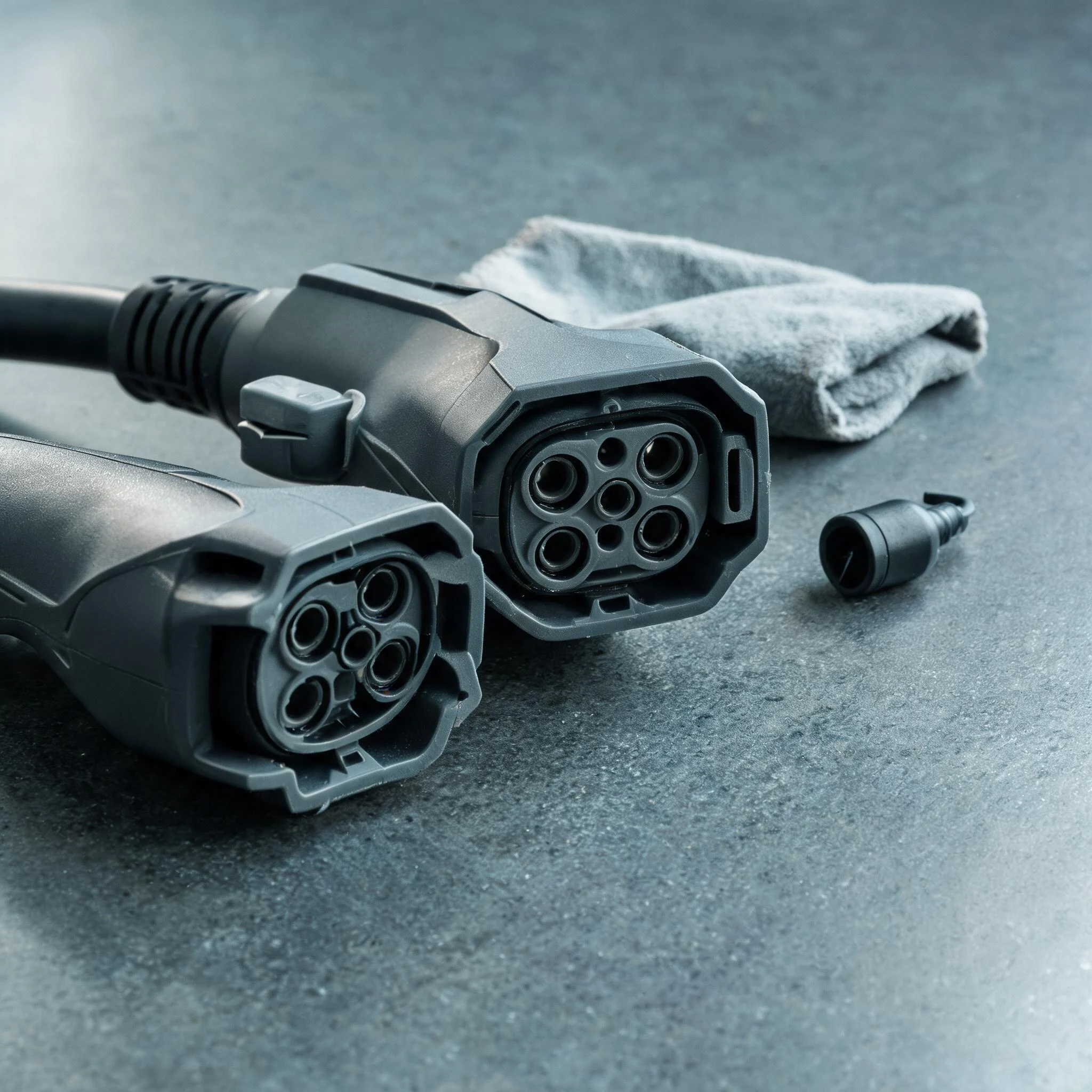
The series has taken apart a car lamp, an espresso machine, a toothbrush, a cordless drill and a floor washer — heat and oil, oil and alkali, water and foam, dust and vibration, water and abrasives. This time it goes outdoors: the connector head of an EV charging gun. It takes four things at once: sun and rain, condensation from day-night temperature swings, tens of thousands of mating cycles, and the heat of high-current charging.
Users judge a gun on three things: does it seat smoothly, dare I charge in the rain, and after two years does it overheat and trip. None of those is decided by the housing or the pins. They are decided by a few rings of unremarkable soft rubber.
The counter-intuitive point: the hardest sealing problem in a charging gun is not being submerged. It is breathing — the body expands and contracts with temperature, pulling moist air into the cavity a little at a time.
1. Six soft parts in the head
- Pin-hole seals: a small O-ring or profiled ring at the base of each pin, blocking water that creeps along the hole.
- Mating-face seal: the full ring where the gun meets the vehicle inlet, which sets the water resistance in the mated state.
- Cable strain relief: the boot between housing and cable, usually TPU or TPE, resisting repeated bending and dragging.
- Latch and button seal: a membrane under the mechanical latch button, sealing while keeping feel and return.
- Temperature-sensor overmould: an NTC near the power terminals encapsulated in a thin silicone layer for conduction and insulation at once.
- Indicator light pipe and seal: the lens and its gasket — often overlooked, and usually the first place to show condensation haze.
2. The real duty: breathing, mating, heat
- Breathing: the body heats in the sun and pushes gas out; it cools at night and draws moist air back in. The harder the seal and the lower the compression, the more pronounced this becomes. Moisture accumulates that way and finally condenses on cold surfaces.
- Mating wear: insertion force concentrates on the face seal and pin-hole rings. Repeated compression rolls and thins the lip, and grit trapped on the mating face turns into a grinding paste.
- Current-induced heat: near the terminals of a DC gun the temperature sits at 60–80 °C for hours. Silicone tolerates it, but sustained heat accelerates compression set — the seal "remembers" being flattened, rebound drops, and leakage starts.
Together they produce the familiar outcome: IP67 when new, "I don't dare charge in the rain" after a year.
3. Material assignment: not all silicone
| Material | Role in the gun | Strength | Weakness |
|---|---|---|---|
| Silicone VMQ | Face seal, pin-hole rings, button membrane | Weather and temperature range, low compression set, low-temperature flexibility | Moderate tear and abrasion resistance; swells in grease (see the properties library) |
| Fluorosilicone FVMQ | Near terminals and grease contact | Oil and chemical resistance with low-temperature flexibility | Cost, limited colour options |
| TPU | Strain relief, wear corners | Flex, abrasion, low-temperature impact | Creeps under long compression, lower temperature ceiling |
| EPDM | Housing seals, cost-driven gaskets | Weather and water resistance at low cost | Poor oil resistance, stiffer when cold |
| Flame-retardant silicone | Near high voltage and terminals | Flame rating, tracking resistance | Mechanics and rebound below general-purpose grades |
The last row matters most: flame retardance and rebound usually trade against each other. Loading filler to reach a rating worsens compression set, and seal life follows. Specify both in validation instead of accepting a flame test report as the finish line.
4. Four places that fail first
1. Mating-face seal
It carries the whole water rating and takes the most mating wear. Too soft and it shears during insertion; too shallow a groove and compression is insufficient, leaving the seal to rely on being tight. A lip plus a hard stop works better: the lip adapts on mating, the stop prevents over-compression (groove design in moulding).
2. Pin-hole rings
Small, numerous, and easily nicked by pin tips during assembly. Guided chamfers and a compatible lubricant are process requirements (see bonding), not options. Failures here are invisible at the factory and show up as seepage months after installation.
3. Strain-relief root
Users pull the gun by the cable. The boot root sees repeated bending, so it needs a corrugated transition, a thicker root and a mechanical lock to the housing rather than adhesive alone. TPU suits this better than silicone — tear strength decides it.
4. Temperature-sensor overmould
The thin layer has to conduct, insulate and survive thermal cycling next to the terminals. The common failure is delamination leaving an air gap: temperature reads late, and the charger trips or derates. Interface reliability is the item to design for.
5. Six structural rules
- Point the lip against the water pressure, opening outward on mating;
- Add a hard stop so compression above 30% has somewhere to go;
- No water traps under the head — or provide a drain;
- Reduce breathing: small cavity, matched hardness and compression, and a breather membrane where pressure equalisation is needed;
- Corrugate the boot so bending stress spreads across waves instead of one thick section;
- Keep it serviceable: a replaceable face seal beats scrapping the gun (tooling and sampling rules).
6. How to validate
- Mating life: 10,000 cycles (some customers ask 20,000), logging insertion force and appearance, watching for a rolled lip;
- Water: IPX6 jet and IPX7 immersion, tested both mated and unmated;
- Condensation cycling: thermal shock between -40 °C and 85 °C, then insulation resistance — the test that exposes breathing (test capability);
- UV ageing: xenon or UV exposure, then check boot and seals for cracking and colour change;
- Salt spray: essential for coastal and de-iced markets, checking terminals and overmould interfaces;
- Temperature rise under load: rated current, measuring terminal and overmould temperatures to confirm the seals are not running hot;
- Drop and drag: 1 m onto concrete, then lateral cable drag, then re-test water resistance.
7. Ten checks for the design team
- Is the face seal a lip or an O-ring, and is there a hard stop?
- Are pin-hole rings assembled with guidance and lubricant, and how are nicks detected?
- Is the boot mechanically locked to the housing or only bonded?
- Has cavity volume been calculated, and how much air does it exchange?
- Is there a water trap, and where does it drain?
- Has compression set of the flame-retardant grade been validated separately?
- Is there a method to detect air gaps in the sensor overmould?
- After mating-life testing, is water resistance re-tested rather than appearance alone?
- Does insulation resistance stay within limits after condensation cycling?
- Can the face seal be replaced on its own?
Conclusion
Silicone's job in a charging gun is to hold a reliable ring of contact pressure outdoors, across temperature swings and repeated mating. It brings weather resistance, temperature range and low-temperature flexibility, but not tear strength or abrasion resistance, and it swells in grease — so boots go to TPU, terminal-adjacent parts to FVMQ or flame-retardant grades, and face and pin seals stay with silicone — a related case is energy-storage liquid cooling.
When a gun trips in the rain or seeps after two years, check for accumulated condensation, a lip thinned by mating, and how much compression is left before changing the material.
The series continues with another industry and another part. If you have soft parts in charging guns, connectors or portable power — outdoor plus mating duty — send the structure, duty condition and test requirements, and we will start with a sealing and material assessment.