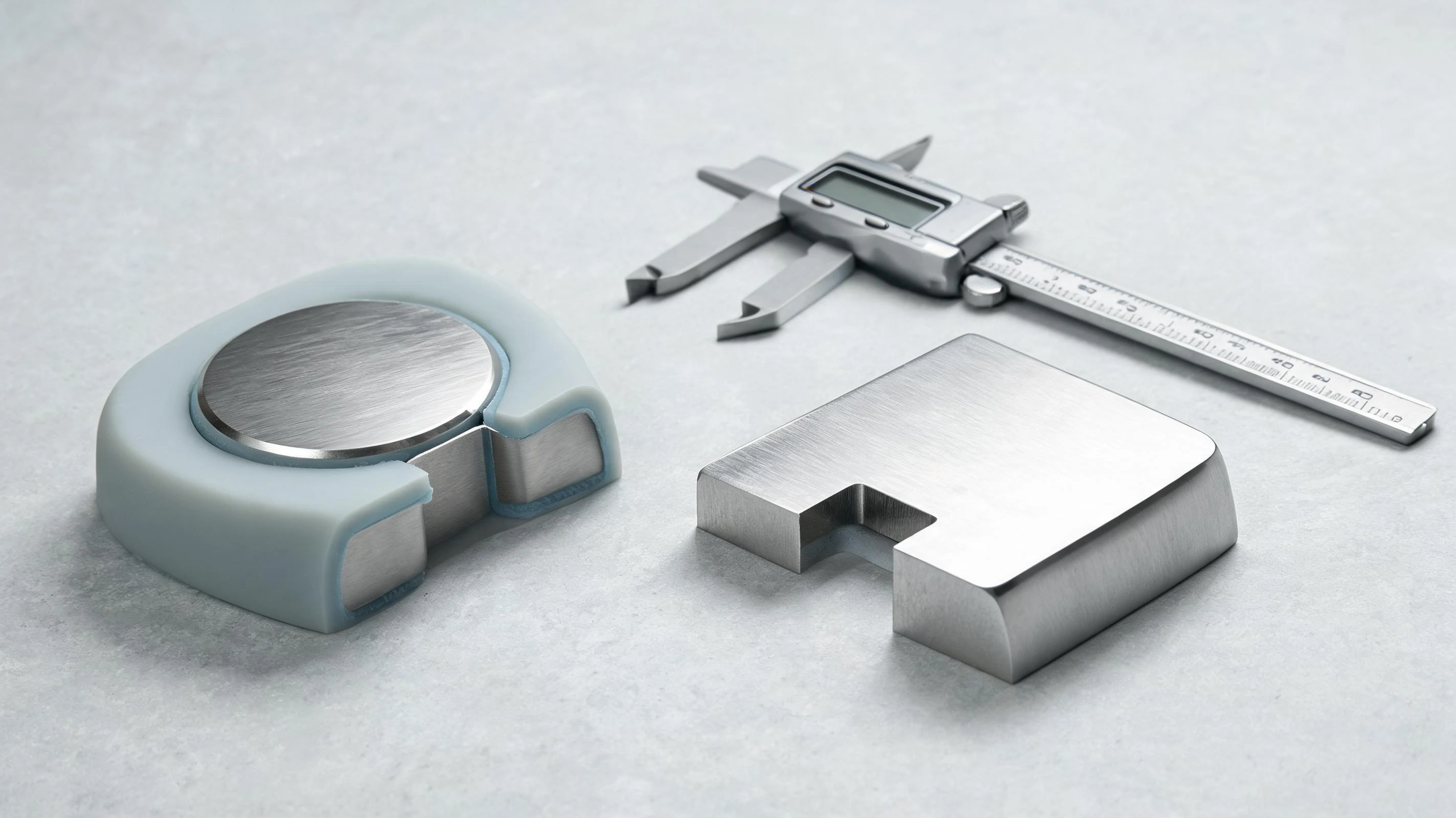
Bonding silicone to aluminium usually starts with an argument in the drawing review: the part is already anodised — do we treat it again, and will that make the bond worse?
The answer depends on the type of anodising and the film thickness. Aluminium is amphoteric: it dislikes both acids and alkalis, and the oxide layer is porous. Choose the wrong route and the interface fails first in hot, humid conditions.
1. An oxide layer is not automatically a barrier
Unsealed anodic film is porous, and those pores are useful: primer penetrates and anchors mechanically. The real problems are sealing and film thickness — once sealed, the surface becomes dense and low-energy, and bond strength drops clearly.
So three questions come first: is the anodising decorative or functional, what is the film thickness, and has it been sealed?
2. Pre-treatment: etch, clean, activate, prime
| Surface | Pre-treatment | Watch out |
|---|---|---|
| Bare or machined aluminium | Degrease, light alkaline or acid etch, plasma activation, metal primer | Over-etching changes dimensions and appearance |
| Anodised, unsealed | Degrease, plasma activation, metal primer | On thick film you are bonding to the film, not the aluminium |
| Anodised and sealed | Light abrasion to break the seal, activation, primer | Abrasion must be uniform or strength scatters |
| Bead-blasted | Degrease, blast, activation, primer | Blasting destroys the anodic look — mask decorative faces |
The most common shop-floor error is treating aluminium exactly like stainless: same primer, same activation parameters. Surface energy, oxide thickness and thermal expansion all differ.
3. Moulding: HCR or LSR
Aluminium conducts heat well, so both routes work: solid silicone compression moulding for structural and thick-wall parts, LSR injection for thin walls, fine features and volume.
Aluminium expands far less than silicone, so cooling creates shear at the interface. Avoid large flat bonds; use locating ribs or undercuts so the stress is distributed instead of peeling an edge.
4. Three failure modes, told apart before you touch parameters
- Clean peel, bare aluminium. Primer incompatible with the anodic film, or the sealed layer was never broken.
- Darkened aluminium, brittle interface. Alkaline cleaner or primer attacking the metal — switch to a neutral system.
- Blistering after humidity. Moisture entering through the porous film, typical where the edge was never sealed.
5. Four tests are enough to decide
| Test | Condition | What to look at |
|---|---|---|
| Peel strength | Actual part width | Cohesive (rubber) or adhesive failure |
| Salt spray | Outdoor and connector parts | Corrosion on the metal side, ingress at the edge |
| Thermal cycling | Application range, e.g. -20 to 85 °C | Edge cracking from differential expansion |
| Damp heat | Soak, then re-test peel | Retention of strength |
6. Five questions before you request a quote
- Is the part anodised — what film thickness, and is it sealed?
- Can the bond area avoid decorative faces, allowing local abrasion or blasting?
- Is the joint a flat bond or does it have ribs and undercuts?
- Will it see salt spray, cleaning agents or long damp heat?
- Is acceptance based on peel strength or on "it will not pull off"?
Conclusion
The decisive question in silicone-to-aluminium work is what kind of oxide is on the surface and whether it is sealed; the primer brand comes second. Settle that, use a neutral cleaning system and a joint that distributes shear, and the bond will fail in the rubber rather than at the interface.
Related: the substrate matrix and case list, and the properties library.