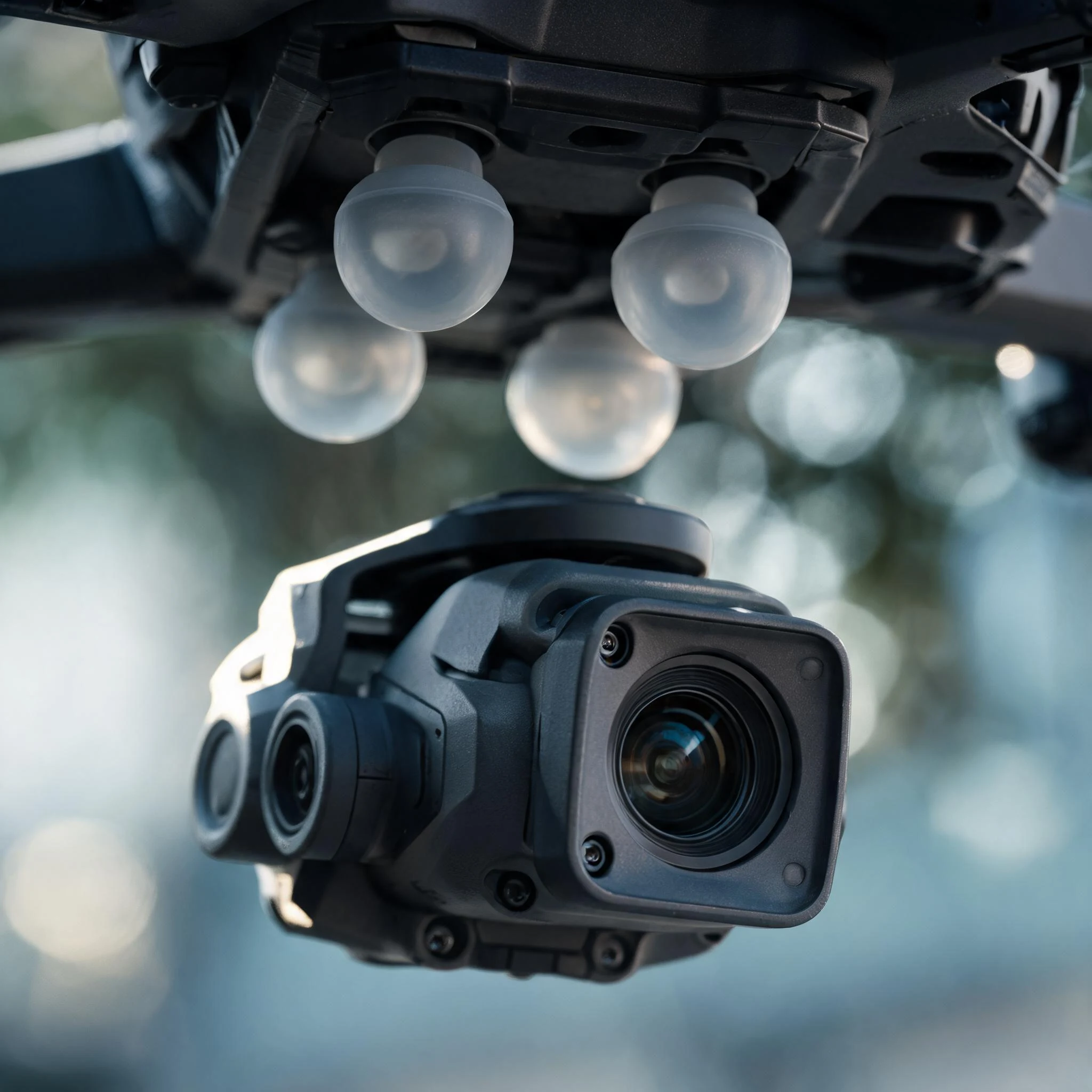
When drone footage drifts or shows jelly-like wobble, the first suspicion is the gimbal motor or the stabilisation algorithm. Take the camera mount apart and there are usually just four unremarkable silicone balls between camera and frame: the gimbal dampers.
They are not decoration and not bumpers. Those four balls decide how much of the airframe's vibration reaches the camera. This note explains why a ball isolates, why too soft is a failure mode of its own, and why the part is treated as a consumable.
1. Why a ball instead of a spring
Isolation is a frequency problem. Airframe vibration — motors, propellers, airflow — sits at high frequency; the camera's unwanted motion is low frequency. Something soft has to sit in between and keep the high frequency out.
A metal spring stores energy but has very little damping: the vibration comes back, and near resonance it is amplified instead of absorbed. Silicone has high internal damping — vibration energy entering the material is turned into heat by internal friction. That is the reason it suits isolation better than a spring.
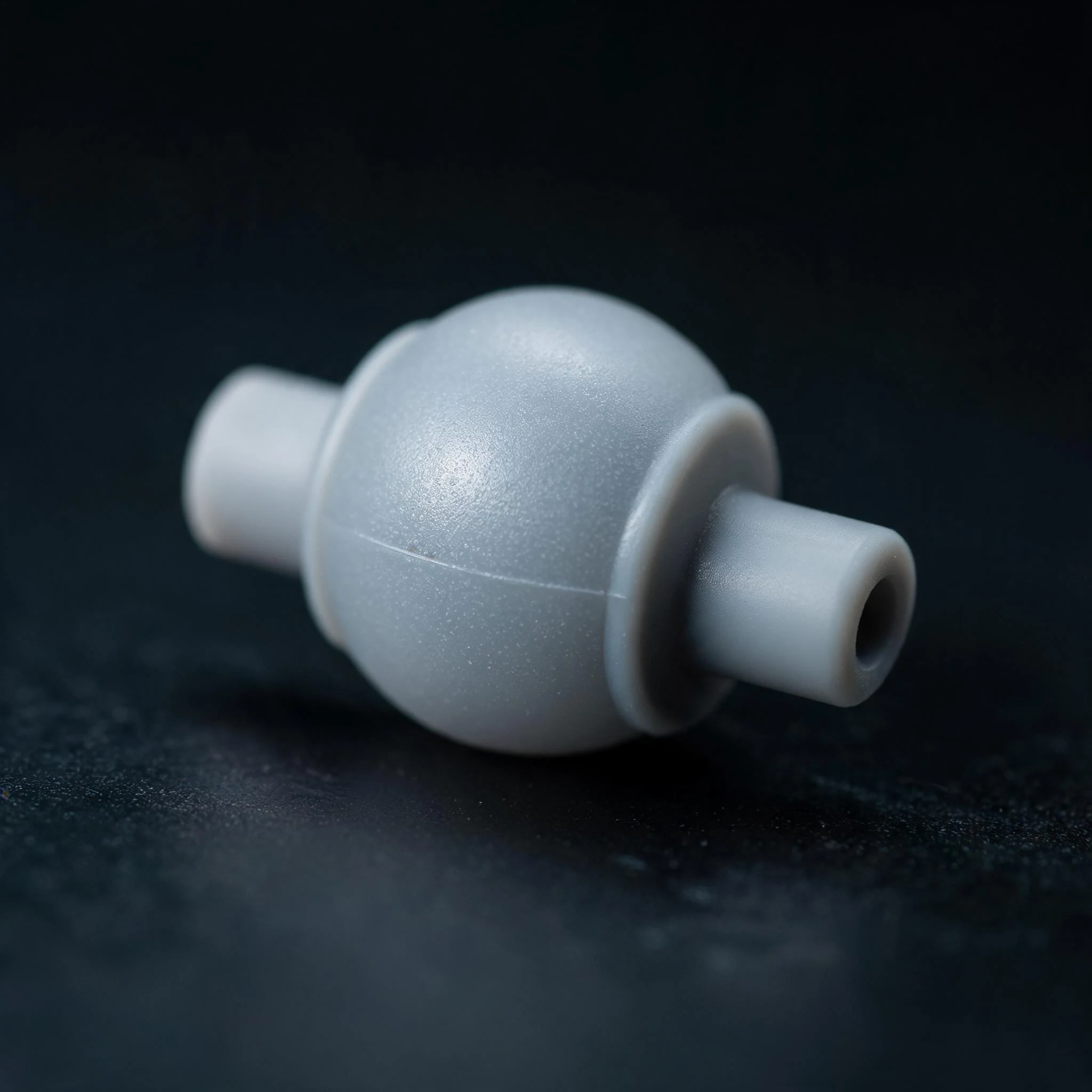
The spherical shape lets one part carry three directions at once: compression vertically, shear horizontally, and pitch and yaw absorbed by the difference in deflection across four mounting points. One moulded ball replaces a small mechanism, which saves both cost and assembly time.
2. The four balls only work as a set
With four-point suspension the critical thing is not a single ball but whether the four match. The camera's centre of gravity sits between them, so if one ball is harder, softer, mounted crooked or preloaded differently, the image drifts persistently in one direction — and no amount of algorithm tuning fixes a mechanical imbalance.
Each damper has mounting studs at both ends and a thin-walled sphere in the middle: wall thickness sets stiffness, the studs set the preload at assembly. Changing the camera, adding a video transmitter or fitting a bigger battery also changes the gimbal load. Keep the old balls and you have effectively changed every isolation parameter at once — the balls that were right are now either squashed flat (stiffer) or swinging loose.
3. Four things that surprise people
- Too soft also shakes. Isolation needs "soft enough", not "as soft as possible". An over-soft ball lets the camera sway at low frequency in gusty air, and the footage looks worse. Match hardness to load and to the target frequency.
- Temperature changes stiffness. Silicone modulus rises in the cold, so the same aircraft can behave noticeably worse on a winter flight; long hot operation brings compression set, and a flattened ball stops springing back.
- It is a consumable. UV, ozone and cleaning agents make the surface tacky or hard, and isolation decays with time. On an older airframe, "it shakes more every month" is usually these four parts asking to be replaced.
- Frequency mismatch is more common than insufficient softness. Move the same balls to a different frame and the airframe frequency changes; the result can be completely different. Dampers are matched to an airframe, not universal parts.
4. Five parameters to fix before ordering
| Parameter | What it decides | How to confirm |
|---|---|---|
| Hardness (Shore A) | Stiffness and load capacity of the isolation | Test flight against gimbal load and target frequency |
| Ball diameter and wall thickness | Travel and stiffness — thinner wall, softer ball | Chosen from installation space and required deflection |
| Studs and preload | Effective hardness after assembly; risk of pull-out | Confirmed against frame hole size and assembly method |
| Temperature and weather | Cold stiffening, hot deformation, UV ageing | Grade selected from operating temperature and outdoor exposure |
| Life and replacement | When isolation starts to decay | Replacement interval set by flight hours or visual condition |
Conclusion
The damper ball is the cheapest part in the gimbal and the one that decides whether the footage is usable. The engineering content is not the silicone itself but the matching: hardness to load, wall to travel, studs to preload, and four balls to each other. Get that wrong and no firmware update will save the picture.
If you are evaluating damping parts, send the gimbal load, installation space and operating temperature. We will start from hardness and structure rather than from a catalogue number. Related reading: robot flexible silicone parts, material selection and R&D and testing.