
A tap light looks like the simplest lamp there is: a soft shell, one LED, one battery. Shipping it in volume means solving four systems at once — body moulding, tap sensing, light drive and power management. Add voice conversation on the same body and a fifth appears: the acoustic channel.
The difficulties differ, but they pull against each other. Wall thickness changes both how light leaves the part and how a tap feels; silicone makes the light softer and the microphone deafer; always-on voice asks for lower power while runtime was always carried by standby current. This note takes the five systems in turn: what each one decides, where its limits are, and how to verify it.
A note on numbers: every range quoted here is an industry-typical figure or a common engineering criterion, used to explain design limits and verification methods. They are not our production specification. Dimensions, hardness, colour temperature, flicker depth and standby current are governed by the project drawing, the sealed sample and the test report.
1. The real difference is the input, not the switch
An ordinary night light or desk lamp uses a mechanical switch or a touch key: the contact point is defined, and the state follows a key position or a single steady capacitance change. Users are trained to look for that button, which is why it can be small, hard and hidden at the back.
A tap light turns the whole body into the trigger surface, and the input is no longer sustained contact but one impact. That single change has three consequences:
- The trigger area grows. Half-asleep at night, an unsteady hand, a child's palm — all of them land. That is exactly the value over an ordinary night light.
- The signal changes nature. An impact is transient, tens of milliseconds; the detection logic has to look at a waveform, not at "is something touching".
- False triggers have to be managed. Ordinary lamps barely consider them. A tap light has to answer why it did not switch on when knocked on the nightstand, stepped on by a cat, moved, or carried in a bag.
So "tap to light" is not just a description of the experience. It is a recognition problem: picking the human tap out of every other vibration.
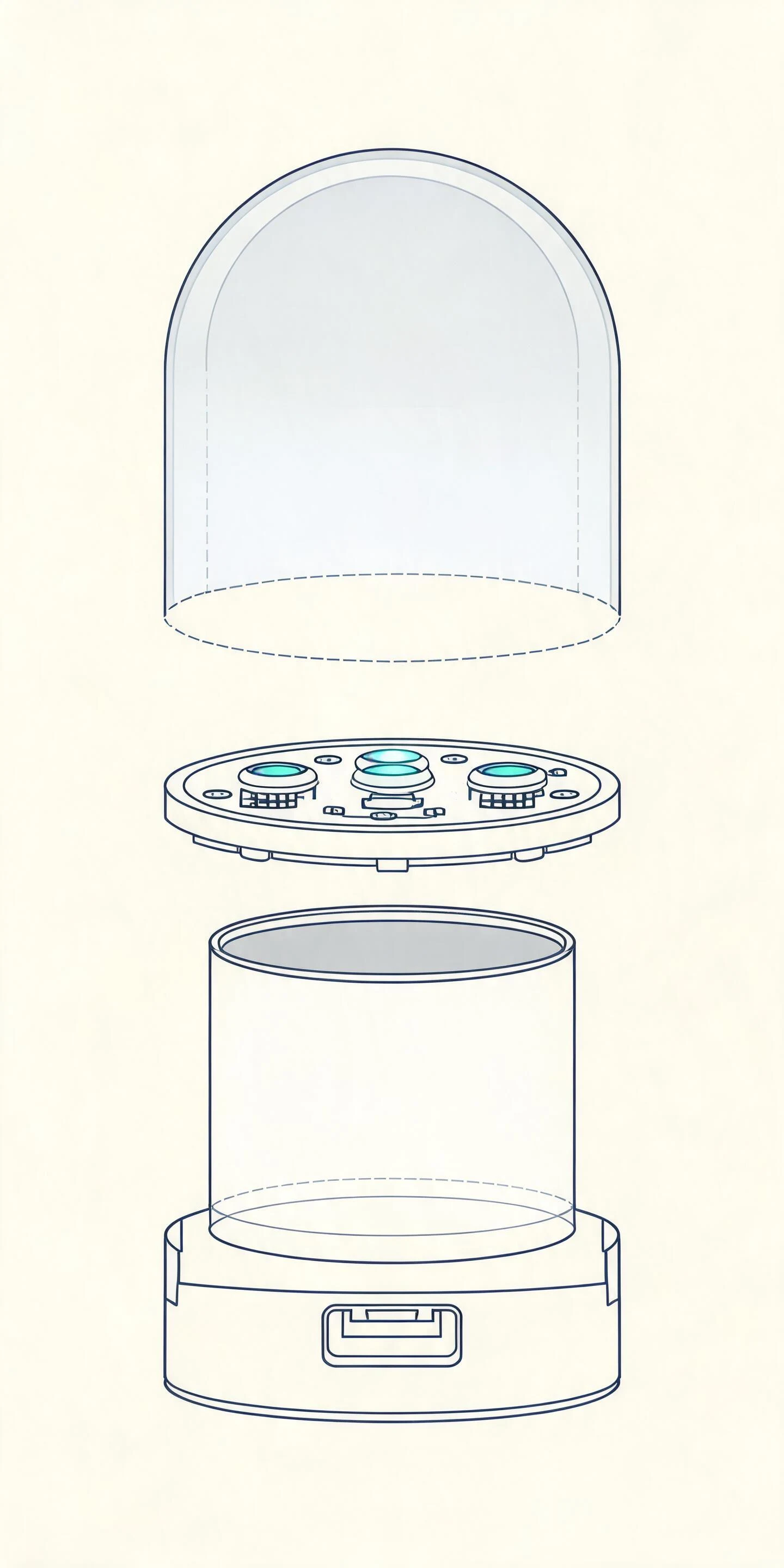
2. The silicone body is an optical part, not a housing
Plastic or metal housings are opaque and need a window cut into them. Silicone carries structure, touch and light output at the same time. Light scatters inside the material before it leaves, so the emitting surface becomes the whole body instead of one LED. Perceived glare drops sharply — that, not a dimmer setting, is why the light looks soft.
Material grade: an adjective is not a report
"Food grade" and "medical grade" are often used as adjectives in purchasing, but they are sets of requirements. Food-contact work is usually evaluated against systems such as FDA 21 CFR 177.2600 or LFGB. Medical work follows the ISO 10993 series for biocompatibility and has to state the contact site, contact duration and sterilisation method. The same silicone can lose its grade claim once the contact scenario changes.
Silicone tolerates a wide temperature range (industry-typical spans reach the −50 °C to 200 °C order), but a lamp body never runs that hot. What limits life is long-term heat ageing and UV yellowing: the light source sits against the inner wall, so local temperature rise accelerates yellowing, and a pale or translucent body near a window will yellow from daylight as well. The anti-yellowing choice belongs in material selection; it cannot be wiped on before shipment.
Transmission: uniformity is harder than brightness
Base silicone transmits well, and diffusers adjust haze. More haze means softer light and lower total flux; less haze means brighter light that reveals the internals. The production difficulty is uniformity: a small wall-thickness difference shows up as a bright band or a dark band, and density differences near the gate leave a visible ring. Neither can be hidden by turning the brightness down; only tooling and process fix them.
3. Moulding: the cost is in the tool and the cure, not the compound
Thin-wall, large-surface bodies with consistent transmission usually go one of two ways: liquid silicone rubber (LSR) injection or high-consistency rubber (HTV) compression. For thin walls, visible surfaces and stable volume, LSR with a cold runner is common: compound stays uncured in the runner and cures only in the hot cavity, so there is less waste, shorter cycles and better batch consistency.
Three things decide whether every part matches:
- The cure window. Addition-cure systems commonly run at 110–170 °C mould temperature (industry-typical), with time rising as wall thickness rises. Too cold gives under-cure and a tacky surface; too hot traps air and over-cures locally, making the part brittle.
- Tool details. Where the parting line sits, which corner vents, which face the gate points at — these decide appearance and transmission. A lamp body is a seen product, so the parting line usually goes underneath or at the back.
- Wall thickness and shrinkage compensation. Thin walls are more sensitive to shrinkage and warpage, so the cavity needs compensation; otherwise bodies from the same tool assemble tight on some parts and loose on others.
In other words, material is a small share of the cost of a silicone light body. Tooling and process stability are the cost. That is why the same appearance drawing can be quoted at twice the price by a different shop — the difference is tool precision and setup skill, not compound.
4. Tap sensing: two routes, two different false-trigger sources
Turning a tap into an electrical signal has two mainstream routes. Neither is inherently better; they suit different structures.
| Item | Vibration / acceleration | Capacitive touch |
|---|---|---|
| Principle | Spring-mass, piezo disc or accelerometer detects the impact waveform | Detects capacitance change on the body surface (pF range) |
| Strengths | Triggers through a thick silicone wall; works anywhere on the body; immune to water films | Low cost, no moving parts, supports press-and-hold dimming |
| Main false triggers | Continuous motion in a bag, knocks on the table, vibration from nearby equipment | Wet hands, water films, sweat, and parasitic capacitance from battery and metal parts |
| Structural constraint | Sensor must be rigidly coupled to the wall or the impact never arrives | Sensitivity varies with wall thickness and dielectric constant; wall tolerance directly affects feel |
| Best fit | Thick, soft walls; complex shapes | Thin walls, clean shapes, continuous dimming |
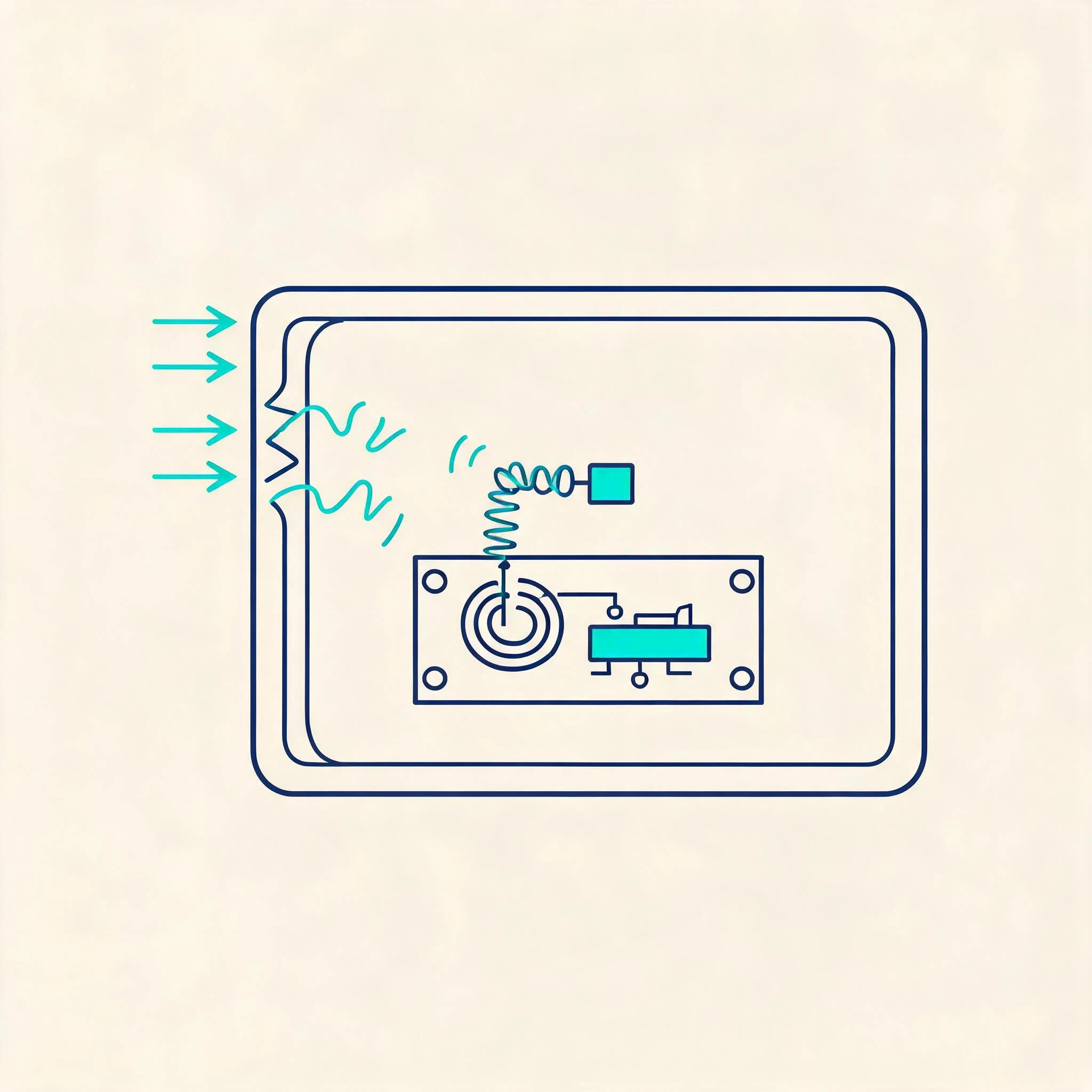
Sensitivity is a set of parameters, not a threshold. The vibration route needs four defined together: trigger threshold, decision window (tens to hundreds of milliseconds), debounce count and a cool-down after triggering. Set the threshold low and a knock switches the lamp on; set it high and an elderly user taps twice with nothing happening, which destroys the experience. The capacitive route has to handle sustained pressing and wet hands, usually with a short window plus a second confirmation rather than a single sample.
The harder problem is consistency. Wall thickness and hardness vary within a batch, and sensor bonding position varies with assembly. In volume the units are often calibrated one by one, or at least sampled per batch for threshold distribution. Skip this step and the result is predictable: the sample feels perfect, the shipment has units that trigger too easily and units that need two taps.
5. Light and drive: what low blue light and flicker-free actually mean
Two hidden specifications matter more than brightness in a night light: spectrum and flicker.
Low blue light is often reduced to "low colour temperature", which is inaccurate. A warm 2700–3000 K (the usual night-light range) only makes the overall appearance warm; what matters is the relative intensity and peak position of the blue band. Two products both marked 3000 K can differ noticeably in blue peak intensity depending on phosphor mix and chip. The silicone diffuser spreads a point source into a surface source and lowers perceived glare, but it does not change the spectrum.
Flicker-free does not mean "I cannot see it flickering". Engineering uses flicker depth, computed from the maximum and minimum within a cycle: the smaller the better. The industry often treats a flicker depth below 1% as a working reference line for "flicker-free", and some evaluations follow the IEEE 1789 recommendation curve. In the circuit there are three routes: a constant-current driver with enough output capacitance to suppress ripple; PWM dimming pushed to a frequency the eye and camera cannot easily catch (3 kHz and above is common); or analogue dimming that changes current instead of chopping it.
One trade-off is usually ignored: the more dimming steps, the harder it is to keep the driver stable at low brightness. Extremely low duty cycles flicker and shift colour, so steps are usually few and chosen to cover night trips, reading and ambience.
6. Power: runtime is really a standby-current question
These products generally use a single lithium cell (3.7 V nominal) with a protection board and Type-C charging. The engineering lives out of sight:
- Charging management: constant current then constant voltage, with the cut-off set by the cell specification; the CC resistors on the Type-C side decide what the charger thinks it is connected to and how much current is allowed.
- Protection: over-charge, over-discharge, over-current, short circuit and temperature. The body is a sealed soft shell with worse heat spreading than metal, so charging temperature rise deserves its own evaluation.
- Standby: the real drain is not while the lamp is on, but while it sits off for a month. MCU sleep current, LDO quiescent current, indicator leakage — miss one and runtime drops by an order of magnitude. Good designs reach the microamp range when off.
So "how many days on standby" is capacity divided by average standby current. Doubling the cell is worth less than halving the standby current. That is why two lamps with the same cell can last very different lengths of time.
7. AI voice: the barrier is not "adding a voice module"
A standard tap light is a closed offline loop: tap, detect, switch. An AI version adds a full chain: wake word, microphone capture, noise reduction and endpoint detection, speech recognition, intent and dialogue, speech synthesis, speaker playback. Once the chain exists, the product changes nature.
Three differences that matter
| Dimension | Standard tap light | AI conversation model |
|---|---|---|
| Input | One impact (a 1-bit event) | Continuous speech (constant sampling and judgement) |
| Output | Light | Light and voice, coordinated (dim while speaking, night volume ceiling) |
| Dependencies | Fully offline; connectivity is irrelevant | Depends on network and cloud services; needs an offline fallback |
Why the hard part is acoustics: silicone is a good lampshade and a bad speaker box
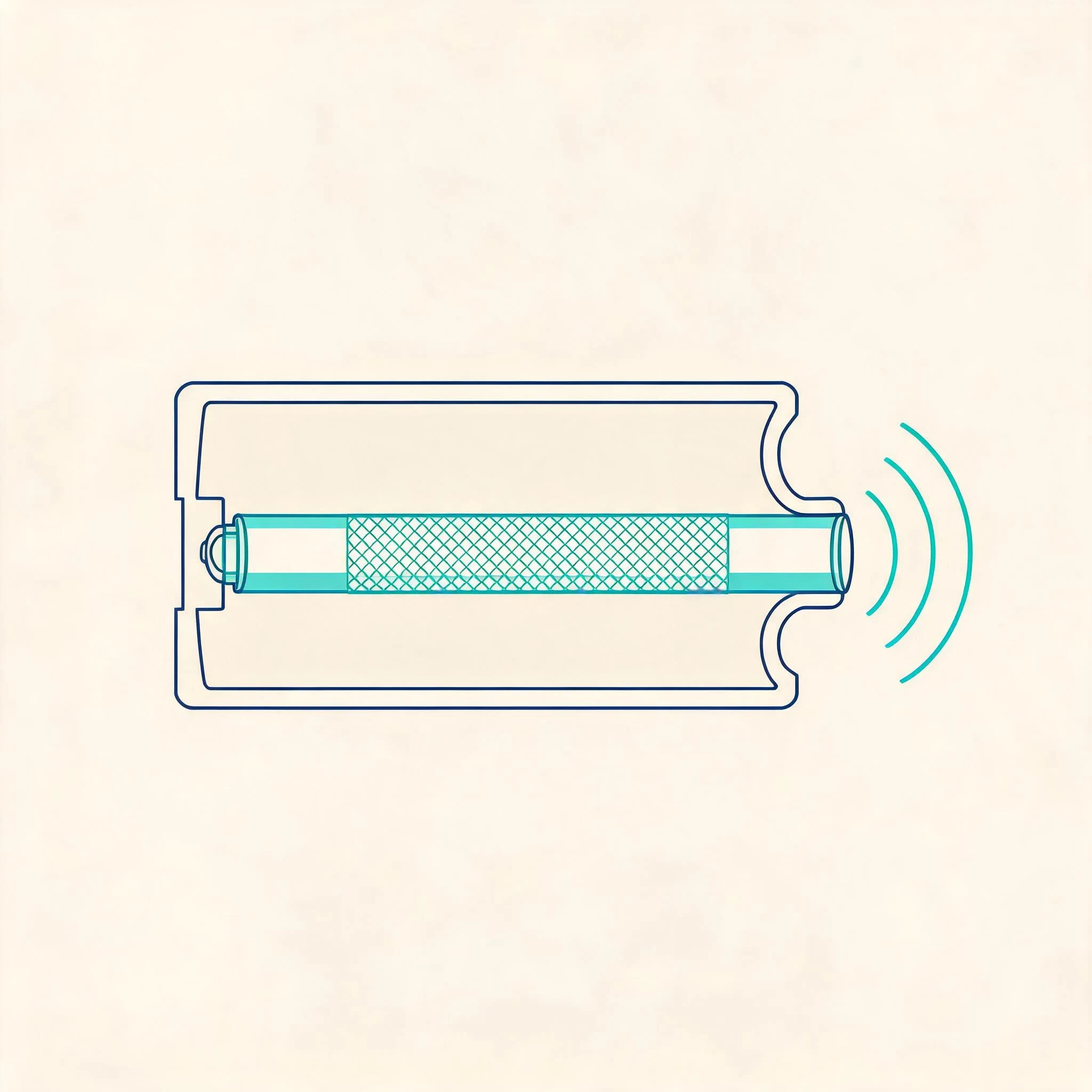
A silicone wall attenuates sound entering the microphone noticeably; the loss varies with wall thickness, hardness and covered area, and industry-typical figures run from a few dB to the low teens. The microphone cannot simply be glued into the body. It needs a deliberate acoustic channel: an opening placed away from hands and contact surfaces, as short as possible, covered with a dust mesh so lint and dust do not block it, while the unit still seals and looks right. Hole diameter, channel length and mesh fineness decide the wake-up rate.
Two related problems follow. Echo cancellation: the speaker and microphone share a soft shell, and structural resonance lets the device hear itself. Vibration isolation: a loud speaker disturbs the tap sensing described above, so the two input channels must be separated.
As a smart-home entry point, it needs three conditions
The nightstand is one of the few places in a home that combines a fixed position, all-night power and a clear scenario — night trips, soothing a child, bedtime reading, a last conversation. That is the real reason "bedside entry point" is plausible rather than marketing.
But an entry point is not built by adding features. Three thresholds matter: stable wake-up rate (far field, with noise, through a duvet), low enough false wakes (woken once by its own speaker at 3 a.m., a user switches it off for good), and basic function without the cloud (a lamp must not depend on Wi-Fi). One non-technical condition sits on top: privacy has to be explainable — a physical microphone switch, a recording indicator and a data-retention policy. Miss one and it does not belong in a bedroom.
That is also why we stay restrained on this front: the body and structure are our strength, while voice capability depends on the voice module and cloud service chosen for the project. Externally we therefore describe only "AI conversation with voice interaction", and the feature list is confirmed in writing at the solution stage rather than assumed on this page.
8. From tool to shipment: five gates that must not be skipped
| Stage | Key control | How it is verified |
|---|---|---|
| Tool development | Parting line, gate, venting, shrinkage compensation | Trial first-off, sectioning and dimensional inspection |
| Silicone moulding | Mould temperature and cure time, wall thickness, transmission uniformity, colour | First-off approval, patrol inspection, transmission reference samples |
| Electronics assembly | Solder reliability, cell assembly, sealing and routing | Functional test plus powered ageing |
| Unit calibration | Tap threshold, brightness steps, colour consistency | Per-unit calibration or batch sampling of the distribution |
| Reliability | Drop, charge cycles, heat ageing and yellowing, noise | Sampled per project agreement, with a report |
The gate most often skipped, and least worth skipping, is unit calibration. Wall-thickness and hardness tolerances are real; without calibration they are handed straight to the user's fingertips. Add this step and returns and poor reviews look different.
9. Trend: healthier materials, smarter function, and underrated base standardisation
Healthier materials is the clearest change of the past two years. Customers ask whether a child can use it, whether it can be wiped, whether it smells — not only what it costs. Low-odour, low-VOC, halogen-free and food-contact materials moved from a bonus to an entry requirement.
Smarter function moves from "lights up" to "understands". Voice is not there for show; it finishes the job of "not wanting to hunt for a switch at night". Real intelligence usually removes operations instead of adding buttons.
The most underrated change is base standardisation. For a brand, the base decides four things: whether the lamp stands stable, whether charging is convenient, whether base and body look like one product, and whether it can be sold as a set. Re-cutting a base tool for every lamp slows cost and lead time; conversely, one body platform with several bases covers desktop, bedside and gift-set channels with more SKUs and no new tooling each time.
Conclusion
The engineering content of a silicone tap light is not in one component but in five systems agreeing: the body decides how light looks and feels, the sensing route decides whether a tap registers, the driver decides whether the light is comfortable, the power design decides how long it can leave the socket, and the acoustic channel decides whether the AI actually hears. Skip any one and the user finds out. That is why it looks simple and is not.
Our position on this product is specific: we mould the silicone body and structural parts ourselves, hold a full family of bases (a wide range of styles and sizes, combined per channel), and offer an AI flagship on the same body platform with voice interaction. For how the product is built and how bases are matched, see our custom silicone manufacturing capability page.
Further reading: material property library, moulding, thin-wall silicone down to 0.2 mm, eight overmoulding failure modes and R&D and testing.