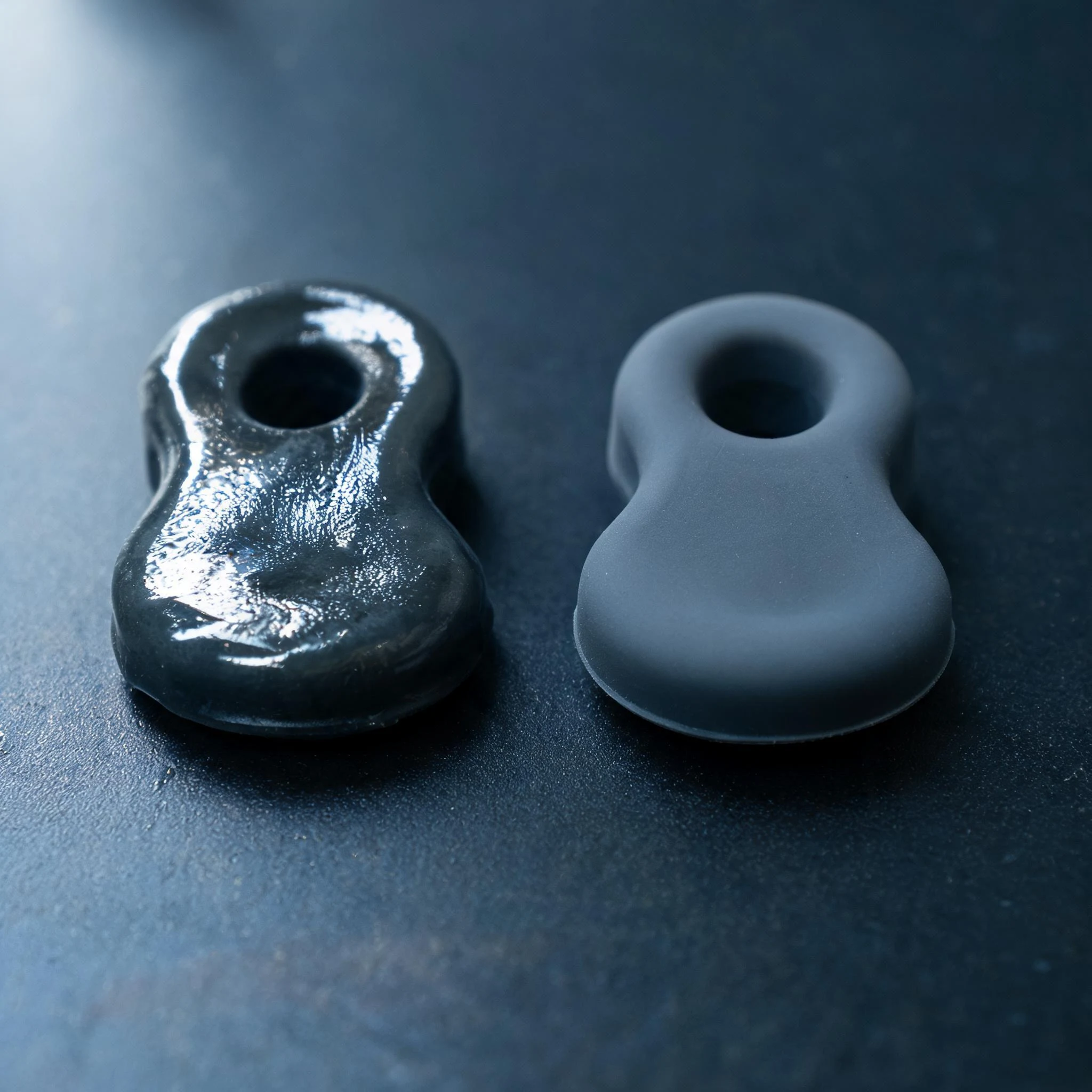
Some failures do not look like "it will not stick". They look like "this batch is tacky". The mould face stays glossy, a fingertip leaves a print, and wiping does not help. In bad cases the mixed compound is still liquid after half a day. The line blames expired compound, then unstable mould temperature, adjusts, swaps material, extends cure — and two weeks later the problem is still there.
This has a name: platinum catalyst poisoning. It has almost nothing to do with formulation, mould temperature or pressure, and everything to do with a more basic shop-floor question: what has touched this tooling, this mould, this substrate.
The full set of failure modes is covered in eight failure modes in silicone overmoulding; this note takes the most hidden one apart.
1. Why platinum is so easy to kill
Addition-cure LSR cures by hydrosilylation: vinyl groups and Si-H groups crosslink under a platinum complex. Platinum is not a reactant — it is the intermediary that brings the two sides together. The dose is tiny, but once it loses activity the chain reaction simply stops.
The problem is platinum's chemistry: it is extremely sensitive to lone pairs on foreign molecules. Sulphur, tin, nitrogen and phosphorus compounds form coordination bonds more stable than the vinyl bond, occupying the active centre. Platinum does not "recover slowly" afterwards — it stops catalysing. That is why this failure has no gradual stage, only "this batch is fine, that batch is not".
2. The poison list: sources matter more than chemistry
| Poison | Common source | Severity |
|---|---|---|
| Sulphur compounds | Sulphur-bearing release agents, vulcanised rubber parts, latex gloves, sulphur soap | Strongest; traces are enough |
| Organotin | Residue from condensation-cure RTV, shared tools | Destroys the catalytic cycle outright |
| Amines and amides | Epoxy curatives, some cleaners, excess amino silane | Large activity loss |
| Phosphorus compounds | Flame retardants, stabilisers | Poisoning |
| Heavy metals | Recycled material, non-compliant release agents | Complete deactivation |
| Flux residue | PCBA after wave or reflow soldering without washing | No cure locally, and the bond fails too |
| Polyols and solvents | Glycerine, glycol, some cleaners | Complexes with platinum |
| Sweat, skin care, smoke | Bare-hand handling, smoking in the shop | Local tackiness on contact faces |
The easiest thing to get wrong about this table: the poison is usually a consumable, not a raw material. What actually scraps a batch is often a pair of latex gloves, a sulphur-bearing release agent, or a dispensing unit that once ran condensation-cure silicone. In one shop, a single machine that has seen condensation-cure material is enough to scrap an entire batch of addition-cure LSR — this is the classic shop-wide accident of the process, not an exaggeration.
3. Why it gets misdiagnosed
Because all three of its symptoms point somewhere else:
- "Tacky in places" looks like low mould temperature. But temperature problems are batch-wide and positionally regular (worse near the cold runner); platinum poisoning tends to leave the contact face tacky while the bulk has cured, and the location follows who touched it.
- "This batch looks odd" looks like expired compound. A fresh cartridge often seems to fix it — but only because the new material has not yet met the contaminated tools. Two days later it returns.
- "One spot will not cure" looks like a mould problem. In practice the upstream item at that spot — a fixture, a backing plate, a glove — is carrying the poison.
One practical test: read the shift and tool-usage records for that batch. Platinum poisoning follows a person, a glove, a tray or a machine; it does not distribute evenly at random. Once the distribution has a pattern, stop adjusting parameters.
4. Six management measures, none of them a parameter
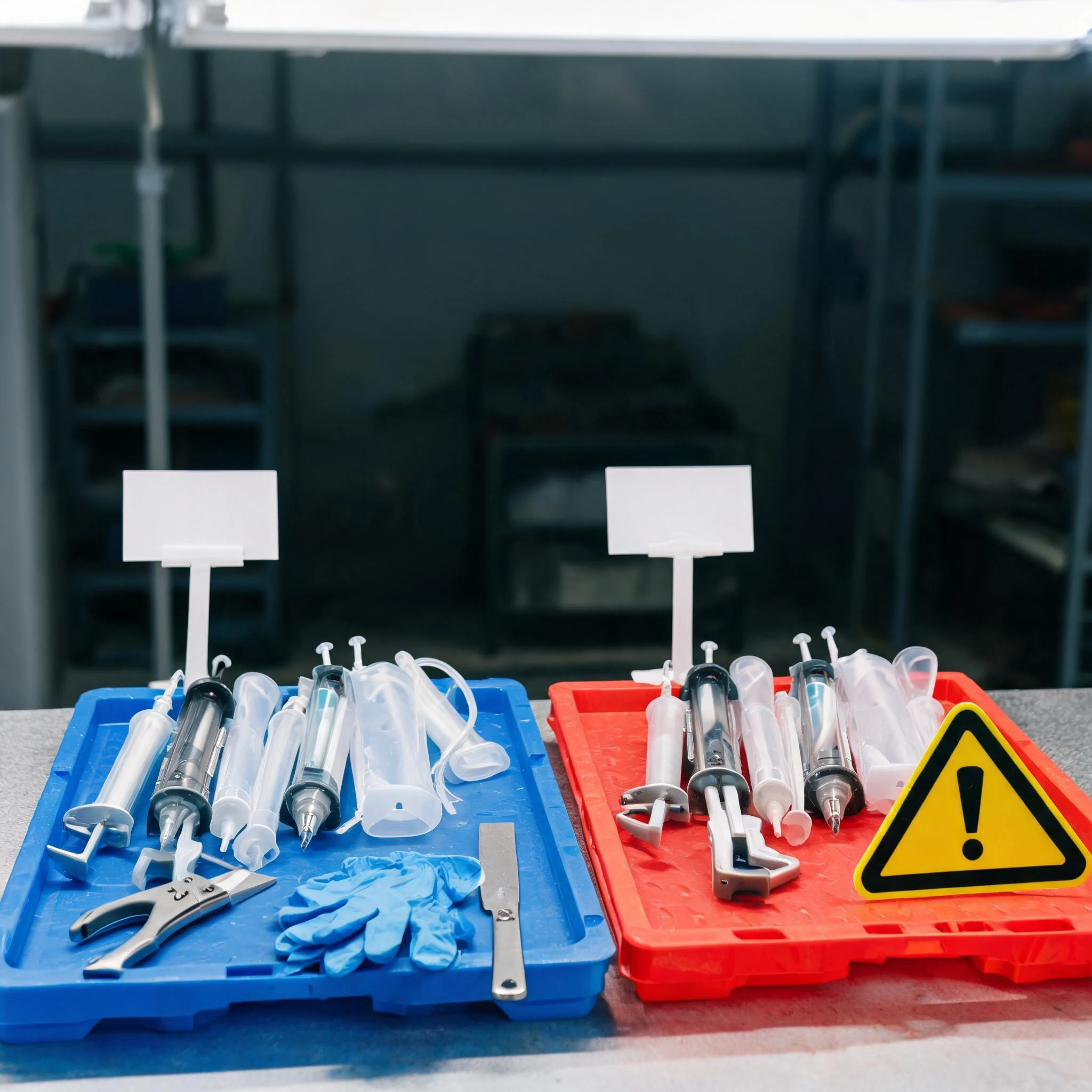
- Dedicated tools. Containers, spatulas, dispensing equipment and mixing heads must never be shared with condensation-cure systems. This single rule outweighs everything else on the list.
- Nitrile gloves only. Latex gloves and sulphur soap are the two most common sulphur sources in a shop; no bare-hand or latex contact with uncured compound or the surfaces to be bonded.
- Restrict the release agent. No sulphur or tin release agents in the tool; use platinum-safe release or silicone oil, and log the change interval.
- Always wash PCBA. Even with no-clean flux. Residue gets trapped between board and compound, which both weakens the bond and starts corrosion.
- Small-patch cure test on incoming material. Unknown substrates, new lots, a new supplier's cleaner: cure a small patch first and confirm it is not tacky before running.
- Maintain the ratio and the mixer. Calibrate metering pumps on schedule and replace static mixers on interval; a ratio error produces marbled compound that is hard in places and tacky in others — which also looks like poisoning.
5. One parameter boundary that is easy to miss
The Si-H to vinyl ratio is normally held at 1.2–2.0. Low means incomplete cure and a tacky surface; high leaves excess Si-H, which can generate hydrogen bubbles in humid conditions — that shows up as internal voids, not tackiness. So "a little more crosslinker for safety" is wrong in both directions; metering, not feel, decides the ratio.
6. Four questions to ask when you buy
- Are addition-cure tools fully segregated from condensation-cure? How is that proven — colour, area, records?
- Which release system is used in the tool, and when was it last changed?
- Is PCBA washed before overmoulding, by what process, and how is cleanliness verified?
- When "tacky in places" appears, how do you separate platinum poisoning from mould temperature and ratio errors?
The fourth question sorts suppliers quickly. Anyone who can explain the order — distribution first, then tools, then ratio — has paid for the lesson. Anyone who answers "try another compound" has not found the root cause yet.
Conclusion
Platinum poisoning deserves its own note because it states the nature of overmoulding most clearly: this is interface chemistry, and every consumable in the shop takes part in the reaction. It is entirely preventable, but not with tighter parameters — with the harder things: separate areas, separate colours, separate people, written records.
Further reading: the full failure list is in eight failure modes in silicone overmoulding; the preparation window is in plasma activation: a 30-minute bonding window; substrate and primer combinations are in the material and primer matrix; validation scope is in R&D and testing.