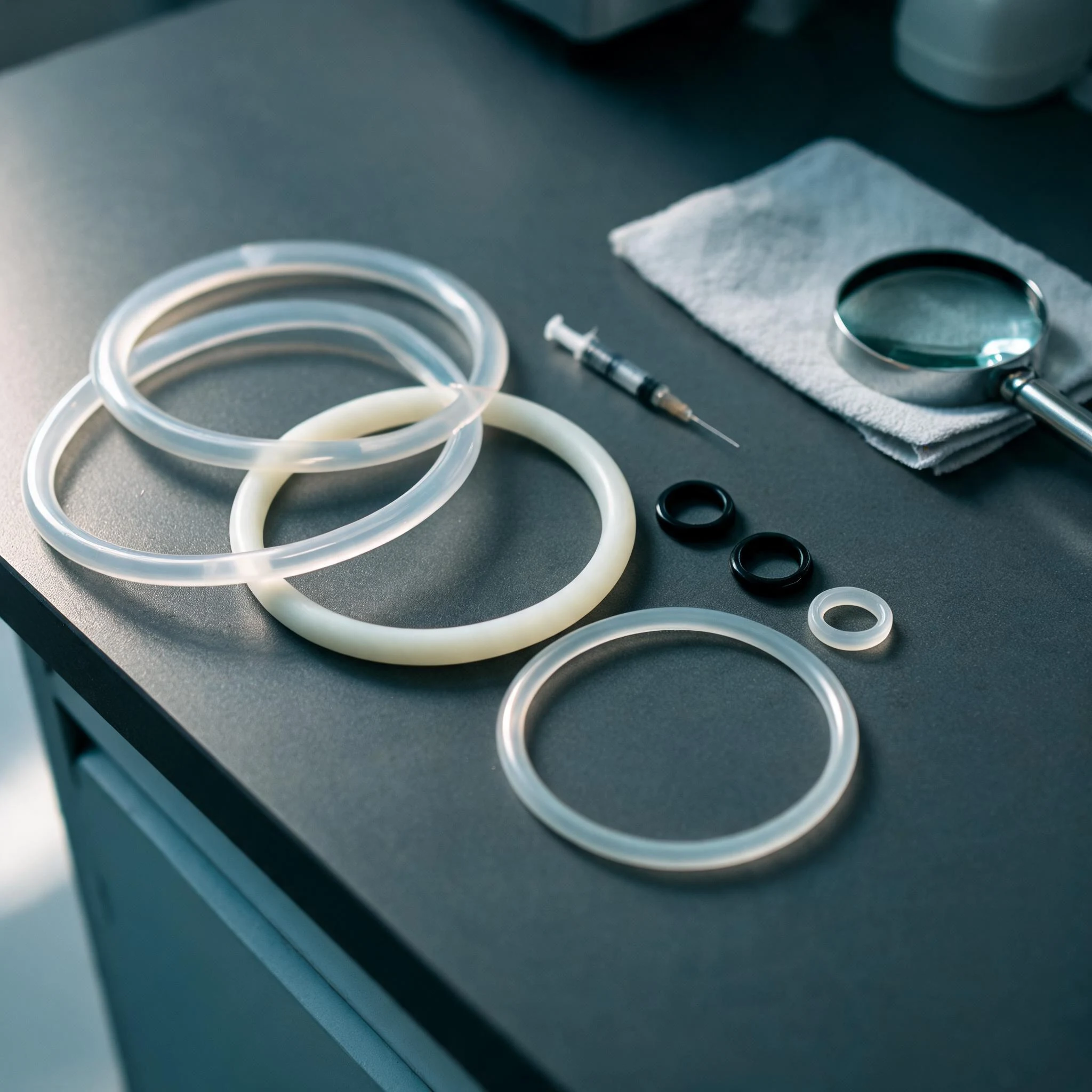
There is a step on the assembly line that looks trivial and is quietly expensive: spraying silicone oil onto seals, O-rings or pump tubing. It lowers assembly force, reduces rolled lips and nicks during assembly, and makes the part feel smoother. It also brings three side effects — spray amount depends on the operator, overspray contaminates nearby parts, and some customers state plainly that delivered parts must carry no free oil.
A class of material that appeared in the last two years targets exactly that step: self-lubricating silicone (oil-bleeding LSR). A lubricating phase is built into the compound and migrates slowly after cure, leaving a stable film on the surface. It sounds like "silicone with oil added", but the engineering difference is much larger than the wording.
1. How self-lubrication is made
The usual route is a controlled fraction of non-migrating or semi-migrating silicone oil pre-blended into the base, with reinforcing filler and a cure system that lets the oil phase migrate at a predictable rate. Three points decide whether it works:
- Migration rate: too fast and beads form on the surface and contaminate the contact face; too slow and assembly still drags. Controlled release is the core technical claim of these compounds.
- Compatibility with the base: the polarity of the oil phase has to match the silicone, otherwise you get bloom, whitening or uneven film (cure parameters matter too — moulding).
- Cure must not lock the oil in: at high crosslink density the migration path closes and the effect fades noticeably after a few weeks in storage.
So it is not "more oil in the recipe". It is a narrow window between crosslink density, oil content and filler system. Change the hardness or the colour and the window can close — which is why the material is still mostly used on a few high-value parts.
2. The real difference from spraying
| Item | Sprayed silicone oil | Self-lubricating LSR |
|---|---|---|
| Source of consistency | Spray volume, atomisation, operator | Compound batch and cure parameters |
| Lubrication life | One-off, lost during assembly | Continuous release, replenished over life |
| Surface residue | Visible free oil, can contaminate downstream | Thin film, lower but not zero |
| Assembly force | Lowest initially | Slightly higher than freshly sprayed, but steadier |
| Secondary steps | Spray, bake, masking | Spray and bake removed |
| Cleanliness and printing | Overspray affects printing, bonding, clean assembly | Still possible; release rate must be assessed |
| Cost | Cheap material, expensive labour and rework | Higher compound price, less labour and masking |
The two rows most often ignored are the last ones: self-lubricating does not mean clean. The oil phase still reaches the surface, just at a controlled rate. For parts that are printed, laser marked or bonded afterwards, the film can stop ink and adhesive just as effectively (see bonding to other materials).
3. Four places where it genuinely pays
1. Small O-rings and profiled seals
On automated lines a robot picks the ring and seats it in a groove; friction rolls the lip or nicks it. Self-lubricating parts hold assembly force inside a band and cut the early leaks that come from rolled lips. Medical and pneumatic assemblies are where this shows up most (properties library covers media and compression set).
2. Peristaltic pump tubing
Tubing is flattened and released thousands of times; wall friction drives flow pulsation and tube life. Self-lubricating compound lowers that friction (material selection compares tubing grades) — but the released oil enters the conveyed medium, so food, pharmaceutical and cell-culture use needs migration and compatibility work first.
3. Prefilled syringes and drug-contact parts
These are extremely sensitive to free silicone oil: proteins in the formulation can adsorb onto oil and aggregate. Self-lubricating compound offers a controlled release rate, but release still happens, so extraction, visible particulates and sub-visible particle testing against pharmacopoeial and customer methods are mandatory. A supplier's "low release" claim is not a test result.
4. Cosmetic pumps and valves
Pump pistons need smooth travel, fast return and no leakage. Self-lubricating silicone replaces spraying here and avoids overspray on visible parts.
4. Four cases not to convert
- Parts that are bonded or printed afterwards: the film reduces primer and ink adhesion unless cleaning or plasma activation is added;
- Optical and transparent cosmetic parts: the film creates haze and interference colour that appearance criteria reject;
- Long-term high temperature: heat accelerates migration, and the part can run dry and drag late in life;
- Customers requiring absolutely no free oil: zero release is not achievable; that requirement needs post-washing or a structure that lowers friction mechanically.
5. How to validate before switching
- Friction coefficient: against the real counter-face (metal, plastic, glass), dynamic and static — not the datasheet value;
- Release rate: extraction in the actual medium (water, ethanol, formulation, culture medium), measuring total organic carbon or silicon content;
- Repeated compression: simulate assembly and use, tracking compression set and friction decay;
- Sterilisation compatibility: EO, gamma and steam, then re-test release and mechanics — gamma changes crosslink density (test capability);
- Function after ageing: 4–8 weeks at elevated temperature, then assembly force, to confirm the dry-out point falls beyond product life;
- Downstream compatibility: printing, bonding, laser marking and clean assembly, each tested rather than assumed.
6. Six questions for selection
- Is the pain consistency or cost? Consistency justifies a material change; if it is only cost, spray parameters are quicker to fix;
- Will the surface be printed, bonded or laminated? Then run adhesion tests first;
- Is the contact medium a drug, food or purely mechanical? Any body-contact use starts with migration testing;
- Will the part see heat or radiation sterilisation in life? Then ask for post-sterilisation release data;
- What is the lowest acceptable assembly force? Self-lubricating parts usually start higher than freshly sprayed ones;
- Can the supplier state a release rate and a batch window? If the answer is only "self-lubricating", do not go straight to volume.
Conclusion
Self-lubricating silicone solves a specific problem: it replaces an operator-dependent spray step with a controlled release built into the material. It works on small seals, pump tubing and pump heads — but it is not "cleaner silicone". Release still happens; it is simply more controlled.
What decides the case is not the material name but three questions: can downstream processes tolerate the film, can the contact medium accept the release, and is friction still within spec at end of life.
If you are weighing self-lubricating compound against sprayed oil — or moving back because of release issues — send the structure, the medium and the sterilisation route, and we will start with a material and process feasibility check.