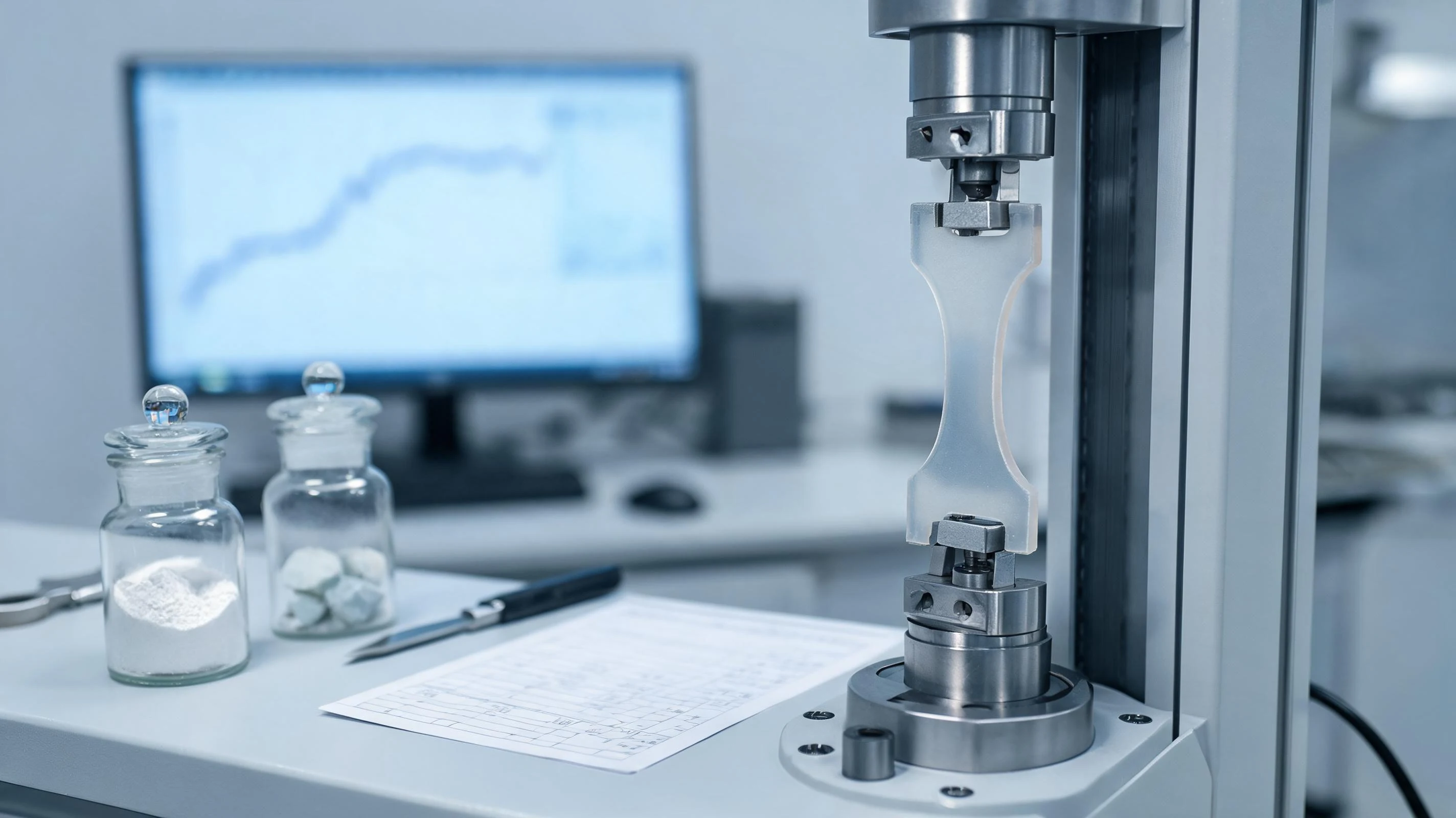
A typical enquiry: an overmoulded key pad, specified as low outgassing, Shore A 40, tear strength at least 12 kN/m, compression set at most 20% after 70 h at 90 degrees C, and UL94 V0. The usual response is to line up ten to twelve formulations, run three rounds of sampling, three to six weeks each. Material informatics does not produce a formulation out of thin air. It makes that round of elimination faster, smaller, and traceable.
1. Three different "AI" problems, often confused
What the industry calls AI formulation usually mixes three things: formulation screening, deciding which experiment to run next among dozens of variables; property prediction, estimating how a formulation will behave under a given condition; and process closure, using in-mould data and statistical models to turn setup experience into a parameter window. The data volume and the failure modes are different for each, and mixing them is how people conclude that "AI does not work".
2. Formulation screening: small samples are normal
Silicone formulation is expensive to test. One round of mixing, curing, cutting and testing takes most of a day, so a lab may produce a few hundred complete records a year. At that scale deep learning has no advantage; small-sample methods such as Bayesian optimisation and Gaussian processes fit better, because each experiment is used to choose the next rather than requiring a large model first.
What matters is how the objective is written. Translate the customer requirement into three to five measurable objectives (hardness, tear, compression set, volatiles, flame rating) plus constraints (cost ceiling, regulatory list, existing process window). That works far better than throwing a dozen metrics in at once, and clear constraints stop the model recommending a formulation that performs beautifully and cannot be moulded.
3. Test discipline is worth more than the model
This is the step most often skipped. If one dataset mixes different tensile machines, different cutting dies, different cure conditions and different rest times, the model learns the test difference rather than the material difference. A workable route is a data card: raw rubber Mooney, silica surface area and treatment, hydrogen content of the crosslinker, platinum concentration, inhibitor, cure curve T90, hardness, tear, compression set, volatiles - every field carrying its test conditions.
The value of that card is not in the algorithm. It is that R&D, quality and suppliers describe the same batch in the same language. Many plants discover at this point that half of the last three years of data is not comparable; align the method first, then talk about models.
4. Ageing prediction: good for ranking, not for release
Compression set and tear strength move with temperature and time, and accelerated ageing usually relies on a time-temperature superposition such as Arrhenius. A model can fit several temperatures from the same batch, estimate the trend at 90 or 100 degrees C, and rank a handful of candidates. It cannot take a few weeks at 150 degrees C and extrapolate to ten years: at higher temperature the side reactions may already have changed, and the extrapolated number means nothing.
So write the rule down: predictions rank, physical testing releases. Put the temperature ceiling for extrapolation into the internal standard, and keep sales from turning it into a lifetime promise.
5. Process closure: turning setup experience into a window
The link between cavity pressure and temperature curves on one side and appearance and dimensions on the other is the most valuable thing to digitise in silicone moulding. An experienced setter reads the curve shape and knows whether a defect is venting or a shift in compound flow. Recording those judgements as curve feature to corrective action, with a statistical model prompting, lets a new operator locate the problem in half an hour. Joined to in-line vision inspection, it moves from detecting defects to adjusting before they form.
The barrier here is not the algorithm; it is whether the curves are stored at all. Without historical curves there is nothing to train.
6. Three things that still block it
- Sample size: a few dozen records will not carry a complex model; run a proper DOE first, then use optimisation to pick the next point.
- Explainability and audits: the customer audit asks why this formulation meets 70 h at 90 degrees C. If the model cannot explain the mechanism, the answer has to come from compound structure and cure system.
- Raw material drift: Mooney, silica surface area and inhibitor batch differences make a model accurate offline and off-target on the line. It has to update with the batch, or nobody trusts it after two runs.
7. A 90-day route that is realistic
| Stage | What happens | Output |
|---|---|---|
| Weeks 1-2 | Clean historical data, align test methods | A usable data card and field dictionary |
| Weeks 3-6 | Add 12-20 DOE runs across the variable edges | An experiment table that shows trends |
| Weeks 7-10 | Use optimisation to select 2-3 candidates | Candidate list and validation plan |
| Weeks 11-13 | Accelerated ageing and a small production batch | Release data and process window |
In practice this usually cuts a dozen candidates to two or three and removes one or two sampling rounds, on the condition that the test method is aligned first. Otherwise the time saved comes back as rework.
8. Five questions buyers and design engineers can ask
- Is your formulation data measured to one method, and can we see the test conditions?
- Is the model used to rank, or to release?
- What is the temperature ceiling for extrapolation, and how is anything above it verified?
- Which indicators trigger re-validation when a raw material batch changes?
- When the model and the test disagree, which one decides?
Conclusion
Material informatics will not replace the formulation engineer. It replaces the time spent completing the elimination that is already known, and gives that time back to mechanism, interface and failure analysis. The real bottleneck is still test discipline and data governance; once those are in place, the algorithm starts to mean something.
Related: optical-grade LSR, thin-wall silicone limits, platinum poisoning, overmolding failure modes, and the material selection and R&D and testing pages.