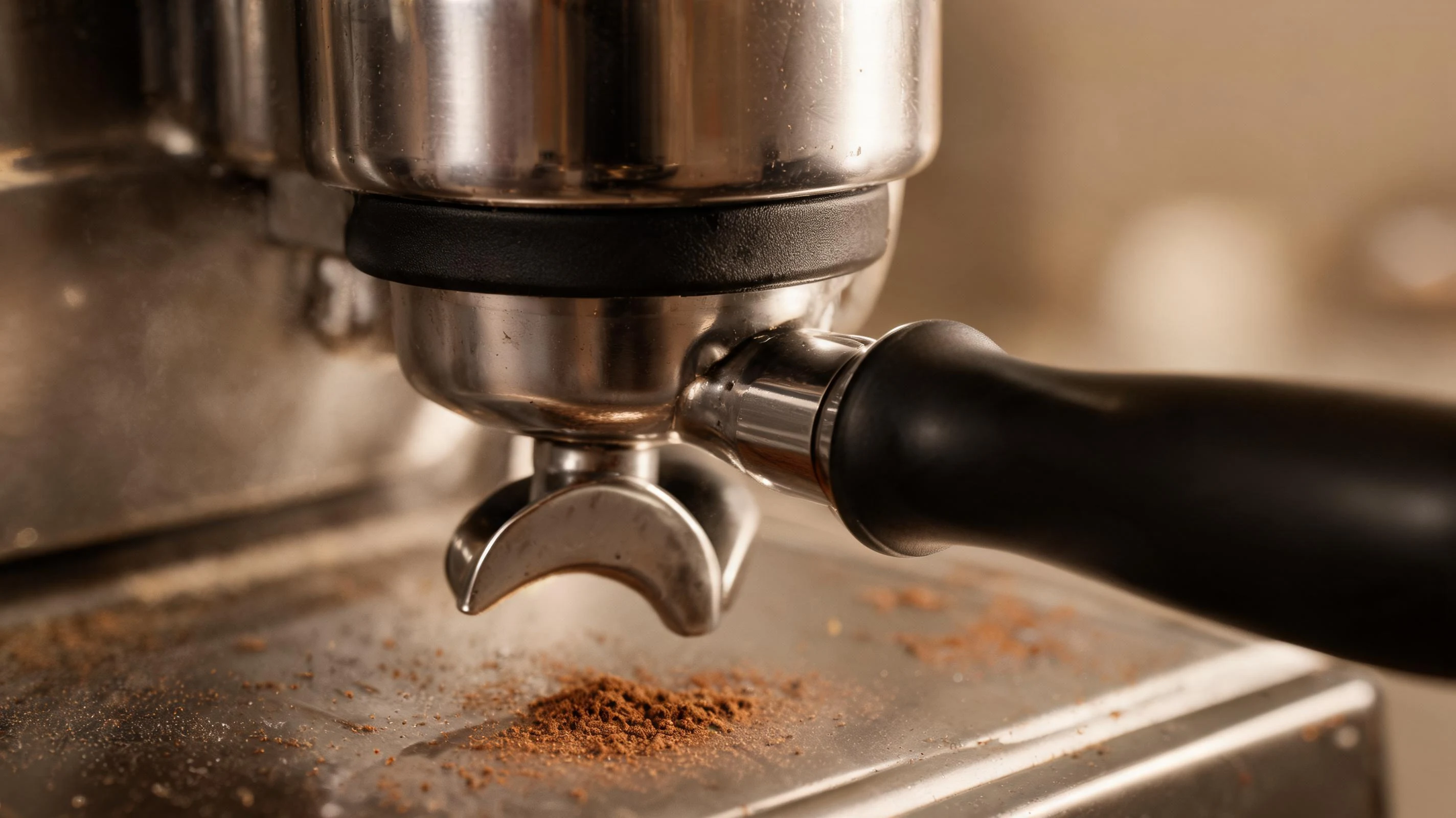
The previous note took apart a headlamp seal. This one moves closer to daily life: an espresso machine. The least visible part that most affects consistency is the black ring under the group head — the group gasket. It is compressed dozens of times a day by the portafilter, holds back water above 90 °C at 9 bar on one side, and sits in coffee oil on the other.
It is a good case because it puts silicone's strengths and weaknesses on the table at once: temperature range, food-contact safety and resilience on one side; oil resistance, alkali resistance and tear strength on the other. Buyers ask "how often do I change the gasket"; machine makers ask "why does it seep after three months" — the same question from two sides.
1. Four sealing positions
- Group head gasket: seated in the group's lower groove, compressed against the basket rim when the portafilter locks in. Water at 90–96 °C, extraction around 9 bar, one compression and one shear per lock-in.
- Steam valve and wand seals: commercial machines run 1–1.5 bar of steam with saturated temperatures above 120 °C; O-rings and stem seals sit in hot steam and take wear from frequent turning.
- Tank, pump and flow-meter ports: ambient water at low pressure, but permanently wet and often push-fit or clipped — easily nicked by sharp edges during assembly.
- Brew unit and puck path (automatic machines): complex mechanisms where seals follow moving parts and contact both grounds and rinse water.
The group gasket deserves its own discussion because it decides three things: whether water seeps at the portafilter rim, how the lock-in feels, and whether extraction pressure holds. When it hardens, the instinct is to lock the handle tighter — in reality the contact pressure is already uneven.
2. Four duty conditions, and heat is only one
- Heat and thermal cycling: from cold to 93 °C water dozens of times a day. The Si–O backbone keeps elasticity across a wide range, which is the main reason domestic machines use silicone.
- Pressure and compression: 9 bar pushes the gasket out of its groove; groove volume and hardness hold it. Every lock-in is another compression, and poor rebound means seepage.
- Coffee oil and milk fat: silicone's weakest point. Coffee oils and milk residue coat the surface and oxidise into a sticky film; part of it migrates into the surface layer, making the compound tacky, swollen and softer.
- Cleaning agents: alkaline backflush powder daily, citric acid descaling periodically. Acid is usually manageable; concentrated alkaline cleaner with long soaking is the quiet killer.
So the trade saying "silicone fears oil, not heat" holds here: temperature is not the bottleneck — oil and cleaning are.
3. Why domestic machines still use silicone
- Food-contact routes are established: food-grade silicone can be declared and migration-tested to GB 4806.11, FDA 21 CFR 177.2600, EU 10/2011 or LFGB; platinum cure leaves few by-products and low odour.
- Good rebound and compression set: sealing depends on contact pressure, and silicone returns after long compression — more valuable than tensile strength for a handle locked dozens of times a day.
- Wide temperature window: from refrigerated milk to hot water with one compound, fewer part numbers and fewer assembly errors.
- Colour and appearance control: transparent, natural or specified colours to distinguish positions and match the machine.
4. Three weaknesses: oil, alkali, tear
- Moderate oil and fat resistance: standard VMQ has limited tolerance for non-polar oils. Long exposure to coffee oil and milk fat changes volume, lowers hardness and leaves a tacky surface that collects soil. High-fat, long-life positions usually call for FKM or fluorosilicone (FVMQ).
- Weak against concentrated alkali and long steam exposure: strong alkali attacks the crosslink network, and under continuous high-pressure steam silicone hydrolyses faster than EPDM — which is why many commercial steam valves are not sealed with silicone.
- Low tear strength: thin lips, sharp corners and repeatedly disassembled clips tear first. The group gasket edge is scraped by the metal basket rim; once a nick appears, seepage starts there.
One practical note that is not a material defect: silicone attracts oil. The same gasket lasts a year on a machine that is backflushed regularly and three months on one that never is.
5. Material choice: four parameters beat a part number
- Hardness: group gaskets commonly Shore A 60–70. Softer seals better and locks easier but extrudes under pressure; harder resists extrusion and lasts longer but demands tighter groove tolerances.
- Cure system: platinum addition for mouth-contact positions — fewer by-products, lower odour and extraction; peroxide systems cost less but need thorough post-curing to avoid taste and fogging issues.
- Compression set: assess at the maximum service temperature, compression ratio and dwell. For thin gaskets under permanent load this matters more than hardness.
- Colour and grade consistency: food-grade compounds from different lots can differ in hardness and odour; keep the grade fixed and re-verify when it changes.
| Material | Role in an espresso machine | Strengths | Limits |
|---|---|---|---|
| Silicone VMQ (platinum) | Group gasket, water port seals, some steam seals | Wide temperature range, food contact, rebound, colour range, low odour | Moderate oil resistance, weak against concentrated alkali, low tear strength |
| EPDM | Steam-side seals, tubing, some static seals | Steam and hydrolysis resistance, low cost | Poor oil resistance, limited food grades and colours |
| FKM | High-fat, high-temperature positions | Best oil and chemical resistance, high temperature | Expensive, poor low-temperature flexibility, limited food-contact grades |
| FVMQ | Compromise where oil and cold both matter | Oil resistance with silicone-like cold flexibility | Higher cost than VMQ, lower tear than FKM |
6. Structure: where failures are planted
Groove depth and compression, the radius at the groove edge, the flatness of the basket rim and the concentricity of the group all decide whether the gasket survives. A sharp groove edge cuts the gasket as it compresses; an over-deep groove loses contact pressure; an under-sized groove volume extrudes the rubber and shortens life. None of that shows up in a material data sheet.
7. Three cheapest pieces of advice for users
- Backflush on schedule — removing coffee oil is the single biggest life extension, and it costs nothing.
- Use the cleaner at the specified concentration and contact time — stronger and longer is not cleaner, it is a shorter gasket life.
- Replace on interval, not on failure — a hardened gasket that still seals is already changing extraction pressure.
8. Checklist for machine designers and buyers
- Which positions see oil or milk fat continuously, and are they specified in VMQ or FVMQ/FKM?
- Is the recommended backflush chemistry and frequency written into the manual?
- Are hardness, compression ratio and groove fill calculated for 9 bar?
- Are groove edges and basket rim radii specified to avoid cutting the gasket?
- Does the food-contact declaration cover the compound and the cure system?
- Is the batch colour and hardness controlled, and re-verified on change?
- Is there a steam-side position where EPDM would outperform silicone — and is it specified that way?
- Does the validation include hot-water cycling, oil immersion and alkaline soak?
- Is the service interval based on cycles rather than on visible failure?
- Who owns the field complaint when a gasket seeps at three months — the material, the groove or the cleaning habit?
Conclusion
In an espresso machine, silicone earns its place on food contact, temperature range and rebound. It gives ground on oil, alkali and tear — which is why the group gasket is a consumable and why the steam side often belongs to EPDM or FKM.
If a machine seeps at three months, the answer is rarely a different compound: check the groove geometry, the alkaline cleaning regime and the oil film first.
Next in this series: another industry, another part. If you make appliances with hot-water or food-contact seals, send the structure, media and cleaning conditions and we will review material and groove together.