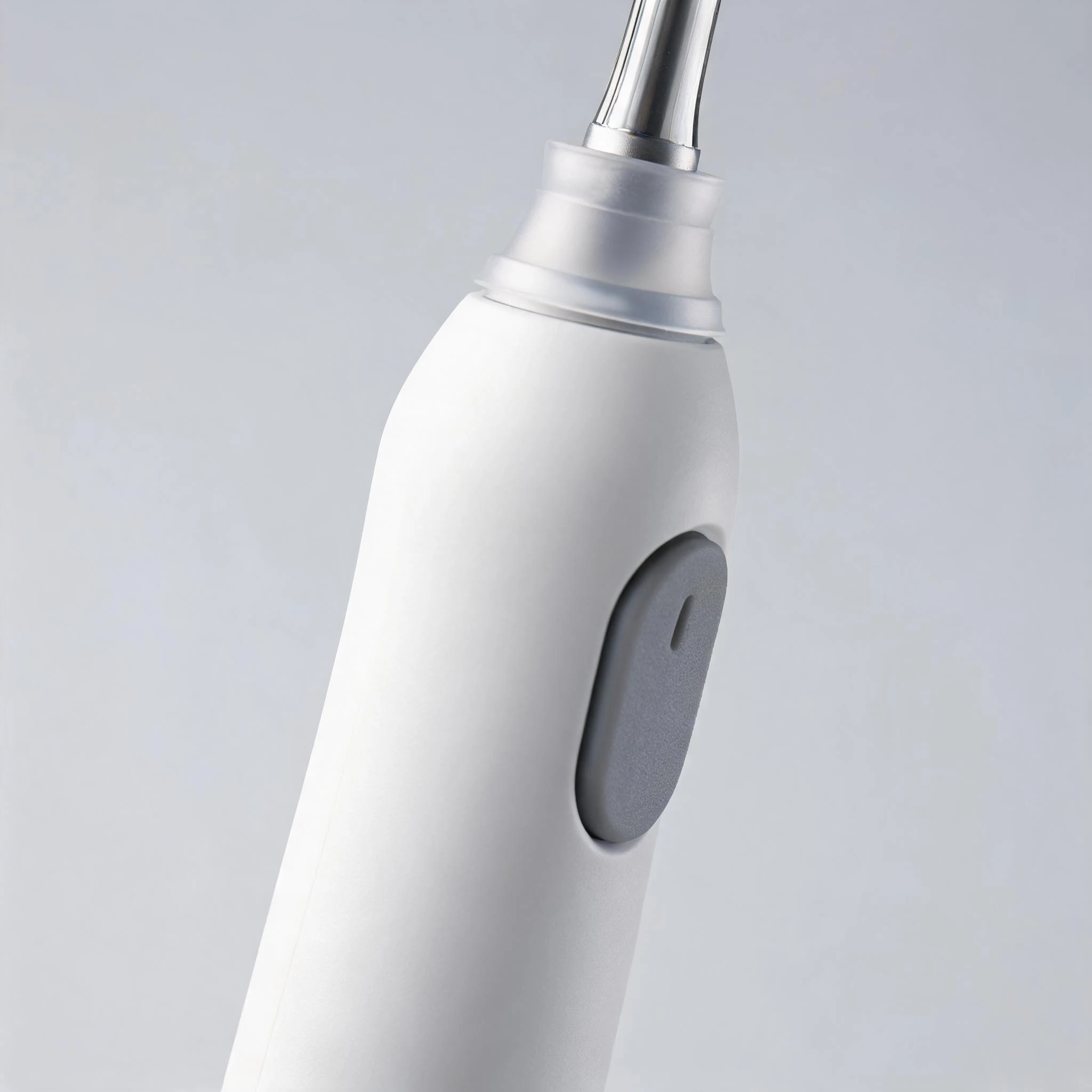
The first two notes in this series took apart a headlamp and an espresso machine — heat and oil, oil and alkali. This one moves to something picked up twice a day: a powered toothbrush. The duty becomes damp, room temperature and repeatedly loaded — the mildest on paper, the hardest in practice.
It is a typical personal-care appliance: the unit claims IPX7, users rinse it, leave it in a cup and store it in a bathroom cabinet that never fully dries, while inside there is a battery, a circuit board and a drive shaft reciprocating tens of thousands of times a minute through the housing. What allows all of that to coexist is a handful of unremarkable soft parts — the output-shaft seal at the top, the keypad on the side, and the charging-area seal at the base.
The point is a counter-intuitive one: why a unit rated IPX7 still takes on water within a year. The seal material is rarely the culprit; negative pressure, contamination and assembly usually are.
1. Four soft parts inside a handle
- Output-shaft seal (top): the critical one. A metal shaft passes through the top to drive the brush head and reciprocates at high frequency. The seal must ride a moving surface and still block water and foam running down from the head — usually a lip seal or a custom profile with a bushing and guide.
- Keypad (side): a silicone membrane bonded or overmoulded over the housing opening. It must flex under a finger and stay sealed through the full stroke; in effect it is a diaphragm that deforms thousands of times.
- Charging area (base): inductive models rely on an O-ring compressing the base cap; contact models also seal the pins, typically by overmoulding or local potting.
- Grip overmould: this layer is mostly not silicone but TPE or TPU over ABS/PC — see section 5, the point most often misread.
Of the four, the shaft seal and the keypad fail most often, because both move. Static sealing is not difficult; sealing while moving fifty thousand times a day is.
2. Why IPX7 fails: three paths nobody plans for
IPX7 means 30 minutes immersed at 1 m in still, clean water at room temperature, tested on a freshly built unit. Three things in real use are not covered.
Thermal breathing and negative pressure
Take the unit into a hot shower and the handle warms to around 40 °C; the air inside expands and pushes out through the weakest seal. Afterwards it cools, the internal volume contracts and creates negative pressure, drawing that moisture — now carrying foam — back in. Once a day, several hundred "breaths" a year.
That is why the usual symptom is condensation inside and a dead board rather than water pouring out: the water is sipped in, not poured in. Samples tested after thermal cycling and then immersed expose the problem far better than a room-temperature dunk.
The keypad is a pump
Pressing the keypad pushes a little air out of the housing and releasing draws a little back. If the membrane's bond line has a slight lift or the adhesive has aged, that breathing pumps moisture in — which is why units with whitened, lifting keypad edges are usually the first to fail.
Contamination on the user side
- Dried toothpaste in the gap between head and shaft hardens into an abrasive shell; every re-fit grinds it against the lip.
- Head re-fitted wet traps water against the shaft seal — the direct cause of odour and accelerated ageing.
- Cleaning habits: rinsing is fine; soaking in mouthwash or disinfectant, or rinsing above 60 °C, attacks both the rubber and the bond line.
3. Silicone's real opponent here: surfactants and soap scum
An espresso machine fears oil and alkali; a toothbrush fears surfactants. Foaming agents such as SLS, flavours, colourants and humectants in toothpaste, plus alcohol and essential oils in mouthwash, leave two effects:
- Tacky surfaces that collect soil: silicone is low-energy and oleophilic, so foam residue clings. The film does not break the seal, but it harbours bacteria, smells, and makes users scrub harder — pulling on the sealing face.
- The bond line fails first: the adhesive layer under a keypad or an overmould interface usually gives up before the silicone does. The rubber survives wet surfactant exposure; the adhesive does not.
One more item is regularly misattributed: black spots in the bathroom. Silicone does not grow mould, but soap scum and toothpaste sugars on a surface that stays wet for 48 hours do — and that is the complaint most often filed as "bad rubber".
4. Materials: why mouth-side parts stay silicone
- Wide temperature window: hot rinsing and cold shipping with one compound.
- Low compression set: sealing is about long-term contact pressure, and silicone keeps pressing after a year — more important than tensile strength here.
- Controlled odour and extraction: platinum-cure produces fewer by-products; with a proper post-cure, odour and volatiles stay low. Mouth-contact parts care about this.
- Colour and hardness range: seals in different colours for poka-yoke, translucent keys for light pipes.
Seals typically run Shore A 40–60 and keypads A 30–50, but hardness only makes sense together with compression ratio and groove geometry.
5. The counter-intuitive bit: the grip is usually TPE
A soft overmoulded grip is the standard appearance solution, but silicone would be difficult and expensive there: its low surface energy makes chemical bonding to ABS/PC unreliable, usually requiring primer, which hurts yield and cycle time. TPE/TPU bonds far more easily to polar plastics and gives a wider feel range with better abrasion and scratch resistance.
So the division of labour is: large grips in TPE/TPU over moulded plastic, sealing and mouth-contact parts in silicone. That is not cost-cutting; it puts each material where it performs.
| Material | Typical role | Strengths | Limits |
|---|---|---|---|
| Silicone VMQ (platinum cure) | Shaft seal, keypad membrane, charge O-ring | Wide temperature range, low compression set, low odour, mouth-safe grades | Needs primer for plastic bonding, moderate tear strength, higher unit cost |
| TPE / TPU | Grip overmould, anti-slip ribs | Bonds to ABS/PC, tunable feel, abrasion and scratch resistance, low cost | Poor long-term compression set, low heat resistance, unsuitable for sustained seals |
| EPDM | Some tube ports and base seals | Water and steam resistance, low cost | Poor oil resistance, limited colours, needs specific grades for mouth contact |
| FKM | Rare positions needing alcohol or essential-oil resistance | Excellent oil and solvent resistance, high temperature | Expensive, poor low-temperature flexibility, hard to colour |
6. Structure: five points that decide sealing
- Compression ratio: static O-rings usually run 15–30%. Too little and it leaks; too much and the part takes a permanent set within a year.
- Groove fill: rubber is incompressible in volume; insufficient groove space pushes material onto parting lines and assembly faces and raises assembly force.
- Lip orientation: the shaft lip must face the water side so internal pressure helps it close; reversed, negative pressure lifts it.
- Parting-line position: never on a sealing face — a few hundredths of flash is a capillary channel.
- Do not coat the sealing face: a feel coating or cosmetic layer on the lip or bond area changes friction and adhesion and makes sealing worse.
Keypads add two specific points: bond-line width and flatness, and the radius at the opening edge — a sharp edge cuts a crack into the membrane after tens of thousands of presses.
7. Failure map
| Symptom | Usual cause | Direction |
|---|---|---|
| Condensation inside, corroded board | Thermal breathing, wrong lip orientation or low compression | Test after thermal cycling; check lip direction and compression, add shaft guide |
| Keypad dead, ghost presses | Water under the membrane, lifting bond line, force decay | Wider bond area with radius, overmould the keypad, add press-fatigue testing |
| Whitened, lifting keypad edge | Adhesive not humidity-resistant, surfactant attack, pre-stretch at assembly | Change adhesive system, avoid pre-stretch, state cleaning limits |
| Water at the shaft, head wobble | Lip wear, dried toothpaste abrasion, oversized clearance | Higher tear grade, add a dust lip, add a water-deflecting step |
| Grip peeling | TPE-to-housing bond failure, cleaning agent ingress | Check material pairing and mould temperature, add an interfacial step |
| Darkening at the head base | Wet storage plus soap scum, not mould in the rubber | Remove water traps structurally; instruct users to shake dry and store apart |
| Contact pins corroded | Weak seal where pins pass through, water pooling at the base | Overmould or pot the pins, add a drainage channel |
8. How to test it properly
- Immersion to IPX7, plus a thermal-cycling-then-immersion run, which is the real scenario.
- Press fatigue: tens of thousands of strokes, then check sealing — not on a new sample.
- Media soak: toothpaste slurry, mouthwash, 75% alcohol and bathroom cleaner, recording appearance and hardness.
- Compression set at the maximum use temperature and compression; this predicts year-two performance.
- Odour and migration to the food-contact regime the customer specifies (for example GB 4806.11) for mouth-side parts.
- Mould and appearance after hot-humid storage.
9. Checklist
- What is the IP target — IPX7 only, or must it hold after thermal cycling?
- Is the shaft seal dynamic or quasi-static? Frequency, stroke and runout?
- Shaft tolerance, surface finish, water-deflecting step and guide present?
- Is the keypad bonded or overmoulded? Bond width, radius, humidity-resistant adhesive?
- Charge area inductive or contact — and should the pins be overmoulded or potted?
- Are hardness, compression ratio and groove fill calculated?
- Is the grip TPE or silicone, and does the bond need primer?
- Who supplies compliance documents for odour and mouth contact?
- Are cleaning limits (temperature, soak time, disinfectants) in the manual?
- Does the validation plan include thermal cycling, press fatigue and media soak?
Conclusion
In a toothbrush, silicone does something specific: it holds the places that move, get wet and touch the mouth. It is temperature-stable, resilient and low-odour, with weaknesses in bonding and tear — so the sensible split gives the large cosmetic surface to TPE and keeps seals and mouth-contact parts in silicone.
And when an IPX7 unit still leaks, it is rarely the wrong compound: negative pressure, contamination and structural detail were left out of the calculation. Next time water appears, check the lip direction, the compression ratio and that ring of dried toothpaste first.
Next in the series: another industry, another part. If you have soft parts for personal-care appliances — toothbrushes, shavers, beauty devices — or you are stuck on ingress, odour or a dead keypad, send the structure, duty conditions and test requirements for a sealing review.