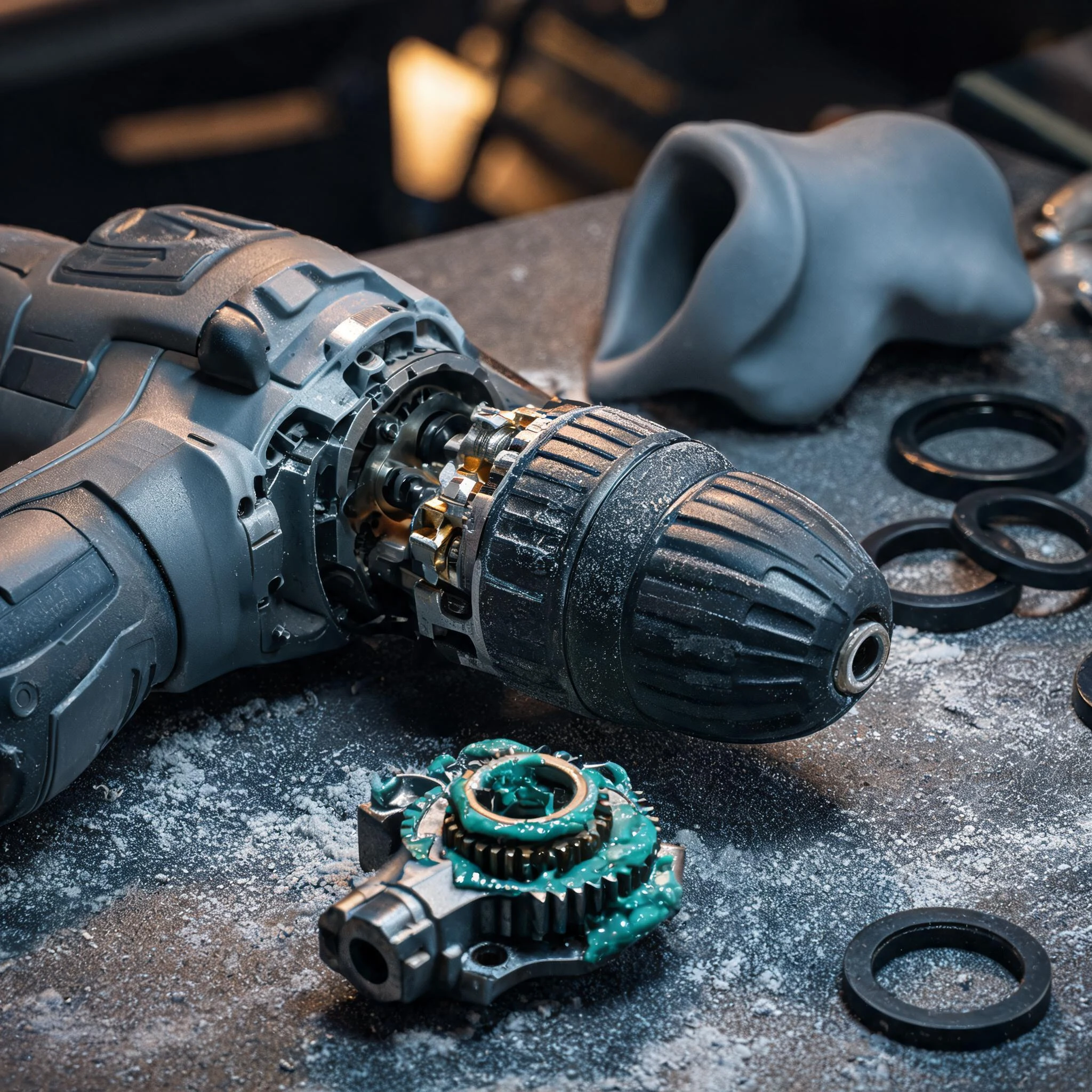
This series has taken apart a headlamp, an espresso machine and an electric toothbrush — heat and oil, oil and alkali, water and foam. This one moves to a job-site tool, the cordless drill, where the duty is different again: abrasive dust, vibration, gearbox grease, and a one-metre drop at any moment.
Power tools are an honest product category. Users do not read data sheets; they judge three things: whether it keeps drilling, whether it still turns after a drop, and whether it throws grease out of the chuck end after two years. All three usually come down to a few unremarkable soft parts.
The point of this note is a judgement that gets overlooked: seals in power tools mostly wear out rather than age out. If you chase it by specifying a more heat-resistant or more oil-resistant rubber, you often spend money and stay stuck. The fix is structural — keep the dust out first.
1. Five soft parts inside a cordless drill
- Trigger dust boot — the ring of soft rubber between the trigger and the housing, folded on every stroke. It blocks dust and also supplies the return feel. It is usually the first soft part to fail.
- Output-shaft lip seal — behind the chuck, where the shaft leaves the gearbox. Grease pushes out, dust pushes in.
- Battery interface seal — the gasket or O-ring between pack and tool, plus the overmoulded zone around the contact pins. Most frequently cycled, and the place dust settles.
- Motor damping pad — a soft pad for vibration and drop protection that often doubles as a dust barrier. Design it only as a damper and the gap becomes a dust channel.
- Grip overmould — usually TPE or TPU over PA (nylon) or PC/ABS, not silicone; see section 5.
Then the small openings people forget: hall-sensor wires through the housing, the LED window, the gear selector and, on some packs, the charge indicator. Individually minor; together they are the main dust entries.
2. The main enemy is dust, not temperature
Working temperature is modest: 60–80 °C at the gearbox under continuous load, a little higher near the motor — far gentler than an espresso boiler or a headlamp cavity. The real enemy is different.
- Dust is an abrasive, not just dirt. Concrete, block, tile, plasterboard and mortar break into hard mineral particles; quartz sits around Mohs 7, far above any rubber. They are not resting on the seal — they are pressed between seal and shaft and dragged.
- Fine enough to enter the gap. Particles of a few to a few tens of micrometres fit into the lip-to-shaft clearance. Ingress-protection tests use talc, which is far softer than site dust.
- Dust plus grease equals a grinding paste. Once a little dust passes the first barrier it mixes with gearbox grease into a toothpaste-like layer that laps the shaft journal. The seal is not corroded away; it is ground thinner and grooved.
Three more conditions run at the same time: sustained high-frequency vibration, drops from a bench or scaffold, sub-zero winter use, and a 60–70 °C car boot in summer. That combination is the real specification.
3. Why wear beats ageing here
To be fair to the material: silicone is a top performer on ageing — wide temperature window, good ozone, UV and hydrolysis resistance, which is why it survives outdoors. Its weakness is mechanical: tear strength and abrasion resistance sit mid-to-low among rubbers, typically 8–30 kN/m tear, below NBR and polyurethane.
Three mechanisms follow, all of them wear:
- The lip thins. A lip seal works through contact pressure along one line. Tens of micrometres of wear widen the contact band, pressure drops, grease weeps, dust enters, and the ring fails.
- Fretting. Vibration causes tiny, high-frequency relative slip between rubber and metal. The rubber surface turns to powder, the powder sticks in grease, and the assembly grinds itself.
- Dust ploughing. Grit trapped under the lip scores a ring into the shaft as it rotates. Once that groove exists, a new seal will not hold either.
Which is why a more temperature-resistant compound rarely helps: nothing resists abrasion by being more heat-stable. Check how the dust gets in, what the shaft surface looks like, and whether the lip was rolled during assembly.
4. The three spots that wear first
Trigger dust boot
Three recurring problems: not enough stroke allowance (the membrane straightens and the root sees shear), uneven wall thickness near the parting line, and grit wedged into the fold so every stroke grinds the same line. TPU or TPE usually suits this part better than silicone — folding fatigue and tear strength matter more here than heat.
Output-shaft lip seal
- Two lips: a main lip facing the grease and a dust lip facing out, with a small grease pocket between them. A single-lip design puts dust straight onto the sealing face.
- Lip orientation: the main lip should be helped shut by internal pressure; reversed, pressure lifts it.
- Shaft finish: too rough wears the lip, too smooth will not hold an oil film; the machining lay must be consistent, because a spiral lead pumps grease out.
- Concentricity: eccentricity loads one side of the lip and produces a one-sided wear mark within months.
Battery interface
Thousands of insertions permanently reduce gasket compression, and the interface usually faces down or sideways where dust collects. Practical measures: a wiper lip that scrapes dust on insertion, a profiled gasket with ridges instead of a flat pad, and overmoulding around the contact pins instead of relying on an O-ring alone.

5. Where silicone actually belongs
There are several soft parts in a power tool, and none of them is a case for "just use silicone":
- Silicone earns its place on sealing faces and damping pads: low compression set (it keeps pressing after a year), good low-temperature flexibility (TPE stiffens noticeably below zero), low odour, easy colour coding.
- Its weaknesses have to be designed around: modest tear and abrasion resistance — keep the dust out structurally; and swelling in mineral oil and lithium soap greases, which softens the part over time.
- Oil-facing positions change material: fluorosilicone (FVMQ) keeps oil resistance and low-temperature flexibility, a common choice for the output shaft; FKM where temperature is high as well; NBR where cost matters and low temperature is not critical.
- Boots and grips stay TPU/TPE: folding fatigue, tear strength and bonding to PA/PC are exactly silicone's weak spots.
| Material | Typical role in a tool | Strengths | Limits |
|---|---|---|---|
| Silicone VMQ | Damping pads, static gaskets, LED window seal, some boots | Wide temperature range, low compression set, flexible when cold, low odour | Modest tear and abrasion resistance, swells in mineral grease, needs primer for PA/PC bonding |
| Fluorosilicone FVMQ | Output-shaft lip seal, seals near the grease cavity | Oil and grease resistance while staying flexible when cold | Expensive, lower tear than NBR, limited colour options |
| NBR | Oil seals inside the gearbox | Good mineral-oil resistance, abrasion resistant, low cost | Poor ozone and weather resistance, stiffens when cold |
| FKM | Hot, grease-exposed positions | Best oil and chemical resistance, high temperature | Poor low-temperature elasticity, expensive, higher compression set |
| TPU | Trigger boot, sleeves, wear guards | Folding fatigue, tear strength, abrasion, fast cycles | Lower temperature ceiling, poor compression set, stiffens when cold |
| TPE overmould | Grip, anti-slip ribs | Bonds to PA/PC, tunable feel, low cost | Moderate abrasion and oil resistance, creeps under long load |
Figures are order-of-magnitude only; grade, filler and cure system change the outcome, so the supplier data sheet plus your own validation decide.
6. Structure beats compound
- Two lips and a grease pocket: main lip for grease, second lip for dust, grease between them.
- Labyrinth or slinger step: remove the straight-line path from outside to the lip. It costs almost nothing and usually beats a material change.
- Compression and groove fill: static seals commonly run 15–30% compression; insufficient groove volume pushes material onto parting lines and assembly faces.
- Assembly lead-in: a lip forced over a thread or keyway rolls over, and a rolled seal is already failed. Add a chamfer and use an assembly grease that does not swell the compound.
- Let the damping pad double as a wall: a lip formed on its outer edge seals against the housing and does two jobs in one part.
- Consolidate small openings: hall wires, LED window and selector on one overmoulded part means fewer through-holes.
7. Failure map: find the cause before changing material
| Symptom | Usual cause | Direction |
|---|---|---|
| Grease weeping behind the chuck | Lip wear, spiral machining lead, eccentricity | Two-lip design, define shaft finish and lay, stiffen the gearbox |
| Gearbox grease black and thick | Missing or rolled dust lip | Add a dust lip and a lead-in chamfer; inspect lips at assembly |
| Trigger stiff, slow return, root cracking | Insufficient stroke allowance, thin wall, grit in the fold | More convolutions, switch to TPU, add an external dust brow |
| Battery will not seat, poor contact | Dust build-up, gasket compression loss, worn pin seal | Downward-facing interface with a wiper lip, profiled gasket, overmould pins |
| Dust inside the housing, motor noise | Pad gap acting as a channel | Lip on the pad edge, consolidate through-holes |
| Grip lifting or peeling | TPE to PA/PC interface failure, wrong mould temperature | Check material pairing and mould temperature, add mechanical locks |
| Leaks only in cold weather | Glass transition too high, over-filled compound | Low-temperature grade, compression and rebound test at the lowest use temperature |
8. How to test it properly
- Dust test to the tool's IP rating — the entry ticket, not the finish line.
- Dust plus vibration — the most useful single test. Dust alone often passes; with a shaker running for tens of hours the lip wear and ingress appear quickly.
- Drop — several angles from 1–1.5 m, then repeat a dust or leak check; drop after cold soak to match winter sites.
- Low temperature — 4 hours at the lowest use temperature, then press and check compression rebound.
- Media soak — with the actual gearbox grease, 70 °C for 72 hours, recording volume swell, hardness change and tensile retention.
- Life cycles — tens of thousands of trigger strokes, shaft rotation with runout, thousands of battery insertions, then re-check sealing.
If you can, the most informative run is not a lab test: drill for half an hour on a real site, then open the tool and see which layer the dust reached.
9. Checklist for product and sourcing teams
- What IP target does the tool carry, and is combined dust-plus-vibration required?
- Which part blocks dust, which blocks grease, and is any part doing both on one set of assumptions?
- Single-lip or two-lip shaft seal? Are lip orientation, shaft roughness and lay direction on the drawing?
- What grease is used — mineral or synthetic — and will the silicone part sit in it long-term?
- Does the damping pad also act as a barrier, and is its gap a straight path into the housing?
- Was the boot's stroke allowance, wall thickness and material (silicone or TPU) calculated?
- Is the battery gasket a flat pad or a ridged profile, and how much compression remains after life cycles?
- Are there lead-in chamfers and a lip inspection step, and is the assembly grease compatible?
- Does the validation plan include dust plus vibration, cold drop and grease soak?
- If the tool sells into winter markets, who validates sealing at the lowest use temperature?
Conclusion
In power tools, silicone has one specific job: hold a reliable contact pressure in a vibrating, dirty, drop-prone environment. It is temperature-stable and resilient, but abrasion and tear are not its strengths and mineral grease swells it — so the industry gives grease-facing positions to FVMQ or NBR, boots to TPU, and keeps sealing faces and damping pads for silicone.
And when a tool starts weeping grease after two years, it is rarely the wrong compound: the dust had a route in from the start. Look for the second lip, the assembly roll-over, and the ring scored into the shaft.
Next in this series: another industry, another part. If you have soft parts for power tools, garden tools or cleaning appliances that see dust and vibration — or you are stuck on grease weep, ingress or an IP rating — send the structure, duty conditions and test requirements and we will start with a sealing review.