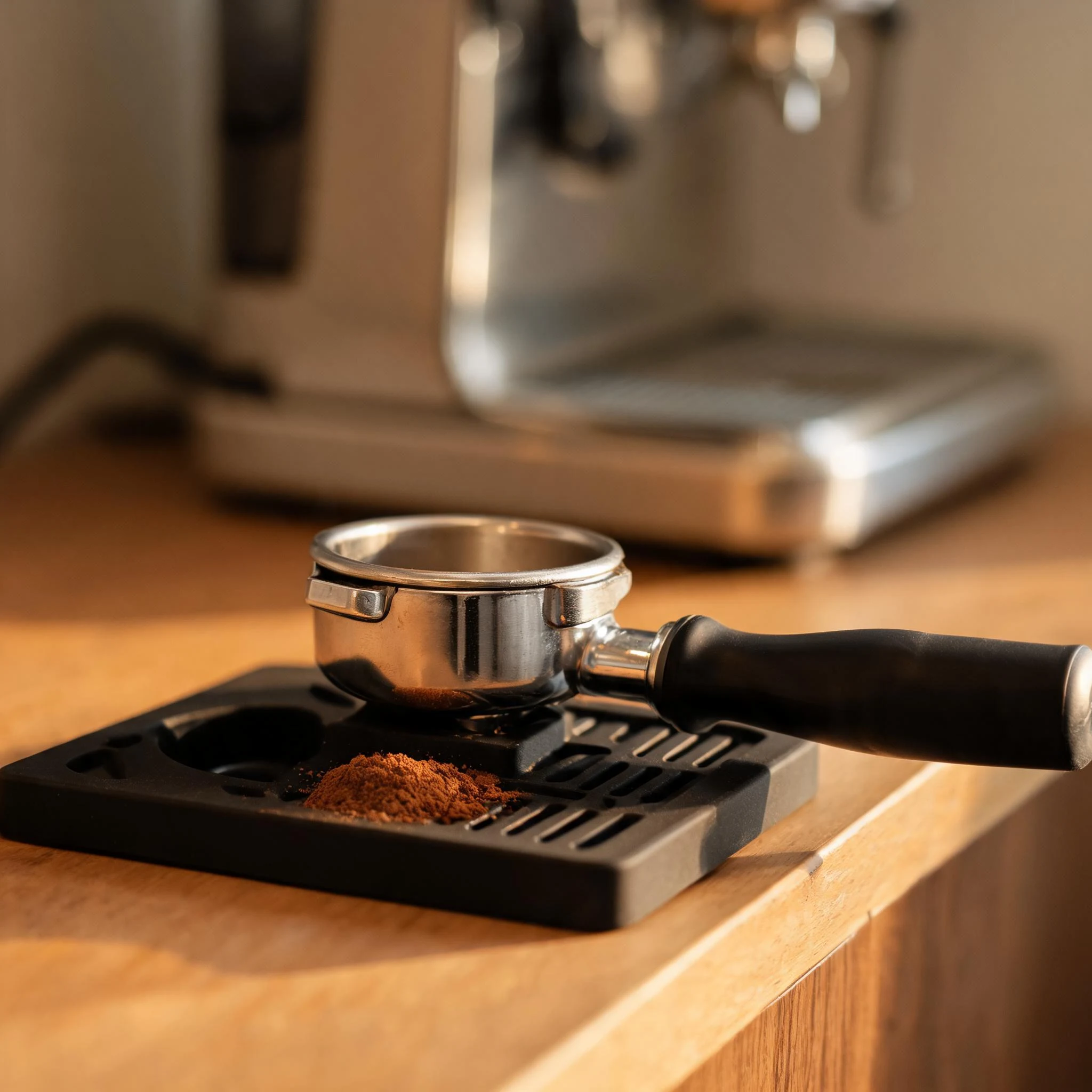
The black mat on the bar is the tool a barista touches most and discusses least. It takes a dozen kilos of force during tamping, holds the portafilter between shots, catches loose grounds, and is wiped with coffee liquid and cleaner all day.
It looks like a rubber mat. In fact it is a structural part that has to satisfy four functions at once - which is why more bars have moved from rubber to silicone. Not because it looks better, but because rubber comes up short on one of the four.
1. Four jobs in one mat
- Holding the portafilter: the basket sits in a cradle and must not rock, or the puck is compacted unevenly and the shot channelled.
- Gripping the counter: it has to hold a stainless surface with wet or dusty hands without walking.
- Absorbing the tamp: force passes through the handle into the mat, which protects both handle and counter without being so soft that it eats the force.
- Catching grounds: what falls during tamping and knocking out has to land on the mat, be easy to clean and not hold dirt.
The four fight each other: too soft and the handle rocks; too hard and the knock dents the handle; too smooth and wet hands slip; too deep a texture and it traps grounds. Material and structure have to be chosen together.
2. Why rubber, EPDM and EVA step back
Rubber mats served cafés for decades, with three recurring problems: the surface turns tacky and blackens as it absorbs coffee oil, so it looks worse the more it is wiped; residual curing agents and odour are a concern on a surface that meets food and drink; and the hardness is high enough that knocking the handle leaves marks. EPDM is better on weathering and water but looks and feels ordinary. EVA is light and cheap, but it dents after a few tamps and absorbs water so it never dries properly.
3. What silicone brings: rebound, a clean formula, wet grip
The advantage is not "softer" but three things holding at once: it recovers from compression instead of keeping a permanent dent; platinum-cured silicone contains no plasticiser, so odour is low and food-contact grades can be specified with a declaration; and friction drops less when hands are wet or dusty, so the mat stays put and the handle does not slide.
4. Softer is not better
Tamping force is commonly in the low tens of kilos, depending on basket diameter and habit, and it all lands on the cradle. Hardness and thickness decide two things: how stable the cradle is and how well the counter is protected.
The working range for silicone tamping mats is Shore A 40-60 and 4-8 mm thick. The soft end feels good and absorbs more, but the cradle distorts; the hard end is stable but can mark the handle. A fine matte or cloth texture holds better with wet hands, and a cradle curved to match the basket resists rocking far better than a plain square groove.
5. Structure: four details decide whether it works
- Cradle: a curve or chamfer deep enough to hold the basket without pinching; single and double baskets need separate sizes.
- Ground tray: a 3-5 mm raised rim makes a shallow tray, with radiused corners so a cloth cleans it in one pass.
- Two faces: fine matte on top for grip, shallow suction or texture underneath to hold the counter.
- Thickness transition: thicker at the cradle, thinner at the edge, so the handle is stable and the edge does not dig into the wrist.
6. Limits: oil, staining and steam
Silicone is not invincible here. Long soaking in coffee oil swells it slightly, and dark coffee stains can stay in the surface - that is staining, not ageing, and it is hard to remove completely, which is why dark mats stay presentable longer. Near the steam wand the local temperature is high, so the mat is not a heat pad; for continuous oil and heat, FKM or metal is still the answer.
| Material | Wet-hand grip | Coffee oil | Denting | Verdict for a tamping mat |
|---|---|---|---|---|
| Silicone | Good | Moderate, slight swell | Good | Fits; the most balanced |
| EPDM | Moderate | Good | Moderate | Usable; average look and odour |
| Nitrile rubber | Moderate to good | Very good | Moderate | Oil-resistant but stains and goes tacky |
| EVA | Moderate | Poor | Poor, dents easily | Not for frequent tamping |
| TPE | Moderate | Moderate | Moderate | Cheap substitute; deforms over time |
7. What else on the bar is silicone
More than expected: group head gaskets, steam valve seals, handle heat sleeves, drip tray pads, pitcher bases and hopper seals. Each has a different duty but the same selection logic - media and temperature first, then structure and cleaning. The failure logic of the group head gasket is in why espresso gaskets fear oil, not heat.
Conclusion
A tamping mat earns its place when four functions hold together: a stable cradle, grip with wet hands, rebound after the tamp, and a surface that wipes clean. When specifying one, give the handle model and basket size, the tamping force and habit, and the cleaning method and frequency - then hardness, thickness and texture can be chosen instead of a generic "food-grade silicone".
Related: properties library, R&D and testing for extraction and food-contact work, and the series notes on lab stoppers and silicone guitar picks.