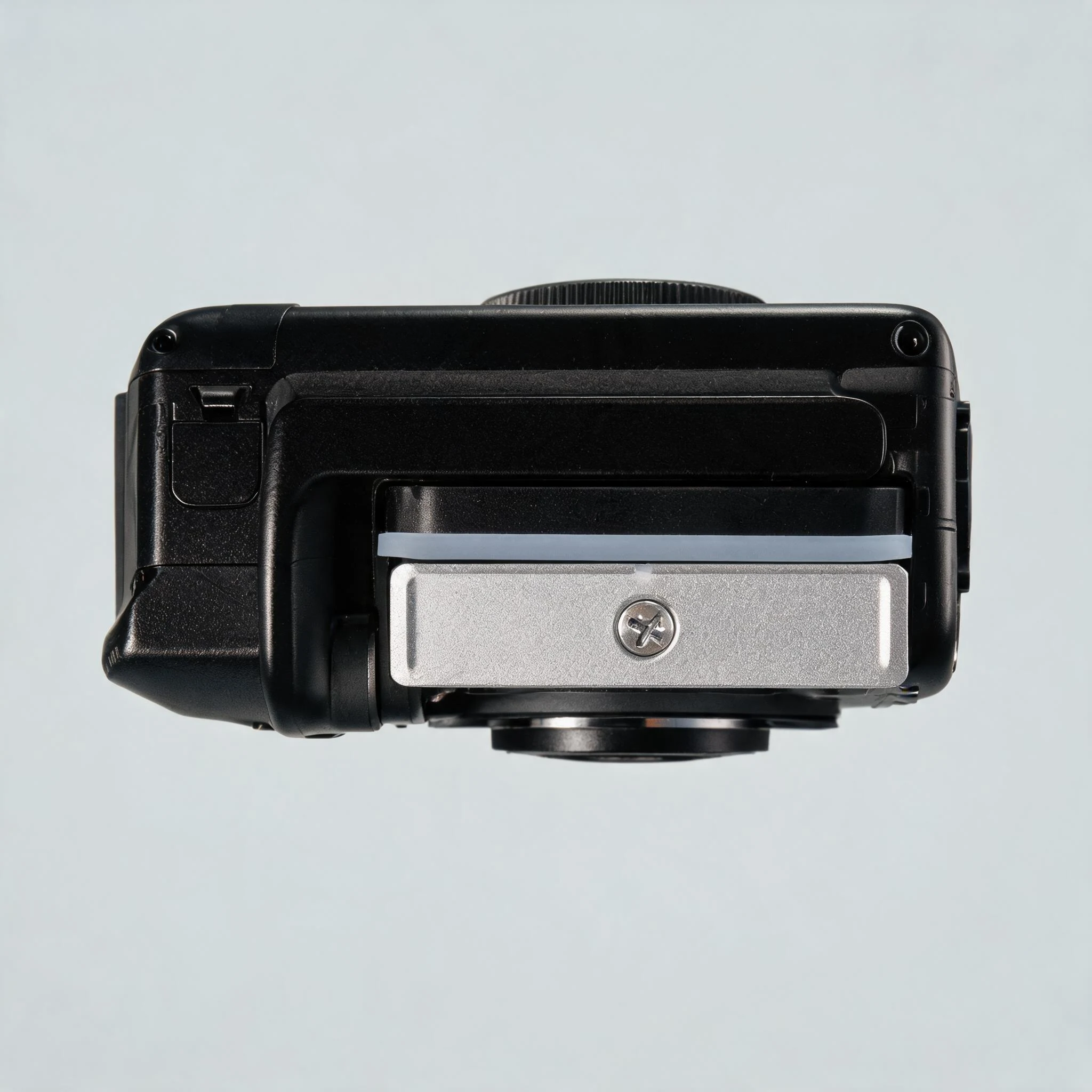
Photographers spend on lenses and gimbals, and rarely look at the pad under the camera: a one or two millimetre layer of soft rubber squeezed between the body and the metal plate. It usually comes free in the box and can be ignored for a year.
It is doing four jobs at once: stopping the plate from rotating, keeping the base paint intact, damping micro-movement during long exposures, and taking up the tolerance of a base that is not perfectly flat. Choose the wrong material or thickness and nothing happens immediately - until you shoot star trails on a mountain, get home, and find every star doubled.
1. Four jobs, none optional
- Anti-rotation. The plate is held by a single 1/4 inch screw. Metal on metal has little friction, so a plate that is not tight enough rotates the moment the ball head is released, and the framing shifts.
- Paint protection. The base of a camera is where paint wears first; a pad turns hard contact into soft contact, and the wear stops at the pad.
- Damping. Shutter and mirror shock travel through the plate into the head; the pad absorbs part of the high-frequency vibration.
- Flatness. A cast base is not perfectly flat and the paint has thickness; a soft pad takes up that error instead of letting four contact points become three plus a wobble.
Two of the four (anti-rotation, damping) rely on friction and elasticity; one (paint) relies on not migrating; one (flatness) relies on predictable compression. Those four requirements already narrow the material.
2. Rubber or silicone: six dimensions, no overall winner
Both materials are used, and silicone is not automatically the upgrade. The difference sits in six items.
| Dimension | Silicone (platinum cure) | Rubber / TPE | What it means for camera gear |
|---|---|---|---|
| Dry friction | High, commonly 0.8-1.2 against aluminium | Medium to high, varies with compound | Both stop rotation; silicone slightly ahead |
| Wet friction | Drops noticeably, water films spread | Also drops, some grades steadier | Rain, underwater and coastal work needs wet data |
| Low-temperature softness | Still soft around -50 C | Stiffens from -20 to -30 C | Winter field work: pads and feet both get slippery |
| Migration | No plasticiser, but low-molecular siloxanes | Plasticisers and antioxidants can bleed | Rubber marks paint; silicone can fog optics |
| Abrasion and tear | Weaker, fuzzed surface holds grit | Stronger | For feet, rubber lasts longer |
| Compression set | Good, D395 B commonly 20-25% or less | Moderate | A pad that does not recover loses clamp force |
In one sentence: rubber where abrasion dominates, silicone where weathering, low temperature and long-term compression matter, and a low-volatility grade anywhere near an optical surface.
3. Thickness and compression: thin slips, thick rocks
Below about 0.5 mm there is no margin to absorb flatness error and anti-rotation suffers. Above 3 mm the pad becomes an elastic layer after clamping: the plate looks locked but still moves a little, which shows up as trailing in long exposures and as nod when the ball head is loosened.
The usual range is 0.8-2 mm thick, 20-30% compression and Shore A 40-60: soft enough to conform, hard enough not to bottom out. Better pads add small bumps or grooves so friction is high at low compression while leaving room to compress. Keep thickness variation within about +/-0.1 mm, or every plate will feel different when tightened.
4. Not migrating is harder than friction
The hard part of paint protection is migration. Plasticisers and antioxidants in vulcanised rubber bleed into the paint over months, leaving a ring that will not wash off and, in bad cases, softening the coating. Silicone removes the plasticiser problem but brings its own: low-molecular cyclic siloxanes evaporate slowly, and a camera lying face down points its base at the mount and sensor, so a low-volatility grade plus post-curing matters.
So "soft is good" is the wrong instinct. The face against the paint and the face against the plate can be two different materials: a non-migrating silicone or a release film against the paint, a wear-resistant rubber against the metal.
5. One industry, four positions, four answers
- Quick-release pad: Shore A 40-60, 0.8-2 mm, low migration first; thickness tolerance tight.
- Tripod foot: a wear part, commonly Shore A 60-80; softer for wooden floors, harder for rock, silicone for cold.
- Housing O-ring: silicone wins on ozone, compression set and low temperature - and the grease must be the same family, or the ring goes tacky.
- Body skin and grip: feel first, textured for friction; the hard part is sweat and sunscreen, not water.
6. Five failures that really happen
- A fuzzed foot pad grips worse: the fuzz holds grit and acts like ball bearings. It is a wear part, not a softness upgrade.
- A pad too thick produces double stars in long exposures; the movement is invisible until the image is enlarged.
- A rubber pad marks the base: classic plasticiser migration, and wiping afterwards does not help once it is in the paint.
- Silicone near optics without a low-volatility grade fogs the rear element or sensor cover glass; it cannot be wiped off.
- Insect repellent and sunscreen make the skin tacky: DEET and some sunscreen actives swell both silicone and TPE.
7. Validation that is not theatre
- Friction: dry and wet, with the counter-surface named (aluminium, polycarbonate or painted surface).
- Migration: clamp the pad between white paper or a painted panel at 70 C for 24 h and look for an oil mark.
- Compression set: D395 B, with temperature, time and compression ratio reported.
- Low temperature: bend after -20 or -40 C, and compare friction for feet.
- Volatiles: TGA or GC-MS for anything near optics; "low odour" is not a number.
- Ageing: UV and salt spray outdoors, hardness and dimension after long immersion underwater.
Conclusion
The pad is fussy because it carries friction, protection, damping and tolerance compensation at once, and those four want different materials. The right answer is usually a combination, not "replace the whole pad with silicone".
The same habit applies to any small part: ask what it touches, how hard it is pressed and at what temperature and media, then talk material. Related notes: the barista tamping mat, lab bottle stoppers, and the properties library.