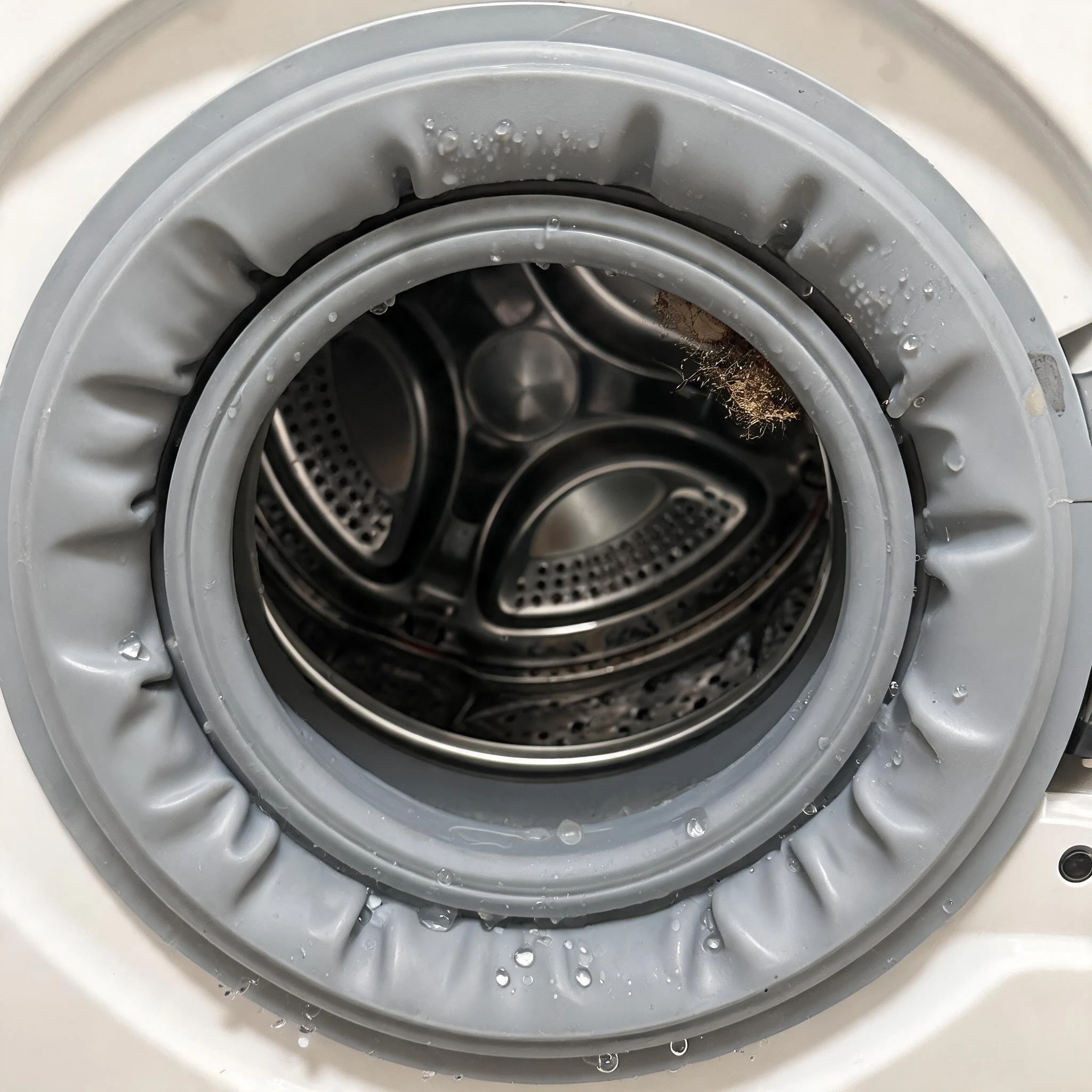
Open a front-loading washer and there it is: the pleated rubber ring around the door, a part everyone has seen and almost nobody has looked at properly. It seals against the glass at one end and the outer drum at the other, folds into two or three ribs so the door can open and close, absorbs movement, and guides condensation back into the drum.
It is also the place in the house most likely to grow mould. The black spots at the bottom of the fold do not wipe away and usually end with "replace the boot". Which raises an obvious question: if it were silicone, would the mould stop?
Short answer: silicone improves part of the problem and cures none of it. Mould feeds on soap residue, softener, skin oil and lint trapped in the fold, not on the rubber itself. The material decides how well the surface grows and cleans; it does not decide whether water sits there.
1. Four jobs in one soft ring
- Sealing: the outer lip presses on the glass, the inner lip on the drum mouth, and the space between forms a water seal during the wash.
- Draining: condensation and foam collect between door and drum; the slope and fold angles guide the water back inside.
- Isolation: at spin speed the drum moves relative to the door, and the soft ring takes up that movement instead of the glass.
- Blocking debris: lint, coins and hair clips stop in the fold rather than reaching the drum.
Those four jobs explain the shape: not a round cord but a ring with two or three ribs, a complex section and a wall that runs from about 1.5 mm to 3 mm. The same fold that makes it work is what holds the water.
2. Where mould comes from: four conditions at once
Mould needs water, nutrients, a suitable temperature and time - and the door boot supplies all four. Water sits at the bottom of the fold, and with the door shut after a wash it stays for days. Nutrients are detergent and softener residue (especially with overdosing), skin oil, conditioner and lint. The area around the drum stays warm, and the heat left after a 40-60 C wash is ideal. Time comes from two or three washes a week, each leaving a little water, until a year later there is a thick layer.
Two accomplices are usually missed. One is the drain hole: many boots have a small hole at the lowest point to return water to the drum, and when lint blocks it the water stays in the fold. The other is the microscopic surface: EPDM readily adsorbs surfactants and calcium soap, forming a slippery film that is itself a growth medium. The real problem is not "bad rubber" but a structure that leaves a permanently wet corner which is hard to reach.
3. EPDM versus silicone: who wins what
The mainstream material for door boots is EPDM, not silicone. That is a trade-off, not laziness.
| Item | EPDM | Silicone | TPE |
|---|---|---|---|
| Detergent and alkali resistance | Good, stable in soap solution | Moderate; long alkaline contact turns the surface tacky and swells it slightly | Moderate |
| Temperature | Commonly -40 to 100 C, short excursions to 90 C washes | -50 to 200 C, more headroom | Commonly -20 to 90 C |
| Low-temperature flexibility | Average, stiffens in cold | Good, stays soft | Fairly good |
| Odour and volatiles | Rubber smell, needs control | Low, low-odour grades available | Low |
| Tear strength in thin ribs | Good | Moderate; thin ribs need care | Moderate |
| Cost | Low; extrusion plus joint curing is efficient | High; large compression or LSR parts cost noticeably more | Low |
EPDM wins on detergent resistance, tear strength and cost; silicone wins on temperature, low-temperature softness and odour. For a 40-60 C wash and a cost-driven white-goods platform, EPDM is the sensible choice. Silicone is not an upgraded rubber; it is a different trade.
4. "Silicone will not grow mould" is a false promise
Mould needs water and soil. Silicone is more hydrophobic and absorbs less water, so it holds less, but water still collects in the fold. Leave the structure and the cleaning habit unchanged and the black spots return. Silver-ion antimicrobial silicone can inhibit growth on the surface, but it does not break down existing soap scum and it is not self-cleaning - say this plainly when a customer asks for an antimicrobial claim.
There are, however, three cases where silicone genuinely fits better: programmes above 90 C or with steam sterilisation, where the temperature headroom matters; unheated laundry rooms in cold climates, where EPDM stiffens and the door feels and seals worse; and baby or sensitive-skin machines, where odour and volatiles are held to a tighter standard.
5. If it is already mouldy
Surface mould can be cleaned with a dedicated cleaner soaked on and then wiped, with two cautions: chlorine bleach is unkind to both EPDM and silicone, and long high-concentration contact accelerates ageing and leaves the surface tacky; and everything must be rinsed and dried, or the residue becomes the next growth medium. If the black has gone into the material and remains after cleaning, it has stained through and the boot has to be replaced - preferably with the original part, because the boot is a shaped part matched to the door and drum mouth.
6. Five questions for appliance colleagues
- What is the highest wash temperature, and is there a steam programme? It sets the temperature floor for the material.
- Which detergents and softeners, and at what maximum dose? It sets the alkali and surfactant requirement.
- Where will the machine be used in winter - an unheated room?
- Does the boot need to be opened for cleaning, and is an antimicrobial claim required? A claim needs test and regulatory backing.
- Annual volume and tool amortisation: a large silicone compression tool has a completely different cost and cycle from EPDM extrusion plus joint curing.
Conclusion
Mould in a door boot is a structural problem mistaken for a material problem. Silicone brings better temperature resistance, low-temperature softness and lower odour, but it cannot cure standing water. Fix the fold angle, the drain hole and cleanability, add the habit of drying and leaving the door ajar, and the black spots become rarer. Whether to switch to silicone is answered by wash temperature, climate and odour requirements - not by which rubber is "better".
Related: seals in floor washers, why espresso gaskets fear oil, not heat, the properties library, and the product index.