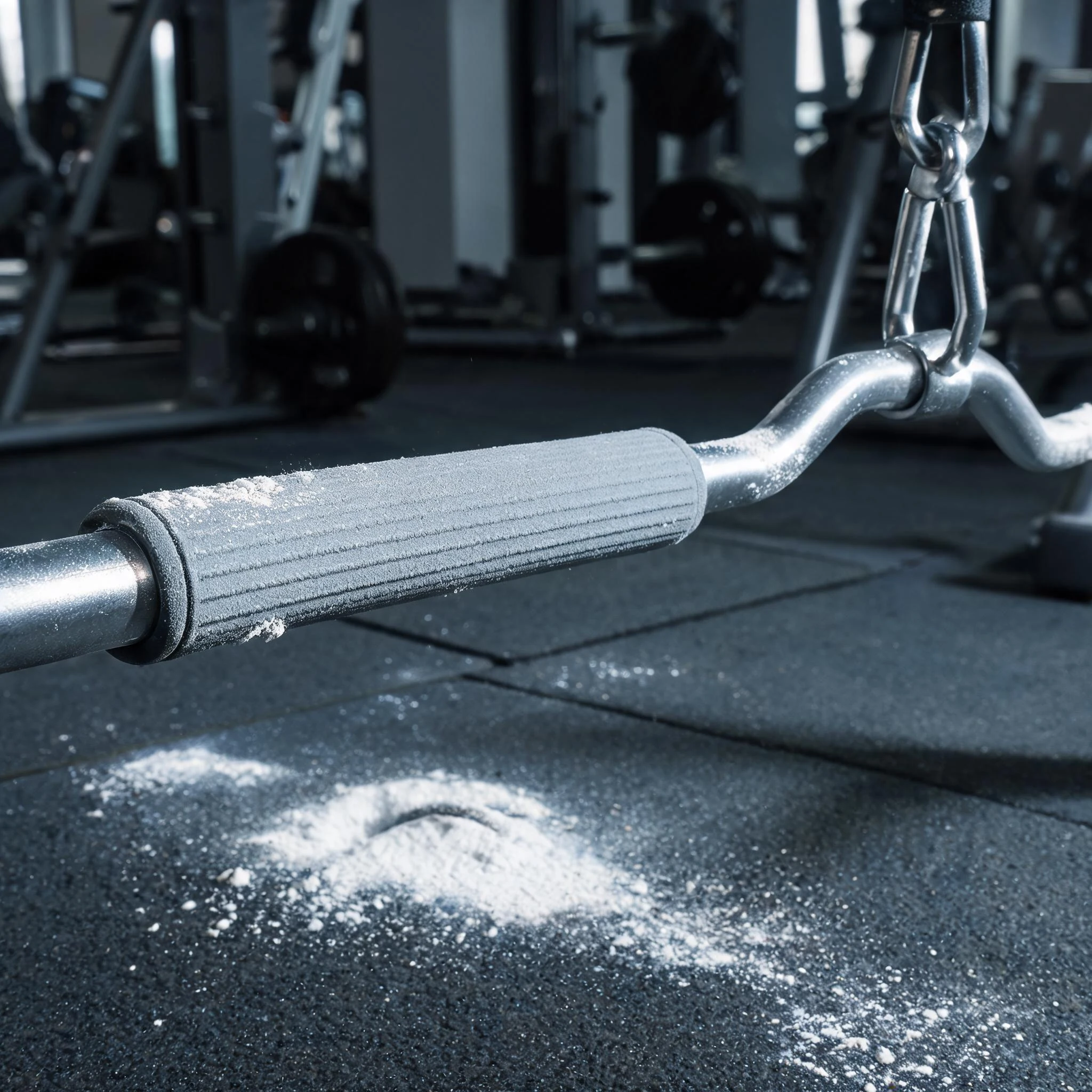
The least regarded part in a gym is the grip: a length of soft compound over a steel tube, or moulded straight onto it. Dozens of hands grab it every day, sweat soaks it, chalk coats it, and almost nobody looks at it closely.
In the last two years some equipment makers have moved from rubber grips to silicone, with the reason written as "more durable, easier to clean". The real reason is more specific: rubber grips get slicker with every session once sweat and chalk are in the surface. Silicone does not absorb chalk and can be washed - but silicone has its own failure mode, and it often arrives earlier.
1. Four jobs in one grip
- Grip: sweat, chalk and hand cream all sit between hand and bar; the grip has to hold friction at that interface.
- Damping: on lat pulldowns, rows and pull-ups the shock runs into wrist and forearm, and the soft layer has to absorb some of the high-frequency vibration.
- Hand protection: the base of the palm and the base of the fingers callus first; the surface must not sand the skin.
- Anti-rotation and retention: the grip must not rotate with the hand, and must not pull off under a heavy load. Both are structure, not material.
The four fight each other: too soft and it rotates, too hard and it abrades; too smooth and wet hands slip, too deep a texture and it packs with chalk and cannot be cleaned. A grip is never a material choice alone; compound, texture and structure are fixed together.
2. Sweat and chalk are harder than water
Sweat is not water: it carries salt, lactate, urea and sebum at pH 4.5-6.5, and dries to a tacky film. Chalk is mainly magnesium carbonate, fine and paste-like once damp. Together they build a layer of chalk, sweat and sebum on the grip that fills the texture flat.
That is exactly where rubber fails: higher surface energy plus plasticisers and antioxidants in the compound let chalk and sebum embed, so the grip blackens and slicks up, and wiping does not help because the layer is now inside the surface. Silicone is hydrophobic, does not absorb chalk, and warm water with neutral soap removes the film - that is the real advantage. The price is abrasion resistance: long rubbing against chalk fuzzes the surface, and a fuzzed surface is slicker than a clean one.
3. The material spectrum: silicone is not automatically better
| Material | Wet grip | Abrasion | Sweat and cleaning | Odour | Cost |
|---|---|---|---|---|---|
| Silicone (platinum cure) | Good, small drop when wet | Moderate, fuzzes over time | Good, washable | Low | High |
| TPE | Moderate | Moderate | Moderate, goes tacky | Low | Low |
| Natural rubber | High dry, drops fast wet | Good | Poor, absorbs chalk and oil | Noticeable | Low |
| PU coating | Moderate to high | Good | Moderate | Low | Medium |
| EVA foam | Moderate | Poor, compresses | Poor, absorbs water | Low | Low |
In one line: rubber or TPE where cost matters, hands are dry and grips are replaced often; silicone where sweat, washing and odour matter; PU where the wall must be thin and wear is severe. Silicone is a different trade, not an upgrade.
4. Structure is easier to get wrong than material
There are two ways to build it. A sleeve is a separate silicone tube held by interference fit: replaceable and cheap tooling. Overmoulding forms the silicone directly on the steel: better sealing and anti-rotation, but the steel needs blasting plus primer or a self-bonding LSR, and both tooling and process cost more.
- Wall 2-4 mm: thinner loses damping and feel, thicker rotates and fattens the grip.
- Quote the finished diameter: 28-34 mm including the compound is common; fix the grip diameter first, then work back to wall and tube.
- Anti-rotation comes from the inside: longitudinal ribs, diamond grooves or interference - friction alone will not lock it.
- Flange or collar at the ends: under heavy pulldowns the grip most often pulls off at the end.
- Bond interface: blasting plus primer or self-bonding LSR; sweat creeps in from the ends, which is where delamination starts.
- Texture: fine matte or shallow longitudinal grooves work best; deep diamond patterns look good, pack with chalk and never come clean in a commercial gym.
5. Hardness: picking a point in Shore A 40-60
Grips usually sit at Shore A 40-60. The soft end feels better and damps more, but deforms and rotates under load; the hard end is stable and wears well but abrades the hand, and calluses follow. Commercial and home equipment want different things: commercial goes harder, more wear-resistant and cleanable; home, women-focused and rehab equipment go softer for feel.
One grip can also be zoned: harder in the main grip area, softer at the ends and under the thumb. Zoning needs a transition zone, otherwise stress concentrates and the first crack appears right there.
6. Five failures that really happen
- Slicker every month: chalk and sebum form a film and fill the texture; wiping does not remove it, warm water and neutral soap does.
- Delamination at the end: sweat creeps under the flange into the bond line, and after a few months the sleeve twists loose - interface treatment missing, or primer dissolved by sweat.
- Cracking at the end: the stiffness step between grip and steel concentrates stress; add a radius, thicken the transition, or lengthen the flange.
- Loose and rotating: the sleeve bore was sized from the tube OD alone, without allowing for sweat lubrication and thermal expansion.
- Odour: rubber curing residue plus absorbed sweat, very obvious in a commercial gym; low-odour silicone grades clear this more easily.
7. Cleaning and validation: no silicone oil
Cleaning is simple: warm water, neutral soap, a soft brush for the chalk film, then air dry. Do not use silicone-based conditioners or leather care oils - they leave a low-friction film and the grip goes slick immediately, and it is hard to remove completely. Do not soak in chlorine-based disinfectant either; both silicone and rubber age faster.
| Check | How | What to look for |
|---|---|---|
| Wet friction | Wet with artificial sweat (or the customer formula), name the counter-surface | Drop against dry, and whether it is acceptable |
| Abrasion | Reciprocating rub or Taber, fixed cycles and load | Fuzzing, dusting, loss of texture depth |
| Adhesion | Pull-off and twist for sleeves; peel for overmoulded grips | Whether failure starts at the end |
| Sweat resistance | Hardness, dimension and appearance after artificial sweat | Swell, tackiness, colour change |
| Odour and volatiles | Odour rating or TGA to the customer method | Critical in enclosed commercial spaces |
8. Five questions before quoting or sampling
- Machine type and maximum load: pulldown, row, pull-up and assisted machines load a grip differently.
- Finished grip diameter and length: fix the diameter first, then wall and tube.
- Fixing method: replaceable sleeve or overmoulded, which decides tooling, cost and service.
- Environment: commercial (dozens of users a day, cleaning) or home (low frequency, feel first).
- Cleaning and disinfection: chlorine, alcohol or neutral soap decides compound and service life.
Conclusion
A grip balances medium, structure and friction: the material decides whether it fears sweat and chalk, the structure decides whether it rotates or pulls off, the texture decides whether it can be cleaned. Silicone solves chalk absorption and washing; it does not solve a lazy structure. Before a commercial gym swaps rubber for silicone, check the end flange, the internal anti-rotation and the bond interface.
One footnote: gym flooring is still rubber territory - it needs extreme abrasion resistance at low cost, and silicone is the wrong economics there. No material is better in the abstract; it is only right or wrong for the position.
Related: grip dots on textiles, self-lubricating LSR, skin contact on medical patches, and the properties library. Earlier in this series: the pad under a quick-release plate, the washer door seal and the barista tamping mat.