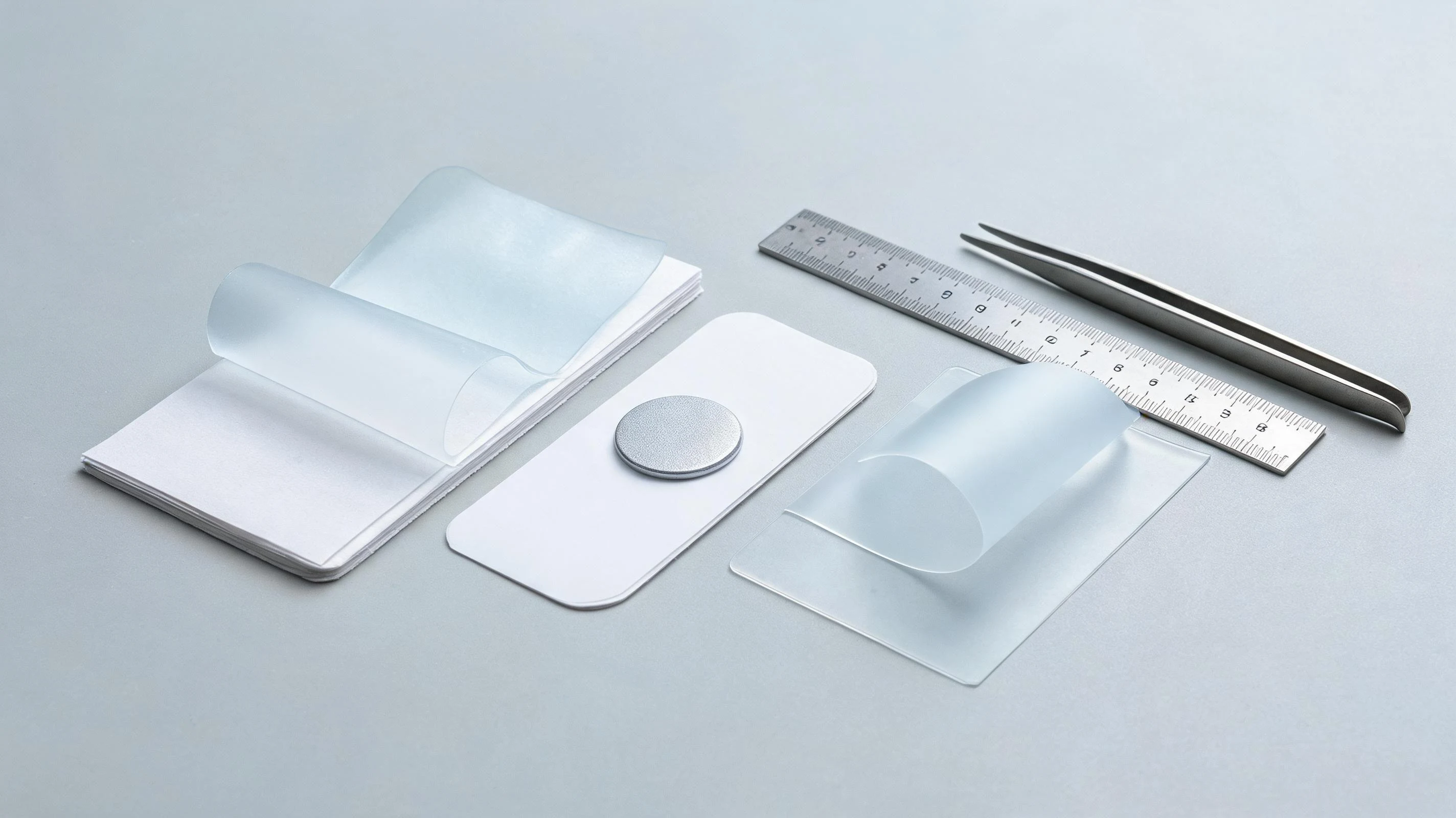
A skin-contact silicone patch looks like the simplest part in the catalogue: a film, an adhesive face, a release liner. The complaints almost never come from outgoing inspection. They come after six hours of wear — lifted edges, a red mark on removal, a patch that went stiff after sterilisation, wrinkles the moment it is applied to a curved surface.
None of those is a "bad silicone" problem. They come from four decisions: the wrong gel for the wear time, a thickness that does not match the body surface, a cure system that leaves extractables, and wear duration that was never treated as a design parameter. This note takes those four in order, then gives the compliance checklist and the failure list.
1. Four layers, not one sheet
Quoting a patch as "one piece of silicone" guarantees a rework at some layer. Each layer answers a different question, and each fails in its own way.
| Layer | Job | What goes wrong |
|---|---|---|
| Skin-contact gel | Soft, repositionable contact surface | Too tacky: painful removal, residue. Too soft: no hold, lifts as soon as the wearer moves |
| Carrier (film or sheet) | Handling, dimensional stability, die-cutting | Thickness scatter wrinkles on curved surfaces; low resilience lifts the edge |
| Functional layer | Conductive, sensing, opaque or carrier for an active | Poor bond to silicone; delamination after flexing |
| Release liner | Protects the contact face, positions for die-cutting | Wrong release force: adhesive pulls off with the liner, or the patch curls |
2. Fix the wear time before choosing the material
The most common disagreement in these projects is that engineering selects by hardness and purchasing selects by price, while the deciding question is how long it stays on and how often it is removed. The order should be: wear duration → repositionability → peel range → hardness and thickness.
| Material | Typical form | Where it fits |
|---|---|---|
| Silicone gel (soft skin adhesive) | Shore 00 range, peel force can be made very low | Hours to days of continuous wear, repositionable, removal without pain |
| Liquid silicone (LSR) | Shore A 10–40, thin walls and fine features | Thin carriers that need moulded features — channels, venting, locating ribs |
| Solid silicone (HCR) | Shore A 20–60, compression moulded sheet | Higher tear strength, die-cut sheets, patches integrated with a rigid part |
For the gel, hardness is not the key number — peel force against hold is. Low peel so removal does not hurt, enough hold to survive the wearer's movement. Test the pair; a single number tells you nothing.
3. 0.2–0.5 mm: moulding and laminating limits
The thinness of a patch is not the same requirement as a thin-walled structural part. Here it means uniform thickness across the sheet, no pinholes, and a die-cut edge that does not whiten.
- Thickness tolerance. On a 0.3 mm sheet, ±0.03 mm and ±0.1 mm are two different prices and two different conforming behaviours. Set the tolerance from the curvature of the surface, not from habit.
- Pinholes and inclusions. One pinhole in the contact layer is a fluid path. De-gassing and filtration matter more than press tonnage.
- Lamination tension. If gel and carrier are laminated at different tensions, a roll will wrinkle after two days and die-cut with a curled edge.
- Die-cutting. A dull blade and excessive pressure leave a crushed white edge — which becomes the starting point of a lifted edge in use.
General thin-wall limits (fill resistance, venting, tearing) are covered in Thin to 0.2 mm: limits of ultra-thin silicone.
4. Low allergen is a process, not a material
Almost every skin-contact patch asks for low allergenicity. That is not a compound property alone; it is the whole process. Platinum-cure addition systems avoid peroxide decomposition products, which is why they are the default for skin contact — at the cost of a catalyst that is very sensitive to sulphur, tin, amines and flux residue.
The shop-floor symptom is specific: most patches in a batch are fine, one area stays tacky, takes a fingerprint, and leaves a red mark after a few hours of wear. It gets written up as "adhesive not dry" when the cause is contamination sitting on the platinum centre — gloves, release agent, cleaner, a transfer tray.
Diagnose in order: distribution first, then tools, then parameters. Tacky patches concentrated in one position or one shift are not a temperature or ratio problem. The full checklist is in Platinum poisoning: when samples pass and batches stay tacky.
5. Compliance: ask what has to be submitted
Requirements follow the contact site and the duration. The same compound used for hours on intact skin and for days on a wound needs a different file.
| Item | Usual basis | What to settle |
|---|---|---|
| Biocompatibility | ISO 10993 series — cytotoxicity, sensitisation and irritation are the common starting set | Contact site and duration decide the subset; do not quote a blanket "full set" |
| Material compliance | RoHS, REACH; phthalates and nitrosamines where the market requires | Get the market and the customer's restricted-substance list first |
| Sterilisation tolerance | EO, gamma or e-beam, steam | Choose the sterilisation route before the compound, or a stiff patch after sterilisation cannot be saved |
| Performance and appearance | Thickness, peel force, hold, appearance limit samples | Sign limit samples; a written description cannot be inspected against |
Temperature, moisture-vapour and extractable data sit in the properties library; test scope and sample submission in R&D and testing. FDA 21 CFR 177.2600 and LFGB are food-contact routes — rarely the primary evidence for a medical patch, but customers combining medical with feeding or mouth-contact products often ask for both.
6. Five field failures, sorted by symptom
Edges lift within hours
Gel too soft or carrier too weak in recovery, so the patch stores no energy when conformed to a curve. Change thickness and taper the edge before adding tack.
Painful removal, adhesive residue
The contact layer is a standard pressure-sensitive adhesive, or the gel is under-cured. Skin-contact parts should be accepted on peel force, not on how sticky they feel.
Stiff and yellow after sterilisation
Grade does not tolerate that sterilisation route, or post-cure was insufficient. Re-qualify with mechanical comparison before and after sterilisation.
Wrinkles on curved surfaces
Sheet tension and thickness tolerance — and die-cut direction running across the conforming direction.
Local tackiness, fingerprints
Usually platinum contamination. Judge by distribution; do not start by adjusting temperature and ratio.
Conclusion
The barrier in medical patches is not "can it be moulded". It is whether wear duration, peel force, thickness tolerance and sterilisation route are fixed together. When they are not, the first rework is almost always at the gel layer and the edge geometry — not in the silicone itself.
Related: skin-contact silicone for temperature monitoring, the properties library, and moulding and tooling.